

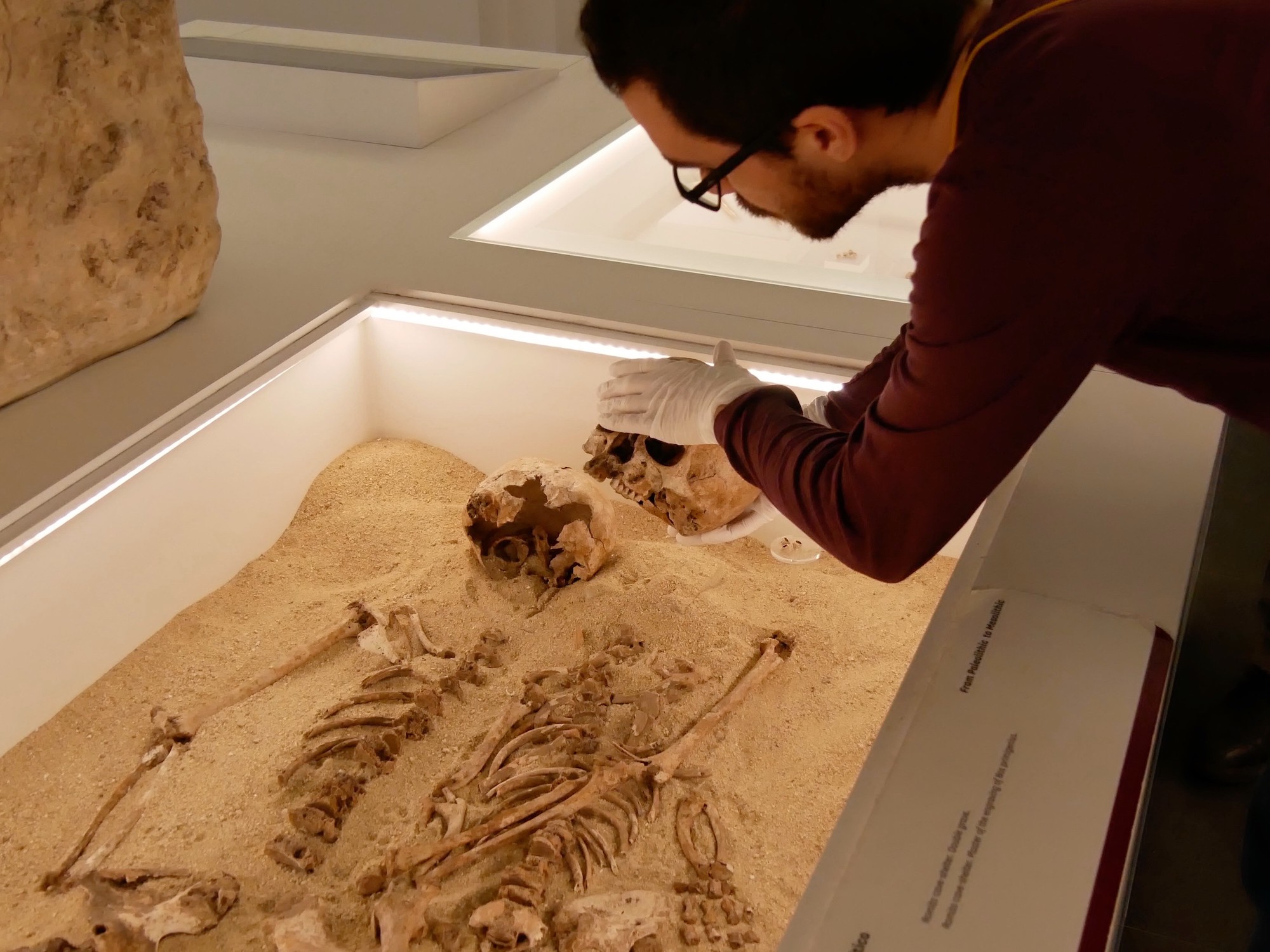
VIENNA, AUSTRIA—According to a statement released by the University of Vienna, an international team of researchers has identified a rare genetic condition in the remains of a mother and daughter who were buried in an embrace in the same grave more than 12,000 years ago. The burial was discovered in 1963 at Grotta del Romito in southern Italy. Romito 1, the remains of a woman who stood under five feet tall, held the remains of Romito 2, an adolescent girl with pronounced limb shortening, and an estimated height of about 3.5 feet. DNA analysis also showed that the daughter carried two copies of a variant in the NPR2 gene, confirming a diagnosis of acromesomelic dysplasia, Maroteaux type, a rare inherited disorder characterized by short stature and shortening of the limbs. “We believe her survival would have required sustained support from her group, including help with food and mobility in a challenging environment,” said Alfred Coppa of Sapienza University. Her mother was found to have one copy of the gene variant, accounting for her milder short stature. “Rare genetic diseases are not a modern phenomenon but have been present throughout human history,” commented team member Adrian Daly of Liège University Hospital Center. To read about Paleolithic burials in a cave in northwestern Italy, go to "Ice Age Necropolis."
Genetic Study Identifies Disease in 12,000-Year-Old Remains
News January 30, 2026
Recommended Articles
Digs & Discoveries September/October 2026
Sardinian Ritual Summit
The Music of Time September/October 2026
War Pigs
Digs & Discoveries May/June 2026
Ancient Architectural Digest
More to Discover
Features January/February 2026
Top 10 Discoveries of 2025
ARCHAEOLOGY magazine’s editors reveal the year’s most exciting finds

-
Features January/February 2026
The Cost of Doing Business
Piecing together the Roman empire’s longest known inscription—a peculiarly precise inventory of prices
 Ece Savaş and Philip Stinson
 -
Features January/February 2026
The Birds of Amarna
An Egyptian princess seeks sanctuary in her private palace
 The Metropolitan Museum of Art, New York/ Rogers Fund, 1930
 -
Features January/February 2026
Taking the Measure of Mesoamerica
Archaeologists decode the sacred mathematics embedded in an ancient city’s architecture
 Courtesy Claudia I. Alvarado-León
 -
Features January/February 2026
Stone Gods and Monsters
3,000 years ago, an intoxicating new religion beckoned pilgrims to temples high in the Andes
 Courtesy John Rick