Hunter-Gatherer Landscape - California

Features January 1, 2011

Construction of vast solar farms in the deserts of southeastern California is threatening to permanently erase prehistoric Native American sites.
SHARE:
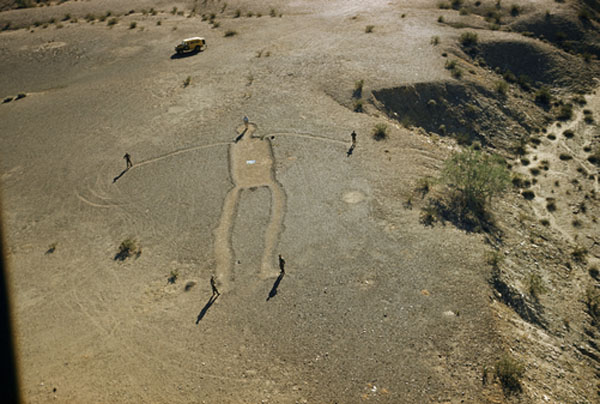
Men study giant figure scratched into surface of desert mesa. (Richard Hewitt Stewart/National Geographic Society)

Construction of vast solar farms in the deserts of southeastern California is threatening to permanently erase prehistoric Native American sites. Critics charge that while the need for new sources of renewable energy is a clear national priority, the rush to build solar infrastructure in order to qualify for tax breaks has led to inadequate archaeological testing and evaluation of sites in the way of planned solar arrays. The region's famous Blythe Geoglyphs, still a destination for Native American pilgrims, will not be directly affected by the development, but the rich archaeological landscape of which they are a part will be altered forever.
More Sites Under Threat 2010

  • Features January/February 2026

    The Cost of Doing Business

    Piecing together the Roman empire’s longest known inscription—a peculiarly precise inventory of prices

    Read Article
    A digital reconstruction shows how the Civil Basilica in the city of Aphrodisias in southwestern Anatolia would have appeared with the Edict of Maximum Prices inscribed on its facade.
    Ece Savaş and Philip Stinson
  • Features January/February 2026

    The Birds of Amarna

    An Egyptian princess seeks sanctuary in her private palace

    Read Article
    The Metropolitan Museum of Art, New York/ Rogers Fund, 1930
  • Features January/February 2026

    Taking the Measure of Mesoamerica

    Archaeologists decode the sacred mathematics embedded in an ancient city’s architecture

    Read Article
    Courtesy Claudia I. Alvarado-León
  • Features January/February 2026

    Stone Gods and Monsters

    3,000 years ago, an intoxicating new religion beckoned pilgrims to temples high in the Andes

    Read Article
    The ritual center of Chavín de Huántar flourished in northern Peru.
    Courtesy John Rick