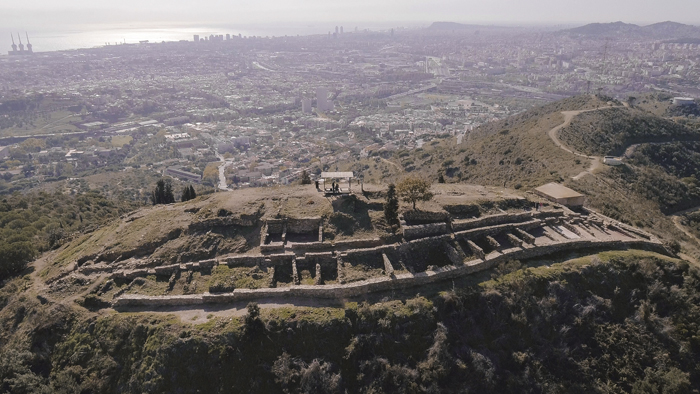
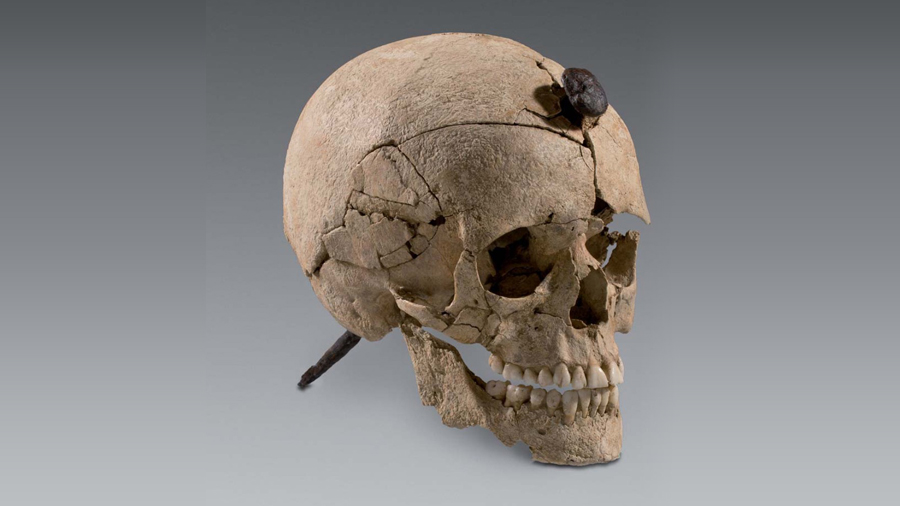
BARCELONA, SPAIN—According to a ZME Science report, severed human skulls pierced with iron nails recovered from archaeological sites in northeastern Spain may have been created for more than one purpose. The skulls in the new study were recovered from the sites of Puig Castellar, where they were found near the walls of the settlement, and Ullastret, where they were found in domestic areas. Researchers led by Rubén de la Fuente-Seoane of the Autonomous University of Barcelona analyzed strontium and oxygen isotopes in samples of tooth enamel, which is laid down over childhood, taken from the skulls. Levels of strontium isotopes in a sample reflect the levels of strontium isotopes in the geology of the region where the person grew up, while oxygen isotopes provide markers for the region’s climate and water sources. The scientists determined that just one of the four skulls from Puig Castellar belonged to an individual who grew up in the local area. The other three individuals were likely raised in regions with different geological profiles. Two of the three skulls from Ullastret probably belonged to local individuals; the third skull belonged to someone who had not grown up in the area. “Our premise in approaching the study was that if [the skulls] were war trophies, they would not come from the sites analyzed, while if they were venerated individuals, these would most likely be local,” De la Fuente-Seoane said. Therefore, the skulls found at Puig Castellar may have been displayed on the walls as a warning and symbol of power, but the heads at Ullastret may have been used in rituals, or displayed as a way to venerate ancestors. “It suggests that the selection of individuals for the severed heads ritual was more complex than initially thought,” De la Fuente-Seoane concluded. Read the original scholarly article about this research in the Journal of Archaeological Science: Reports. To read about a recent study of megalithic burials at a necropolis in southern Iberia, go to "Iberian Gender Imbalance."