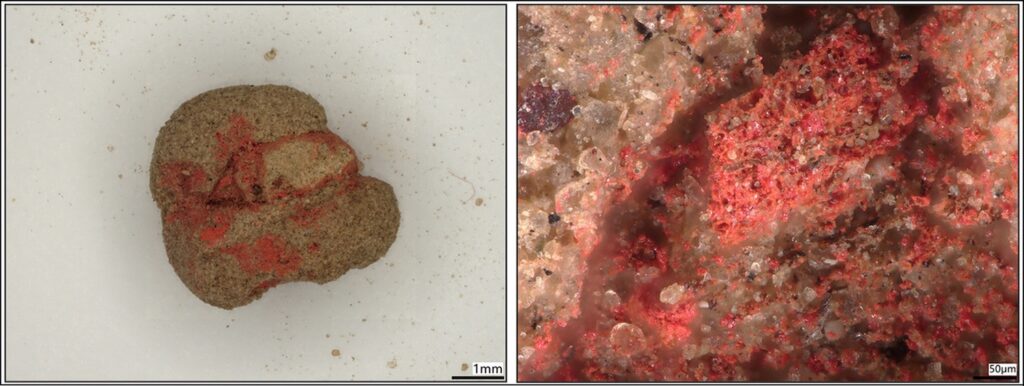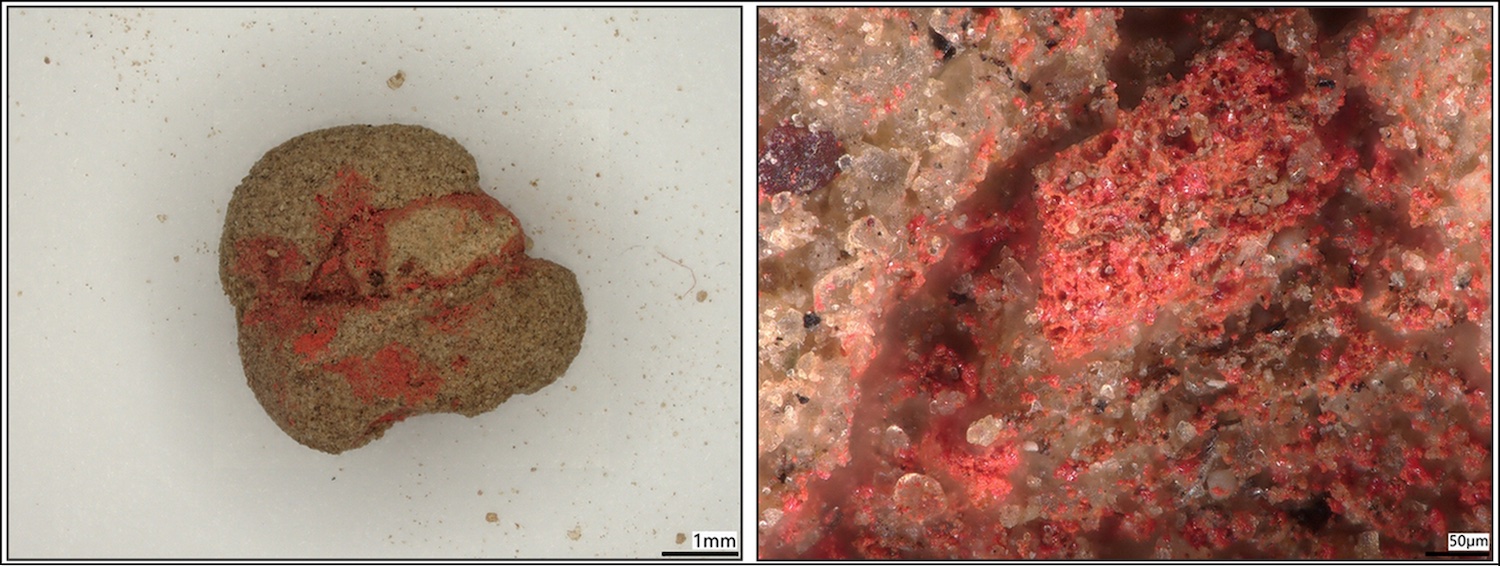
KHERSON OBLAST, UKRAINE—Science in Poland reports that cinnabar has been recovered from graves in a Scythian cemetery in southern Ukraine. Known as the Chervony Mayak cemetery, the site was in use from the second century B.C. to the mid-third century A.D. More than 175 graves in the cemetery have been excavated to date. Lumps of cinnabar, a toxic mercury sulphide with an intense red color, were found in three of these burials by a team of researchers led by Oleksandr Symonenko of the National Academy of Sciences of Ukraine. The lumps have now been analyzed by Beata Polit of Maria Curie-Skłodowska University and her colleagues. “Pigments of various shades of red have been discovered in graves attributed to the Late Scythian culture, but they are rarely subjected to archaeometric analysis using specialized equipment,” she said. A 2,000-year-old burial chamber contained the remains of two women, one aged about 18, the other between 35 and 45 at the time of death. Three lumps of cinnabar were found near the head and upper chest of the older woman. She is thought to have been buried first, and her remains moved to the back of the chamber when the second body was added a short time later. “It is possible that, in the context of graves to which more bodies were added, the pigment could have been used to neutralize bacteria or slow down the decomposition of the body,” Polit said. Pigments found in containers and shells, however, may have been used as cosmetics or paint ingredients, she added. Read the original scholarly article about this research in Antiquity. To read more about the rituals of this nomadic people, go to "Rites of the Scythians."