
Medieval Grave of Woman and Child Uncovered in Italy

News September 30, 2026

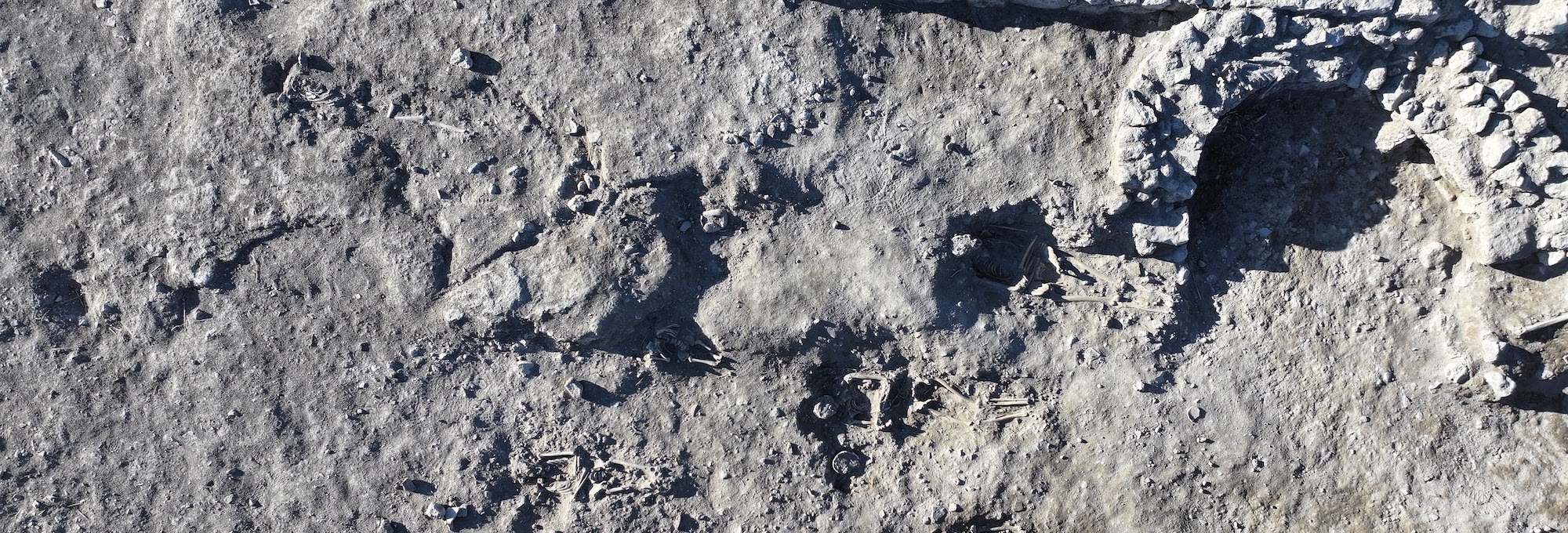
Drone photo of cemetery, Sipontum, Italy
Giuliano Volpe

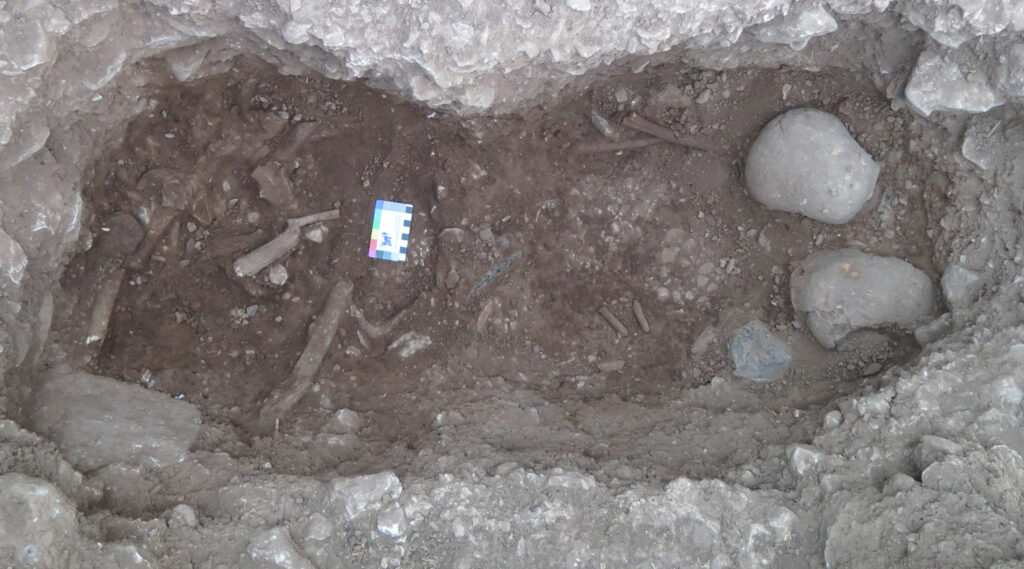
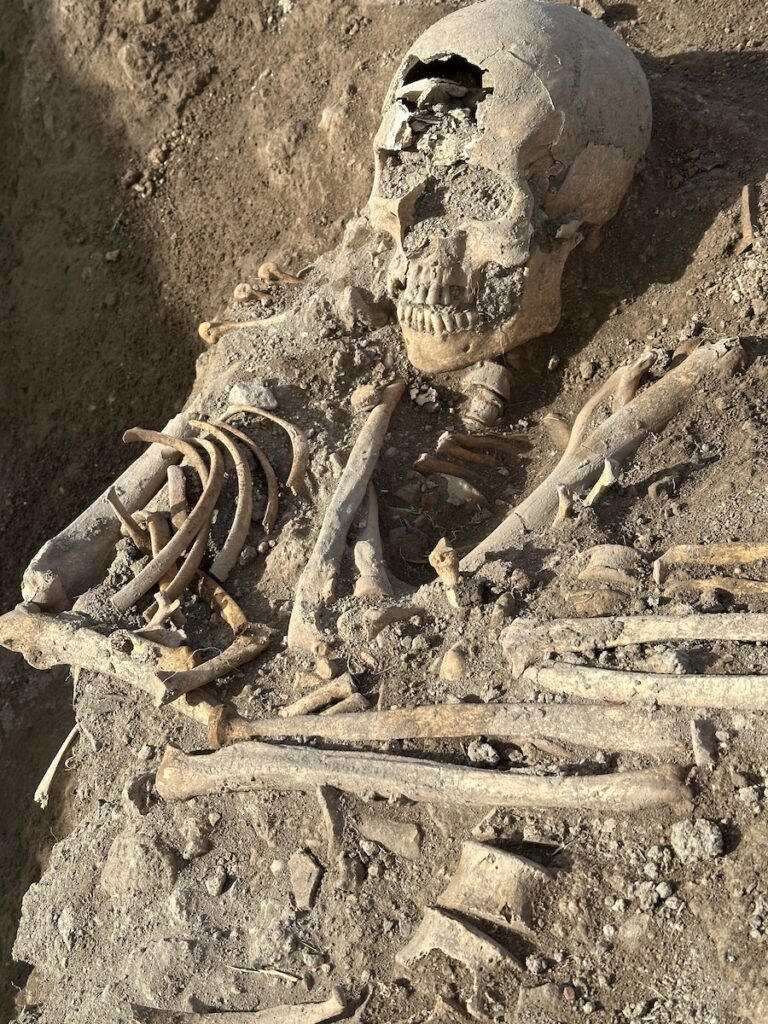
BARI, ITALY—The remains of a woman holding a child have been unearthed at the site of Sipontum, which is located in Italy on the coast of the Adriatic Sea, according to a Gizmodo report. “There must have been a close relationship if the girl or boy was in her arms,” said Giuliano Volpe of the University of Bari Aldo Moro. “DNA analysis will clarify the kinship relationship more precisely,” he added. The grave was found in a medieval cemetery at the port city. The woman is estimated to have been between 30 and 40 years old when she died, while the child is thought to have been between five and seven years of age. Carbon dating of the remains is planned. Researchers have dated the cemetery, which was likely located near a church, monastery, or hospital, to the twelfth or thirteenth century based upon the ceramics and fragments of painted plaster found in the soil layers above the burials. “They were simple burials, without grave goods or elements of clothing or ornamentation (with the exception of a fibula and traces of a bracelet), possibly wrapped in shrouds,” Volpe explained. To read about a wooded park in a medieval town in Lazio, go to "Italy's Garden of Monsters."
Did Early Americans Reuse Spearpoints?

News September 30, 2026

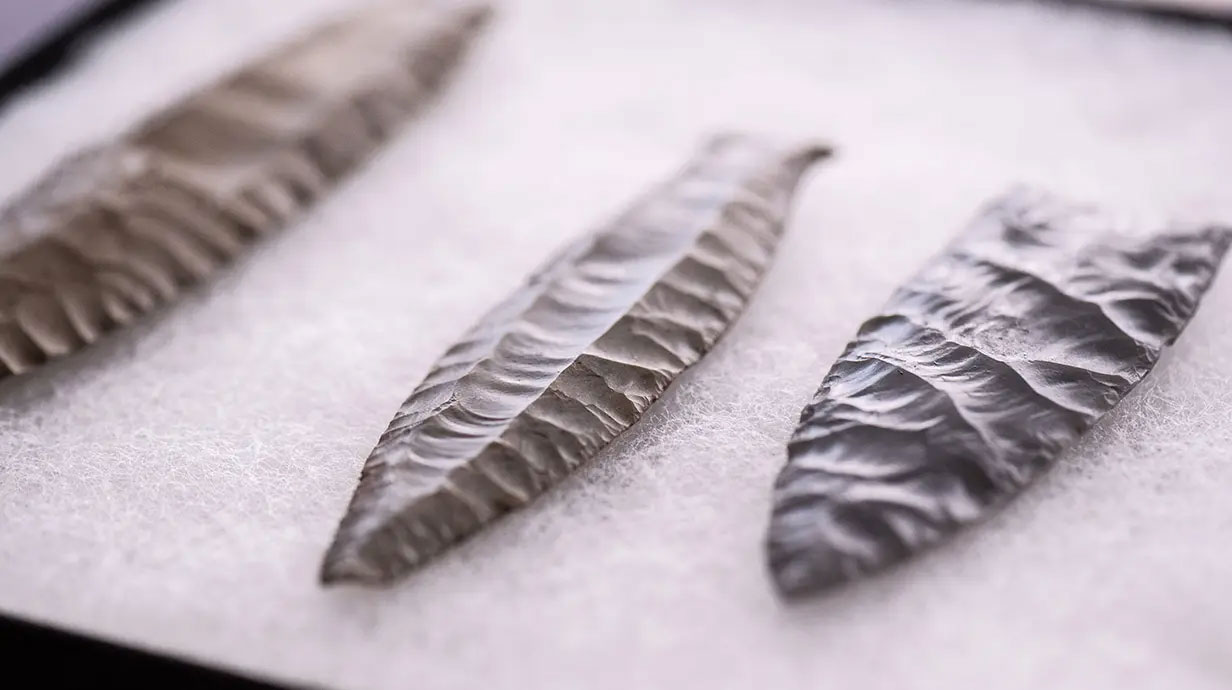
Replica projectile points from the Cumberland and Clovis people
Photo by Kevin Bain/Ole Miss Digital Imaging Services

OXFORD, MISSISSIPPI—According to a statement released by the University of Mississippi, Jesse Tune of the University of Mississippi and Shane Miller of the University of Alabama have examined some 500 stone projectile points crafted by the Clovis and Cumberland people in the Tennessee River Valley region. “We’re talking about Ice Age hunter-gatherers, people who looked and acted just like us and had the same needs that we do,” Tune said. The study suggests that groups of migrating Clovis people were more likely to resharpen and reuse their spearheads. “Spear points were designed to be disposable objects, and that makes what the Clovis were doing interesting,” Tune said. Several hundred years later, the Cumberland people are thought to have inherited knowledge of chert deposits and other resources acquired by their ancestors. “When we look at the Cumberland points, we can see where they got the raw material, roughly the time period that they lived and that they’ve used the point multiple times,” Tune said. “But [the point] was rarely completely broken to the point that it couldn’t be used anymore,” he added. The team members think that the Cumberland people used their knowledge of the landscape to make new tools as needed, rather than carrying damaged points. Read the original scholarly article about this research in the Journal of Archaeological Method and Theory. For more on the Clovis, go to "America, in the Beginning."

Ancient Carving May Represent Nubian King

News September 29, 2026

MISEEDA, SUDAN—According to the Greek Reporter, Joanna A. Ciesielska of the University of Warsaw and her colleagues think that a life-sized petroglyph at the site of Miseeda in northern Sudan may depict an ancient Kushite ruler. A church was built around the carving during the seventh century A.D., suggesting that the location continued to be important to the people of the area. The petroglyph may have marked a border area, like a similar carving of the Meroitic king Sherkarer at Gebel Qeili, but the identity of the possible Nubian ruler and the age of the carving at Miseeda have yet to be confirmed. Large images of a lion, a possible rhinoceros, and an elephant have been found on the hill surrounding the ruins of the later church. Other carvings include crosses and ships dating to the Christian period, human figures that have not been dated, and animal carvings dating to the Kerma period, from about 2500 to 1500 B.C. Read the original scholarly article about this research in Antiquity. For more on Kushite rulers, go to "A Nubian Kingdom Rises."

Sarmatian Burial Discovered in Older Burial Mound in Ukraine

News September 29, 2026

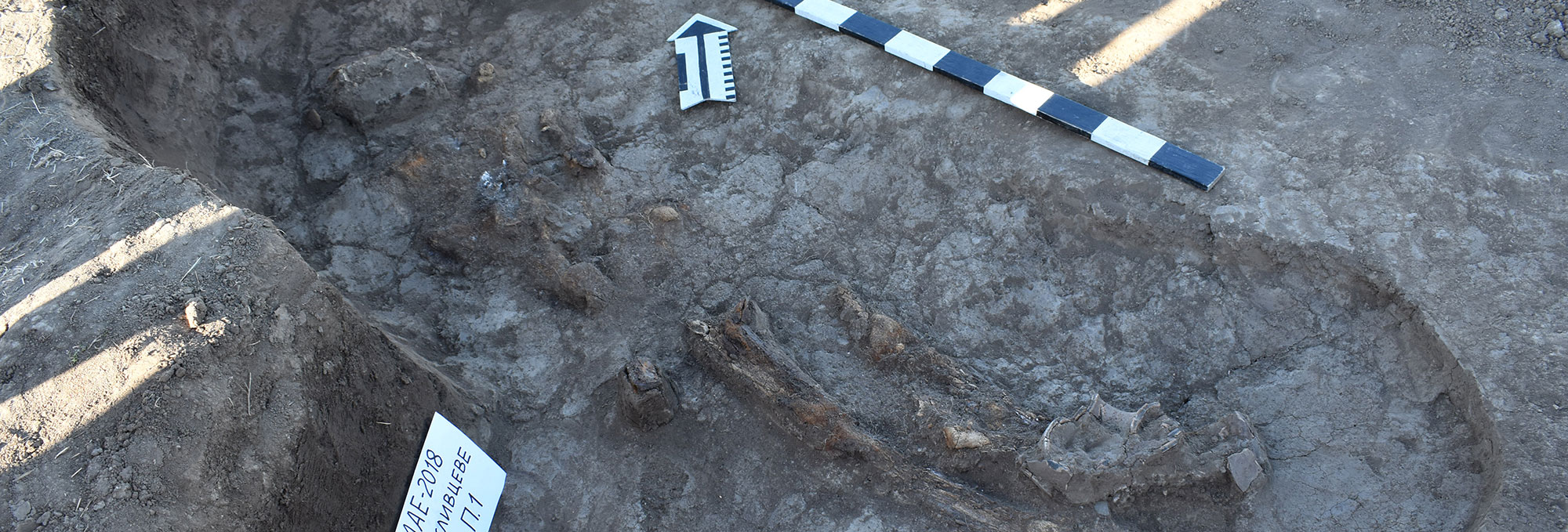
Sarmatian burial, Kherson, Ukraine
Courtesy Yuriy Boltryk

KHERSON, UKRAINE—A Sarmatian grave dated to between the first century B.C. and the first century A.D. was unearthed in a Bronze Age burial mound in Ukraine near the Sea of Azov, according to a report in La Brújula Verde. After hundreds of years of plowing, the mound, which was built by the Yamnaya culture, stood just four feet tall and had spread to about 130 feet wide. Yuriy Boltryk and Olena Fialko of the National Academy of Sciences of Ukraine report that the Sarmatian man had been buried in the Yamnaya mound some 2,000 years after its original construction. The man's body rested on bedding thought to have been made of tree bark with his head pointed to the northwest, a practice linked to the nomadic Roxolani tribe. A leg of lamb and a lamb shoulder blade had been placed across his legs, while an iron dagger measuring about 18 inches long was found at his side. A clay jug with a single handle and a tall neck was also recovered from the burial. Similar vessels have been found at other Sarmatian sites, the researchers explained. To read about the remains of a Sarmatian man found far from home in Cambridgeshire, England, go to "Ancient DNA Revolution: A Stranger in a Strange Land."

Butchered Bones in Chile Dated to 13,000 Years Ago

News September 29, 2026

Digital reconstruction of extinct mammals that inhabited the vicinity of the former Lake Tagua Tagua, Chile
Mauricio Álvarez

TARRAGONA, SPAIN—Live Science reports that cut marks have been detected on the bones of gomphotheres recovered from the basin of central Chile's ancient Lake Tagua Tagua by researchers from the Catalan Institute for Human Paleoecology and Social Evolution (IPHES-CERCA). The archaeologists also uncovered stone tools at the site, indicating that people butchered the now-extinct tusked mammals between 12,000 and 13,000 years ago. The bones of extinct horses and deer species, also bearing cut marks and signs of burning, have been discovered in the Lake Tagua Tagua basin during previous excavations. Scientists will continue to analyze the bones and sediment samples from the lake basin to study how some of the first people to reach the Southern Cone of South America lived. To read about gomphothere bones found at a site in Sonora, go to "Around the World: Mexico."

Clinker Ship Found in Germany’s Bay of Greifswald

News September 28, 2026

WARSAW, POLAND—According to a Phys.org report, a 400-year-old shipwreck has been discovered in northern Germany’s Bay of Greifswald. The remnants of the vessel were identified in 2023 during work to prepare for the construction of an underwater gas pipeline. A rescue team of five archaeologists, including Michał Grabowski of the University of Warsaw, completed 22 dives over 12 days to recover as much as possible from the wreckage, which rested in heavy silt under 25 feet of water. Fragments of the ship’s hull showed that it had been made with planks held together with iron nails and a mix of tar and animal hair. Tree-ring analysis of one of the timbers revealed that the tree had been cut down between 1626 and 1639. In all, archaeologists recovered shoe soles, a stitched leather strap, pulley blocks, an anchor, rope, barrel staves, and a hollowed-out oak trunk that may have been used as the ship’s bilge pump. Carpentry tools, such as the handle of a hand drill, suggest that the vessel was equipped with a workshop for repairs on long voyages. An unusual clay brick with holes placed inside a wooden block may have been used for sharpening tools. “I had no idea what it was, but I really wanted to solve the mystery,” Grabowski said. “And I still very much want to.” With so little of the ship recovered, it is impossible to identify it or know why it sank, though some of the timbers are charred. Grabowski and his colleagues plan to look for more pieces of the shipwreck in the area. Until then, the site has been covered with sandbags and the pipeline has been rerouted. Read the original scholarly article about this research in the International Journal of Nautical Archaeology. To read about the luxurious cargo of a seventeenth-century shipwreck off the coast of the Netherlands, go to "An Elegant Enigma."

Young People Were on the Move in Bronze Age Greece

News September 28, 2026

Researchers analyze a skull from an archaeological site in Greece in a laboratory at the American School of Classical Studies at Athens
University of Gothenburg

GOTHENBURG, SWEDEN—Analysis of 199 skeletons uncovered at several archaeological sites in central and southern Greece indicates that young people were more likely to migrate between communities during the Bronze Age, according to a statement released by the University of Gothenburg. It had been previously suggested that young women were more likely to move out of the communities of their birth in order to marry into another patrilineal society. “Our study demonstrates that the numbers of nonlocal women and men are comparable, suggesting that several different factors might have been driving an individual’s mobility,” said Serena Sabatini of the University of Gothenburg. The study determined that between five and 10 percent of the individuals analyzed from each of the communities had grown up somewhere else. “Interestingly, nonlocal individuals were identified across different burial practices, featuring both unremarkable and richly furnished graves, revealing that individuals were mobile regardless of their wealth or status,” Sabatini said. Plus, no children were identified among the nonlocals. Sabatini and her colleagues concluded that single, young individuals, rather than entire families, were more likely to look for new homes. Read the original scholarly article about this research in PLOS One. To read more about Bronze Age Greece, go to "The Unexpected World of the Odyssey."

Pyramid-Shaped Tomb Unearthed in Egypt’s Dakhleh Oasis

News September 25, 2026

CAIRO, EGYPT—Ahram Online reports that a pyramid-shaped tomb dated to the late third or early fourth century A.D. has been unearthed at the site of Bir Al-Shaghala in the Dakhleh Oasis by archaeologists from Egypt’s Supreme Council of Antiquities. Bir Al-Shaghala was part of the necropolis of Mothis, the oasis' capital during the Ptolemaic and Roman periods. Underneath the pyramid superstructure, the researchers uncovered a mudbrick hall with a vaulted ceiling. Two mudbrick burial chambers were set to the right of the hall. The staircase and the sandstone entrance to the tomb were built in the Egyptian style, with hieroglyphic inscriptions of funerary spells and protections. A cornice decorated with a winged sun disk and two cobras, and a funerary scene from the Egyptian Books of the Netherworld on the lintel, also reflect Egyptian style. A sandstone offering table, a sandstone purification basin, pottery, and a bronze coin bearing an image of the emperor Constantine were also found. Greek influence is shown in the 19 lines of Greek text inscribed on a stone funerary stele. The text is dedicated to a man named Pisechtes, who is thought to have been a judge. The archaeologists suggest that the tomb may have been reused, with a mudbrick chapel and a shrine with four square mudbrick columns added to the main entrance at that time. To read about Ptolemaic-era mining in Egypt's Eastern Desert, go to "Miners' Misfortune."

Artifacts in Etruscan Tomb Reflect Mediterranean Trade

News September 25, 2026

Etruscan tomb near Vulci, Italy
Superintendency of Archaeology, Fine Arts, and Landscape for Southern Etruria

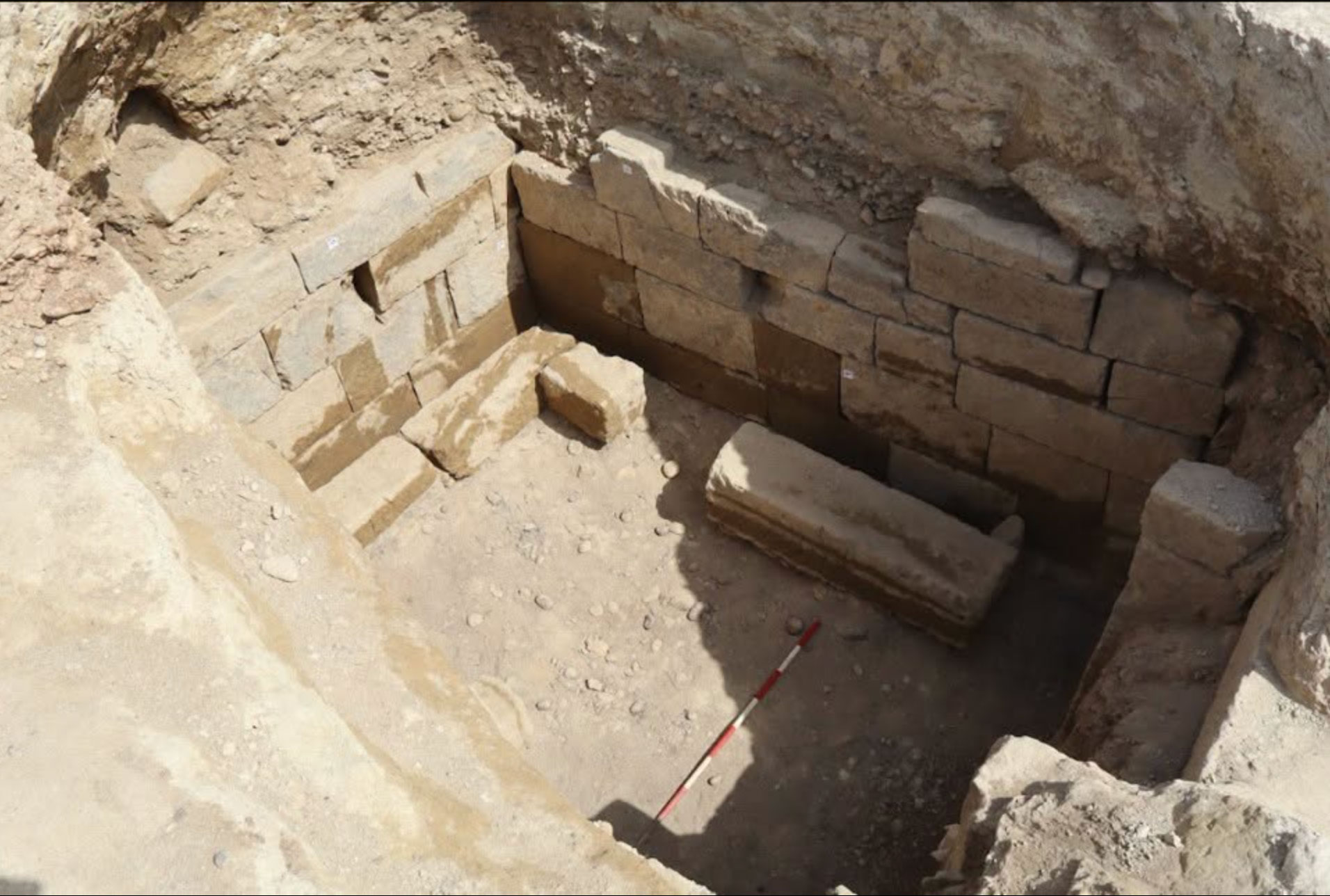
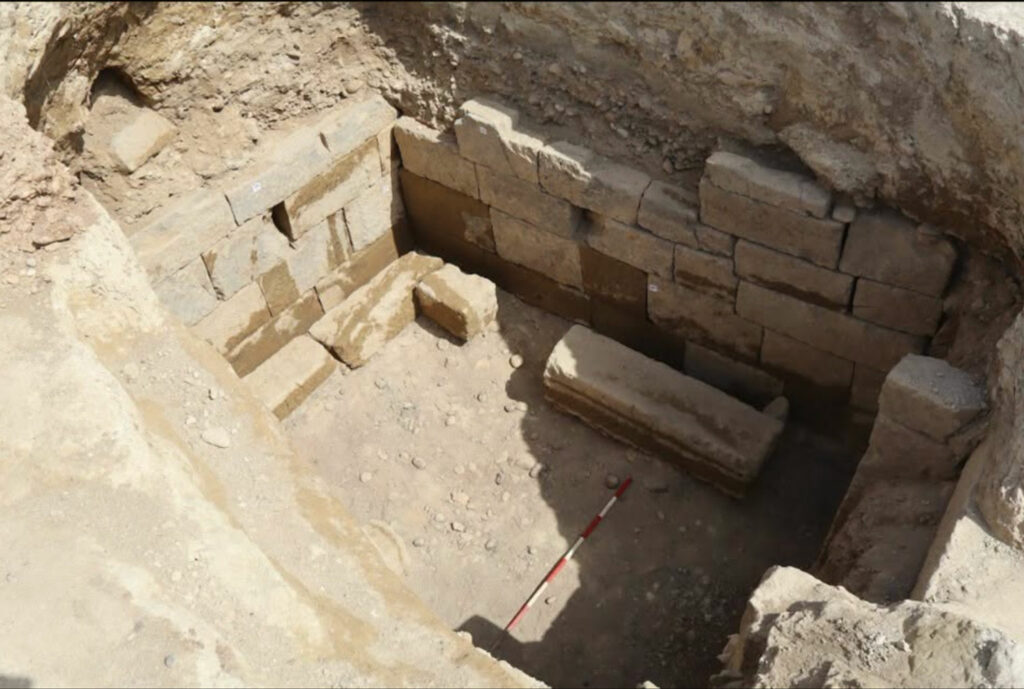
ROME, ITALY—According to the Greek Reporter, an international team of researchers has uncovered a tomb dating to the late seventh century B.C. in a necropolis near the site of the Etruscan city of Vulci. The tomb had three rooms made of large blocks of volcanic stone, but repeated looting in the twentieth century caused the roof and walls to collapse. The resulting layers of rubble protected the remaining artifacts. Archaeologists from Sapienza University, the French School at Rome, and the British Museum recovered local pottery as well as ceramics imported from Athens and Corinth, ceremonial dining vessels, weapons, chariot fittings, a bronze tripod, a lamp made of gypsum alabaster, carved bone and ivory, jewelry, and women’s footwear from the tomb. The researchers suggest that the lamp may have been imported from Naucratis, Egypt, or the Greek island of Rhodes. To read about the early Etruscan practice of interring ashes of the deceased in urns shaped like homes, go to "Model Homes: A Hut for the Afterlife."

Intact Burials Excavated at Göbekli Tepe

News September 25, 2026

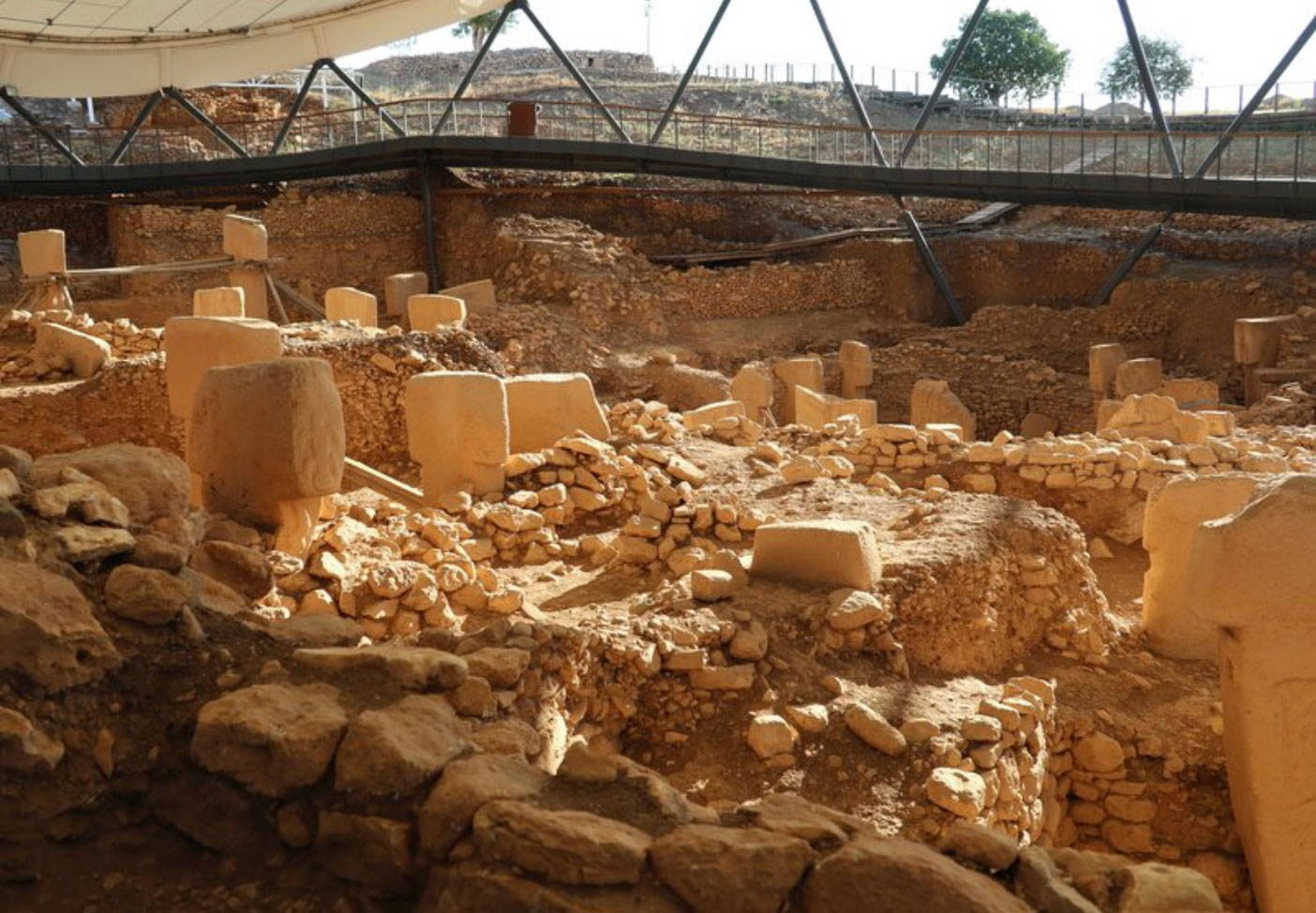
Structures at Gobekli Tepe, Turkey
© DAI Department of Natural Sciences/Photo: Julia Gresky

ISTANBUL, TURKEY—Researchers led by Julia Gresky of the German Archaeological Institute have discovered intact burials at Göbekli Tepe, according to an IFL Science report. Located in southeastern Turkey, the monumental structures and pillars were built by hunter-gatherers in several stages between 9600 and 8200 B.C. During previous excavations of certain buildings at the site, archaeologists have uncovered fragments of human bones mixed in with debris. A kidney-shaped pit was found to contain the remains of a woman, a young man, and an adolescent girl. The remains of a young woman were found in a flexed position in a single burial. These graves have been dated to between about 8700 and 8000 B.C. The researchers now think that the bone fragments found in buildings may have been placed there during ritual activity. It is also possible that erosion and landslides carried the bones into the site from burials that had been placed higher up on the city’s mound, Gresky said. The scientists note that the bones found in the burials had been broken, coated in calcium deposits, and had been gnawed on by rodents, similar to the bones found in the building fill. The discovery also suggests that people may have lived at the site, rather than meeting there only for rituals, as had been previously suggested. Read the original scholarly article about this research in PLOS One. To read more about excavations at the site, go to "Last Stand of the Hunter-Gatherers?"