
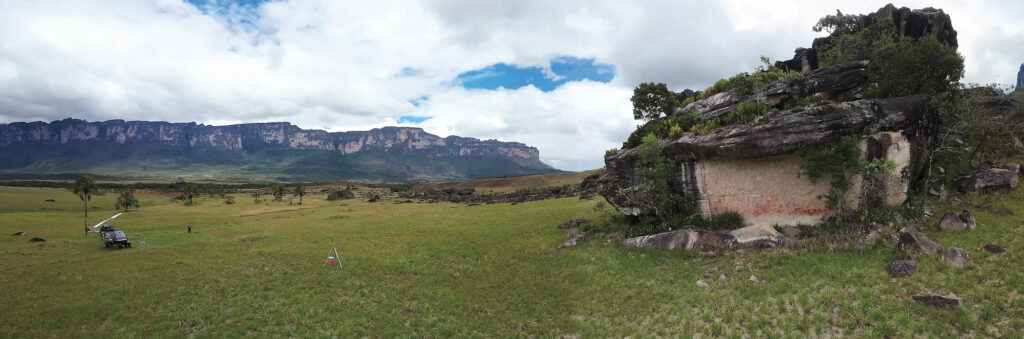
Where the borders of Venezuela, Brazil, and Guyana meet, Mount Roraima rises some 9,200 feet above sea level. It is the highest of the tepuis, or tabletop mountains, that loom over the otherworldly landscape of Venezuela’s Canaima National Park. According to a foundational myth of the region’s Pemón people, Mount Roraima is the stump of the divine tree that once bore all the world’s fruits and vegetables. They believe the tree was cut down by the trickster hero Macunaíma, whose rash act triggered a flood that ushered in the age of humans. Each tepui, which in the Pemón language means “house of the gods,” has its own biosphere that is home to a unique array of flora and fauna. Among them is Auyán Tepui, from whose peak flows the world’s tallest waterfall, known as Angel Falls. Biologists and archaeologists surveying these distinctive environments have found no signs of human habitation, or even traces of an ephemeral presence, that might suggest ancient peoples regularly visited these mountaintops. The sheer cliffs of the tepuis make them notoriously forbidding even for modern climbers. “It makes sense ancient people wouldn’t want to make an effort to scale them,” says archaeologist José Miguel Pérez-Gómez of Simón Bolívar University. Even though people in the past may have decided against ascending these tepuis, Pérez-Gómez thinks the mountains must have once been central to the beliefs of ancient cultures, much as the Pemón consider them sacred today.