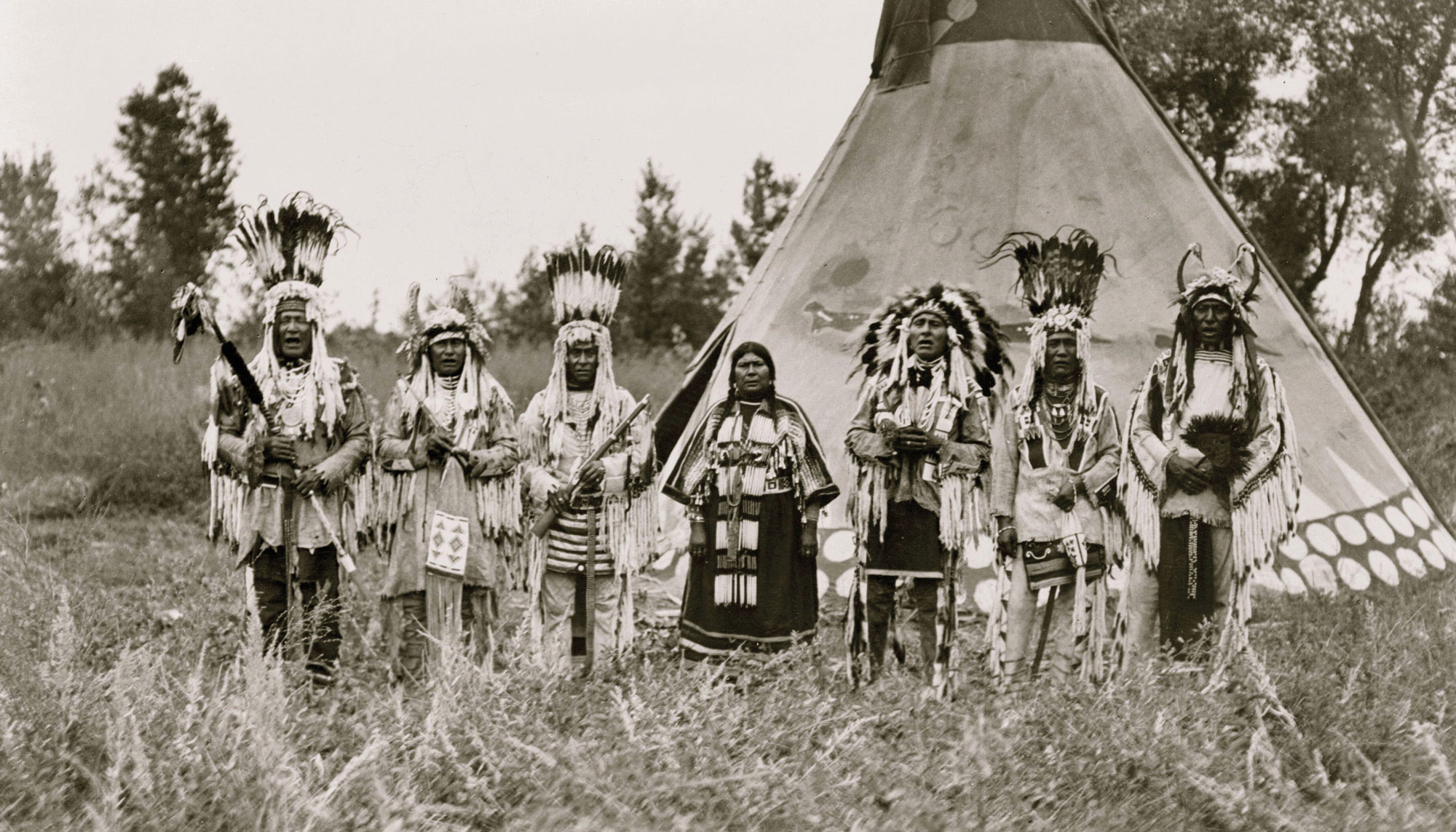
In 1807, the Shawnee leader Tecumseh put forth his vision for Native American unity and resistance. “These lands are ours, and no one has the right to remove us,” he declared in a speech to his fellow Shawnee chiefs. “The Great Spirit above has appointed this place for us to light our fires.” The following year, Tecumseh and his brother Tenskwatawa, a spiritual leader, headed a group that founded a settlement—called Prophetstown by local English speakers—in a valley near the confluence of the Tippecanoe and Wabash Rivers in the Indiana Territory. The settlement was intended to be a refuge for all Native Americans and a headquarters for the brothers’ pan–Native American movement.
Located in an area probably called Tippicannuck by the Shawnee, Prophetstown was quickly settled by a diverse range of Native peoples from lands in present-day Illinois, Wisconsin, Michigan, and beyond. Tenskwatawa, the prophet of the town’s name, oversaw construction of wigwams, cabins, and roads. A reformed drinker, Tenskwatawa mandated temperance. In 1806, two years before the settlement was founded, William Henry Harrison, then governor of the Indiana Territory, had mocked Tenskwatawa with a challenge to make the sun stand still. The holy man accurately predicted an eclipse.
Prophetstown grew so rapidly that famine threatened the fertile valley, and Tenskwatawa cannily convinced Harrison to provide corn and farming tools. But Tecumseh vociferously resisted Harrison’s move to take over millions of acres of Native land. In November 1811, Harrison’s forces advanced on the community while Tecumseh was traveling in the Southeast and Great Plains, making his case to chiefs of far-flung nations for a confederation of tribes. The people living at Prophetstown debated whether to engage. In the ensuing Battle of Tippecanoe, Native warriors ran low on ammunition and retreated. Harrison’s scouts found Prophetstown abandoned, and his forces burned the village.

In 2004, Indiana established Prophetstown State Park, but the exact location of the settlement remains unknown. New archaeological surveys and historical scholarship, however, are bringing the complete picture into focus. In one area of the park, archaeologists have unearthed a wealth of flake tools, stone points, and shell-reinforced potsherds dating back more than 3,000 years—along with an olive-green glass fragment, possible evidence of nineteenth-century occupation. In another area of the park, a Miami village called Kethtippecanunk thrived until the Kentucky Militia razed it in 1791. One gunflint found in the village probably dates to the nineteenth century. Perhaps Kethtippecanunk, then, was later selected as the location of Prophetstown.
Archaeologist Christopher Moore of the University of Indianapolis believes the collection of likely nineteenth-century artifacts scattered across several sites in the park suggests that Prophetstown wasn’t a single centralized village. “You would have had cornfields between separate occupations that all together would be called Prophetstown,” he says. “It involved thousands of people.”
THE SITE

During the Middle Woodland period (ca. 200 b.c.–a.d. 600), people in the area built earthen burial mounds, including one that is visible in the park. Visitors are cautioned not to disturb the sacred structure. A reconstruction of a nineteenth-century Native American village that features dome-shaped wigwams, a council house, and a corn crib for food storage gives parkgoers a sense of what Prophetstown may have looked like. The park’s Circle of Stones includes 15 three-to-four-foot-tall stones, each commemorating one of the tribes known to have lived at Prophetstown, as well as one representing all the other Native peoples who lived there.
WHILE YOU’RE THERE
Prophetstown State Park is a haven for birders, bikers, and hikers, so expect to work up an appetite, and plan a visit to The Farm at Prophetstown. This working farm and museum hosts five-course farm-to-table dinners in its replica 1920s farmhouse. Educational demonstrations there cover all aspects of prairie life, from beekeeping to blacksmithing. By car, Tippecanoe Battlefield Park and its museum are less than five minutes from the state park’s visitor center.