
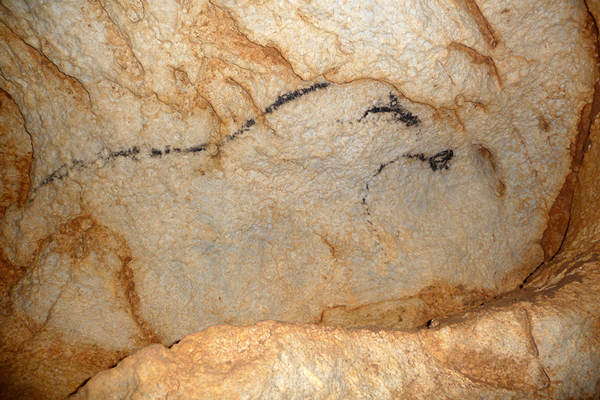
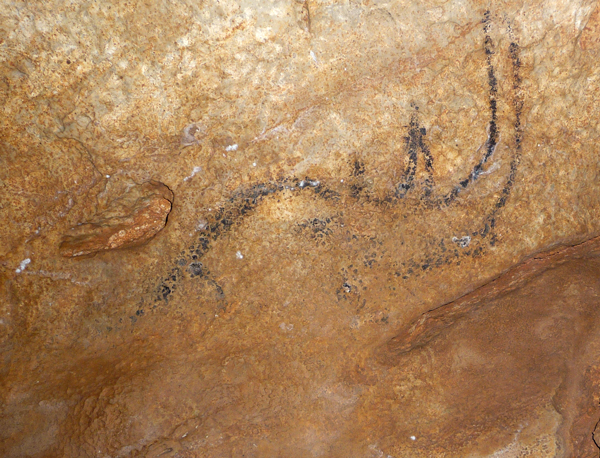
Radiocarbon dates from Coliboaia Cave in Romania show that animal images drawn on the cave walls are among the oldest visual art in Europe and further confirm that early humans did indeed create art. According to cave art expert Jean Clottes, who visited the cave in spring 2010, there are about eight images that appear to have been drawn with pieces of charcoal, using a technique similar to one that was used to create the 35,000-year-old figures on the walls of Chauvet Cave in southwestern France. "The Coliboaia dates are important because they prove that from the earliest times of cave art in Europe, people had the same cultural practices all over the continent," says Clottes. "This reinforces the overall unity of Ice Age art." Over the millennia, the drawings have been scratched by bats and, in some cases, a layer of calcite has grown over them, obscuring what they were meant to depict. One image clearly shows a rhinoceros (bottom), others may depict horses or bears (top). To get the radiocarbon dates, Clottes removed a tiny amount of charcoal from one of the drawings, as well as a piece of charcoal he found on a ledge below the image. The drawing was dated to about 32,000 years ago, the charcoal from the ledge to about 35,000. Future research at the site will include tracing the eight drawings and studying an as-yet-unknown number of images that have been carved into the cave walls.