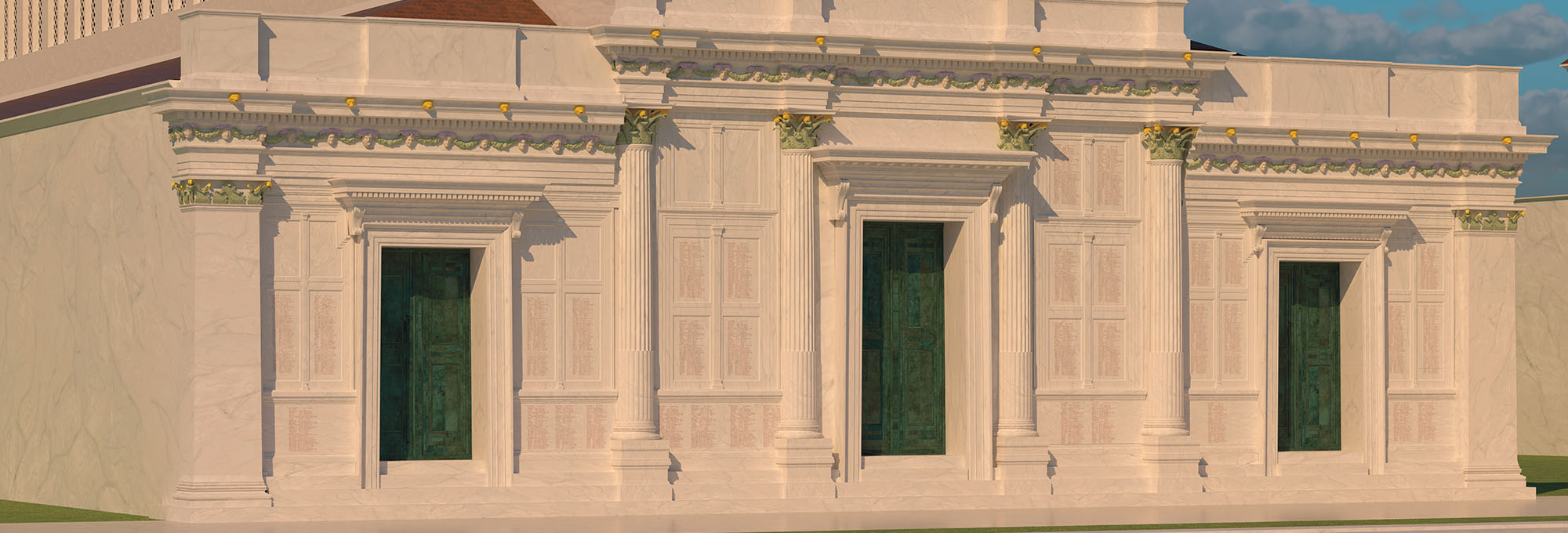
Upheaval and uncertainty swirled around the splendid cities of the Roman Empire at the end of the third century a.d. When a new emperor, Diocletian, took the throne in a.d. 284, he set about righting a system in shambles. By a.d. 301, Diocletian had redrawn the map of the empire’s provinces and refashioned the emperorship as a four-person job, a tetrarchy. From Britannia to Armenia, the tetrarchs’ forces had beaten back usurpers to the throne, bellicose border tribes, and rival empires alike, but legions couldn’t fix the weak economy. The Roman government had debased its coinage for decades, sparking rampant inflation. Diocletian decided to unveil an unprecedented series of laws intended not only to curb inflation but to overhaul the marketplace economy in every town under the empire’s authority. All would feel its effects.
One citizen under the purview of these laws might have been a cleaner and refurbisher of clothing in Aphrodisias, a wealthy midsize town in southwestern Anatolia. Crossing a lush, palm-lined city park on a stifling summer afternoon in a.d. 301, the woman might have paused to watch stone carvers on scaffolding sweating as they chipped at the facade of a basilica. These carvers had covered the entire front of this stately official building, a local landmark, with tiny letters. “There must be thousands,” she’d have thought. Up close, she would have seen that the text was in Latin—which no one here spoke—and that the uncountable lines of fingertip-size letters nearly reached the tops of columns far overhead. No one could possibly read that.
The woman probably would have heard that the writing that scrolled across the basilica was a new law direct from the imperial court. It ordered the men in the market stalls not to overcharge their customers, then prescribed the highest prices allowed for just about everything: eggs, fish sauce, sandals, glue, feathers, Alexandrian glass, chairs. She might also have heard that the new law instructed her regarding how much she could bill her own clients, decreeing prices for no fewer than 26 different treatments specific to garments of differing qualities. She would bristle at that. What did the emperor know of laundry? And why should he presume to tell her how to conduct her family’s business? That’s not how things had ever worked. Yet the penalty for disobedience was, supposedly, death. The woman would turn right at the entrance to the city baths and perhaps ask friends she encountered there what rumors they had heard about this odd law.
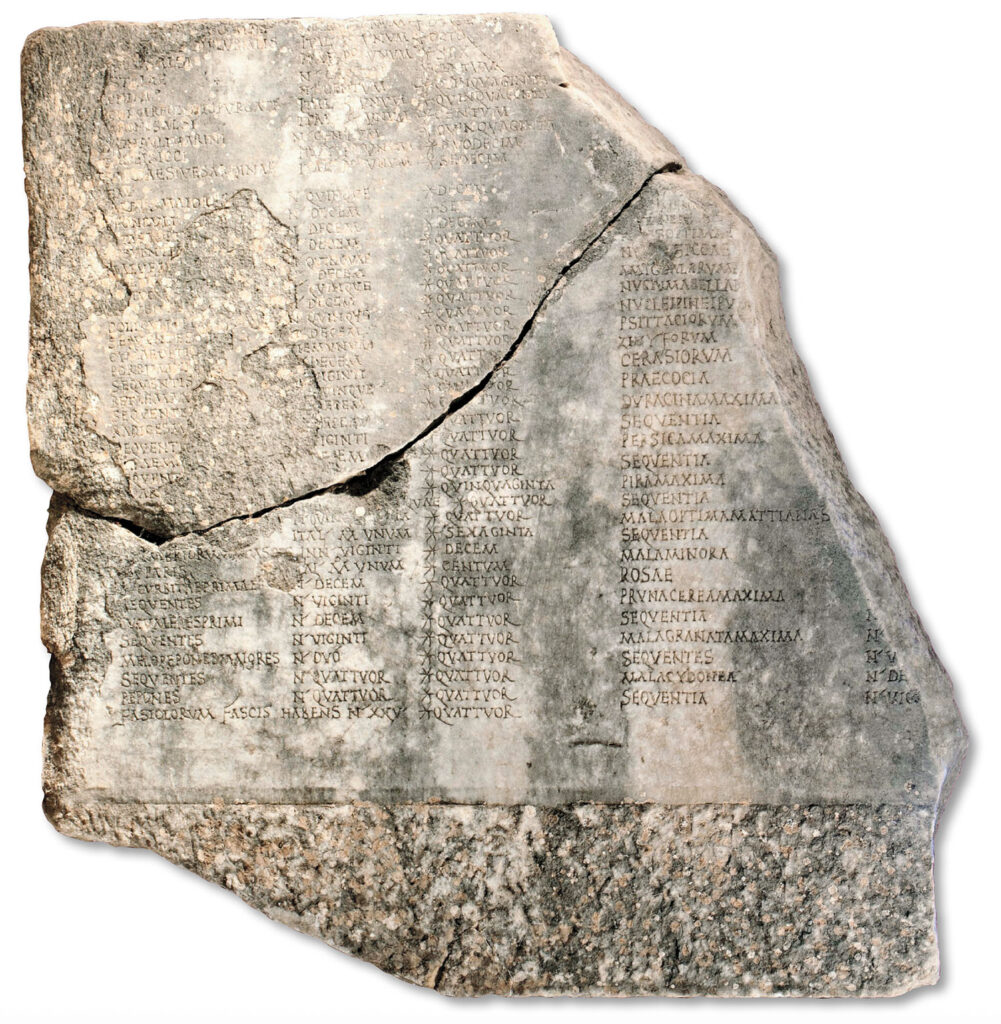
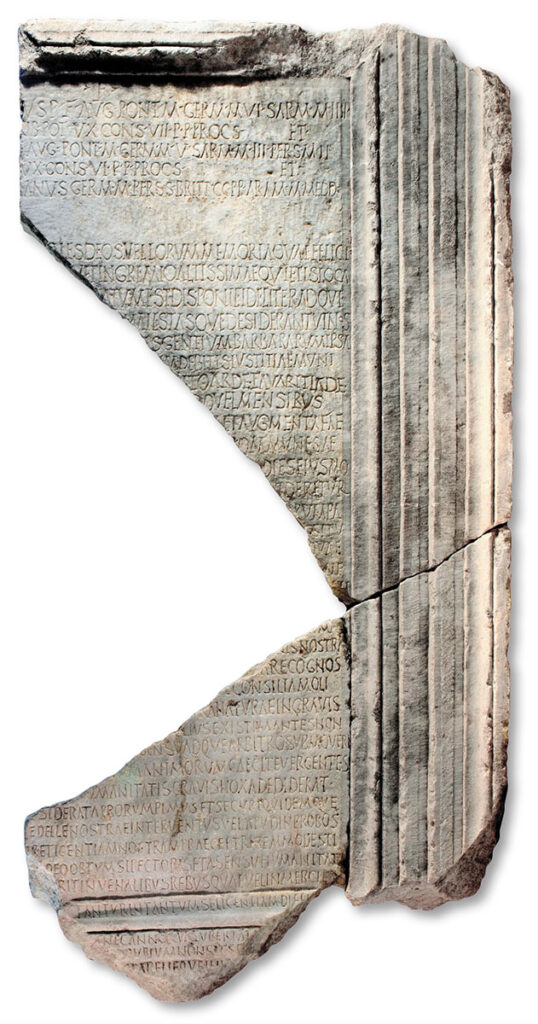
The text the letter carvers labored over was a document scholars call the Edict of Maximum Prices, or simply the Prices Edict, the keystone piece of a suite of economic legislation issued by Diocletian in a.d. 301. The edict mandated price ceilings for some 1,400 goods and services—from lentils to loincloths and from Latin tutors to lions—arranged in 70 chapters. Government officials circulated the law across the empire and demanded that it be set in stone. Archaeologists have found fragments of copies of the edict at more than 40 sites, making it by far the most widely distributed inscribed text known from the Roman world. It is also the longest Latin text known to have been put to marble.
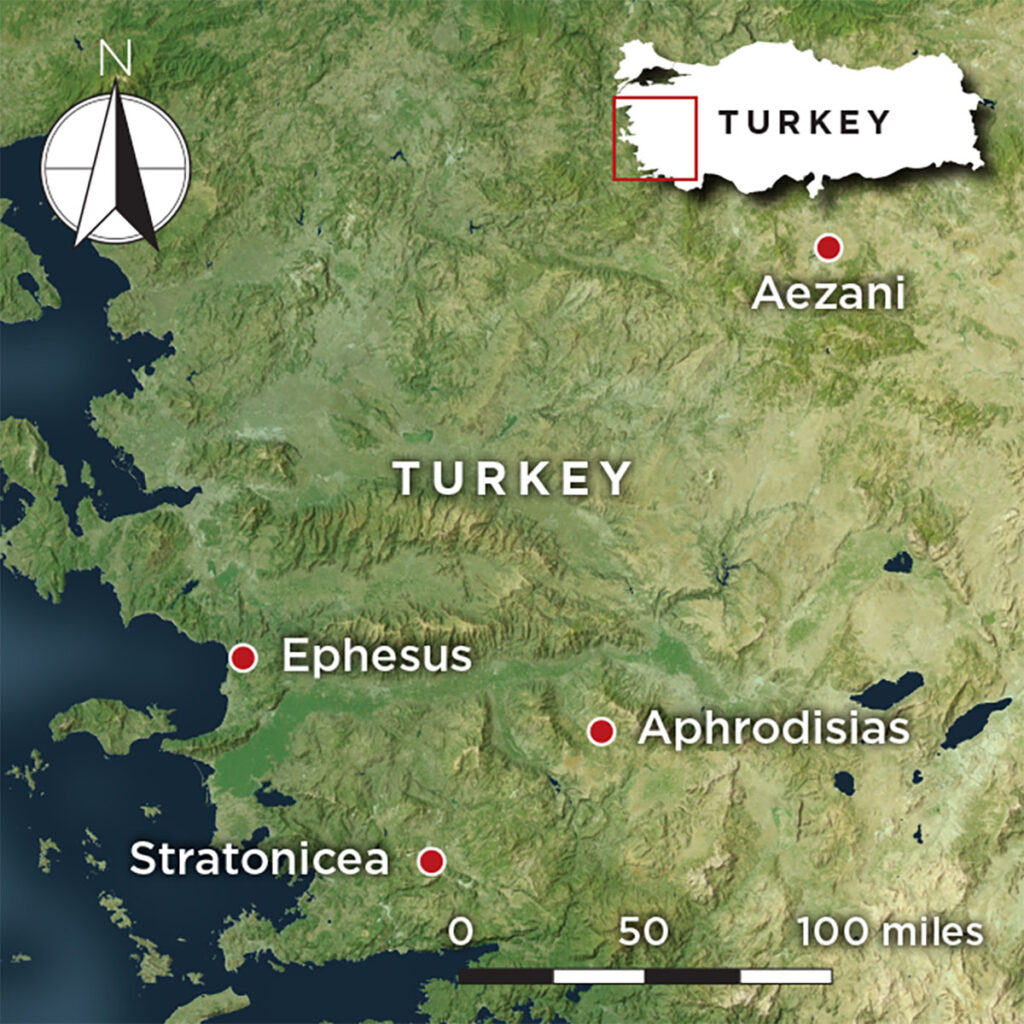
The edict’s text was so long, in fact, that archaeologists have only located two places where engravers actually finished it, one being Aphrodisias, and the other a city 113 miles northeast called Aezani. The Aphrodisias version originally spanned approximately 4,000 lines, spelled out in some 62,000 characters. About 40 percent of the edict’s original text is preserved at the site. Two other copies of the edict in Anatolia, including the one at Aezani, remain on the public buildings where they were originally inscribed. The Aphrodisias inscription, however, was scattered around the ancient city in several hundred fragments, which have had to be retrieved over the course of more than six decades of excavation.
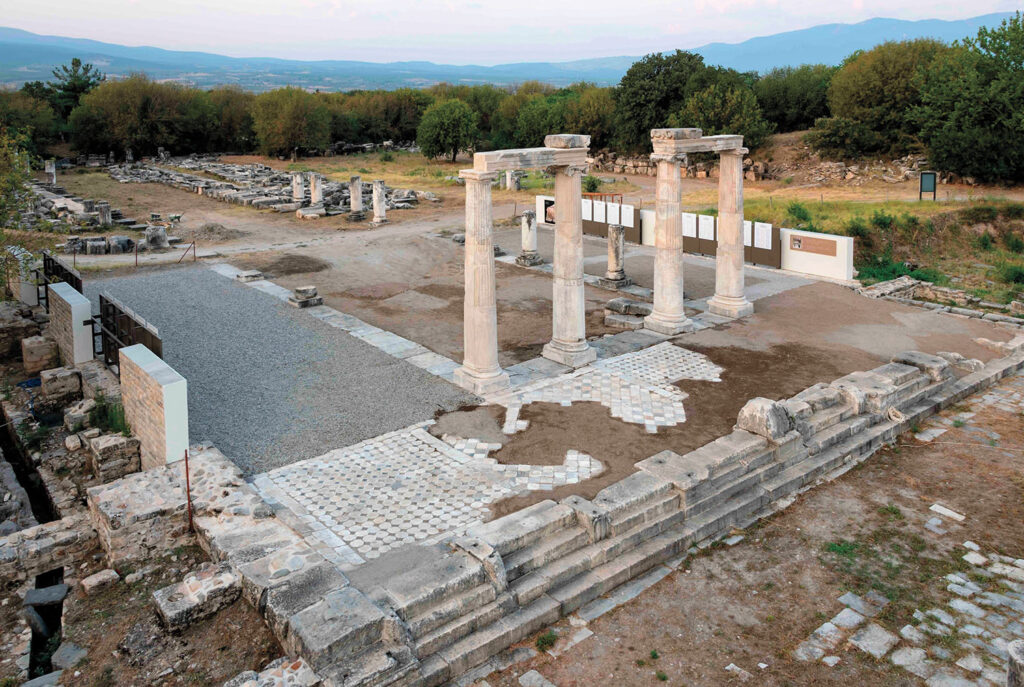
The existence of the Aphrodisias version of the edict had been known to scholars since 1893. In the late 1990s, a team of epigraphers, archaeologists, and architects embarked on an ambitious project to put its pieces back together. The team set out to determine exactly how the text had proceeded along the facade of the structure they call the Civil Basilica, chapter by chapter and line by line. They also wanted to envision how Aphrodisians who saw the edict covering nearly 250 square feet of marble would have perceived it. In the process, they have restored parts of the colossal basilica, reconstructing some of its surviving columns and lintels at the site. They have also conceptualized the building’s full appearance through 3D digital renderings. They have crafted definitive new translations of the edict in English and Turkish, traced the handicraft of individual ancient stonecutters, and perhaps even answered some questions about the law that have perplexed scholars since the discovery of “this monstrous text,” as epigrapher Michael Crawford of University College London calls it. While reassembling this literal wall of text, researchers have thought anew about what Diocletian intended by his radical statement, as well as what it meant for everyone else.
In their stern preamble to the Prices Edict, Diocletian and his fellow tetrarchs lamented the greed of merchants “aiming only at their own advancement and enrichment, measured not by the year or the month or the day, but almost by the hour and the minute.” But Diocletian’s main concern was his troops. The Roman government was emptying its coffers to pay soldiers enough to afford everyday necessities, whose costs were being incessantly driven up.
In the edict’s first chapters, Diocletian’s bean counters laid down caps for prices that affected most everyone. Item No. 1 was wheat. Barley, peas, groats, sesame, hay, “country” wine, fancy wine, beer, virgin olive oil, “second-best” olive oil, pork, oysters, cheese, and jujubes were all enumerated in the edict’s pantry chapters. Fixed maximum wages codified the cost of labor. A teacher of rhetoric could be paid more than twice as handsomely as a teacher of architecture. A portrait painter could charge double the rate of even a virtuoso wall painter. One chapter concerned the price of slaves, valued by age and gender. Another put price tags on “Libyan beasts.” Male lions were the biggest-ticket item on the entire list, equaled only by one pound of silk thread dyed a very special kind of purple.
No fewer than 400 different articles of cloth and clothing were sorted by the edict’s compilers. Someone perusing the list could compare a chlamys style of cloak made with wool from Modena, Italy, and adorned with purple stripes, to a more dressed-down “British” or “Danubian” cloak. Epigrapher Benet Salway of University College London wonders what these brand designations signaled. “Are these distinctions sort of protected appellations like in French wines or cheeses?” he asks. Whether a British cloak was actually imported from Britain or represented a generic style, such as cheddar cheese does now, its inclusion in the edict suggests that a clotheshorse in Anatolia knew what they were buying. “From the point of view of Diocletian looking down from his palace, he sees the empire as a single market, and he’s covering the whole thing,” says Salway. “The edict is radical not just in the number of goods it’s trying to control, but also in the fact that it’s universal.”
The tetrarchs fired off the Prices Edict to provincial governors across the Roman Empire. Despite the fact that the surviving copies can all be traced to Greek-speaking provinces—most were found in present-day Egypt, Greece, and Turkey—almost all were written in Latin. A related, shorter text, referred to as the Currency Dossier, has only been identified at Aphrodisias, where it was inscribed alongside the Prices Edict, probably also in a.d. 301. On September 1 of that year, this text proclaims, the face value of most coins would double.
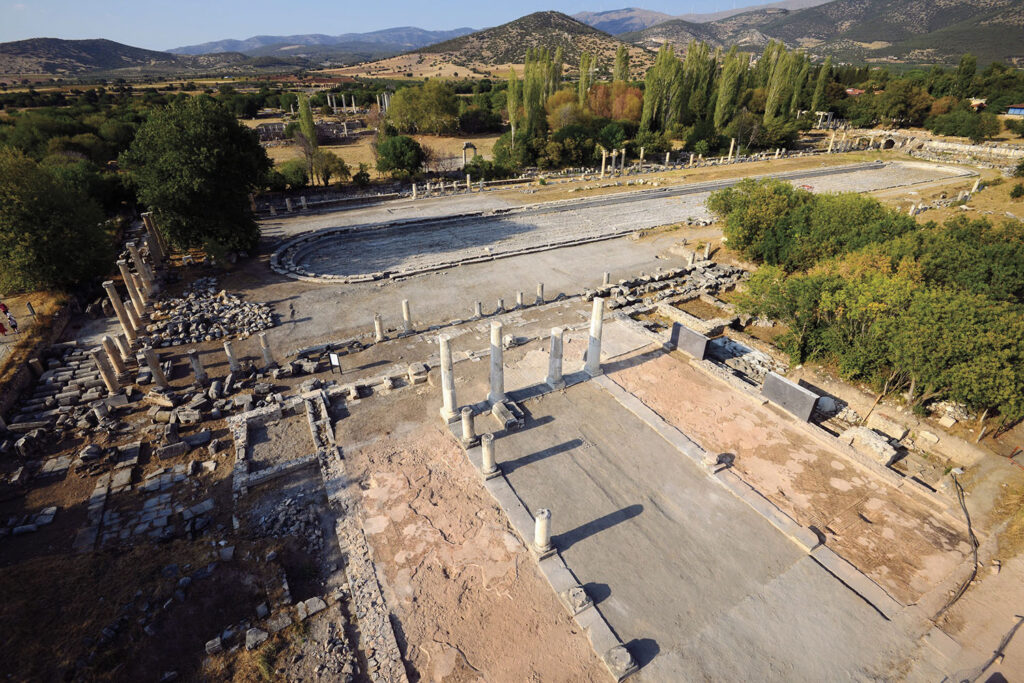
The average working person in Aphrodisias may have suffered cost-of-living headaches, but the city’s prestige was growing at the turn of the fourth century a.d. Seventy-five miles and about three days’ travel from the Romans’ primary eastern port of Ephesus, Aphrodisias should have been a backwater of farmland and swampland. Yet everywhere in the city, grandeur was insistent. In a city with 10,000 to 15,000 residents, the stadium seated approximately 30,000. Excavations in the park next to the Civil Basilica between 2012 and 2017 revealed a 558-foot-long oblong ornamental pool. “This is the biggest pool that we know of in the whole of the Roman Empire, including Rome,” says archaeologist Serra Somersan of the University of Oxford. “Aphrodisias is a monumental, megasize city in a place where it shouldn’t be.” The city’s reputation rode on the talent of its sculptors and the extravagance of its festivals. Once a small settlement with a modest sanctuary dedicated to Aphrodite, the town sided with the victors in Rome’s first-century b.c. conquest of Anatolia, as well as later civil wars and local uprisings. In 39 b.c., Aphrodisias earned exemption from paying taxes to Rome as a reward for its loyalty and never looked back. “They did very good networking,” says Somersan. “They wanted to be constantly present in Rome’s eye—and they managed it.”
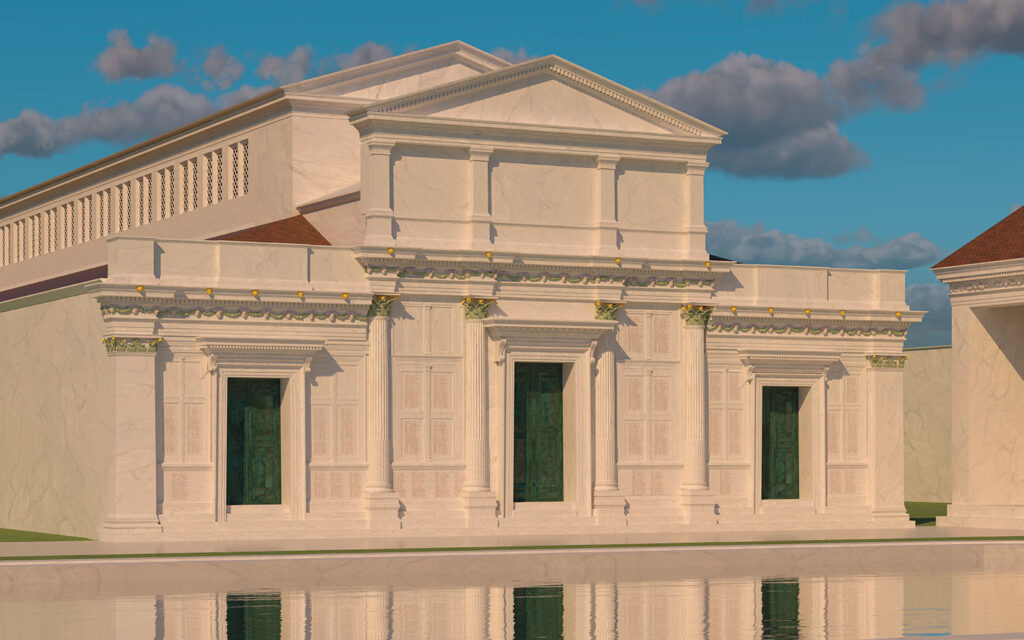
Like the stadium and the pool, the Civil Basilica, built around a.d. 100, was bigger than necessary, measuring 476 feet long and 98 feet across. It was punctuated by flamboyant fluted Corinthian columns hewn from local white or blue-gray marble and fringed with a frieze displaying festive garlands and wild-eyed theater masks representing soldiers, satyrs, and prostitutes. The basilica was large enough to host shops in its aisles, meetings in its side corridors, and even banquets or processions through its nave. During excavations of the building between 2005 and 2010, archaeologists uncovered a chamber where speeches may have been given or trials held. “The basilica was the building that people associated not only with business, but also maybe with the Roman government,” says archaeologist Philip Stinson of the University of Kansas. “Roman archaeologists, for a long time, thought of Aphrodisias as an outlier, this kind of Xanadu, Disneyland place. But it was a real place with real institutions.”
Sometime in the early fourth century a.d., Aphrodisias was elevated to the status of capital of the province of Caria, and the governor quite likely presided from the basilica. When the Prices Edict arrived from the emperor, Aphrodisians apparently didn’t hesitate to emblazon it across the city’s most important administrative building with their trademark fanfare. The reflection of the empire’s longest Latin inscription shimmered in the empire’s biggest pool.
Aphrodisias had a particularly grand rendition of the Prices Edict, but it wasn’t the only city in the area where the text was posted. William Sherard, a British consul in the region between 1703 and around 1718, recorded a peculiar list of ancient prices he’d spotted at the site of Stratonicea. (See “Goddess at the Crossroads.”) There, 45 miles southwest of Aphrodisias, the Prices Edict was also inscribed on a preexisting structure, the city’s council chamber. The engravers in Stratonicea, however, abruptly stopped their work in the middle of the chapter concerning timber, about a third of the way through the full list.
When archaeologist Kenan Erim of New York University and his team arrived at Aphrodisias in 1961, they found a well-preserved site whose magnificent marbles had not been thoroughly plundered. Aphrodisias’ stadium remained essentially undisturbed, and the Temple of Aphrodite’s columns still stood upright. “For me, it’s a site like no other,” says University of Oxford archaeologist R. R. R. Smith, who has directed excavations at Aphrodisias since 1991. “At other places, you don’t have statues found beside the bases on which they were set, with their heads, with their inscriptions in situ. It’s that congregation of these powerful public symbols together that you can imagine elsewhere, but at Aphrodisias, you can actually see, re-create, and feel their effect.” Between 1969 and 1971, archaeologists recovered most of the largest fragments of the Prices Edict from where they had fallen, near the north facade of the Civil Basilica. Crawford first encountered and began to study the edict at Aphrodisias at that time, and, in 1999, he was joined by Stinson.
It soon became apparent to Crawford and Stinson that the Prices Edict could not be understood and translated with the greatest possible accuracy unless it was reconstructed in tandem with the basilica’s facade. The archaeo-epigraphic project became more and more complex as the team added objectives, and as fragments of the edict continued turning up. “We felt like the letter carvers,” says Stinson. “When they thought they were finished, more text arrived.”
To produce a new translation and re-creation of the edict at Aphrodisias, Crawford looked to other versions to fill in the gaps. The 40-plus known copies included some discrepancies. Although it came from the emperor’s desk, the document’s grammar was sloppy, and the Greek-speaking carvers of Anatolia likely could not recognize the meaning of Latin words or Roman numerals. Errors were introduced, and fact-checking imperial pronouncements was above a marble worker’s pay grade—it said as much right there on the building. But Crawford’s tenacity paid off. “We can now establish and number a definitive list of chapters,” he says, “and the text of the edict is nearly complete.”
Beyond epigraphy, the Aphrodisias edict project presented archaeological and architectural challenges. At the project’s outset, it was unclear if the edict had been inscribed directly on the basilica’s facade or on a freestanding set of panels. In addition to lines of text, many fragments featured architectural molding, whose purpose puzzled the archaeologists. The basilica’s north facade centered on a monumental central doorway, flanked by symmetrical wings, each with an additional door. Two load-bearing pillars and four columns divided the facade. By analyzing the molding on fragments of the edict along with other architectural elements, Stinson determined that the sections of the facade between the doors and columns were carved to resemble window shutters, unusual decor in Roman architecture, and that the text of the edict was inscribed on their surfaces. As Stinson and Crawford reimagined the design of the facade, they were able to fit the fragments of the edict that contained decorative molding into place.
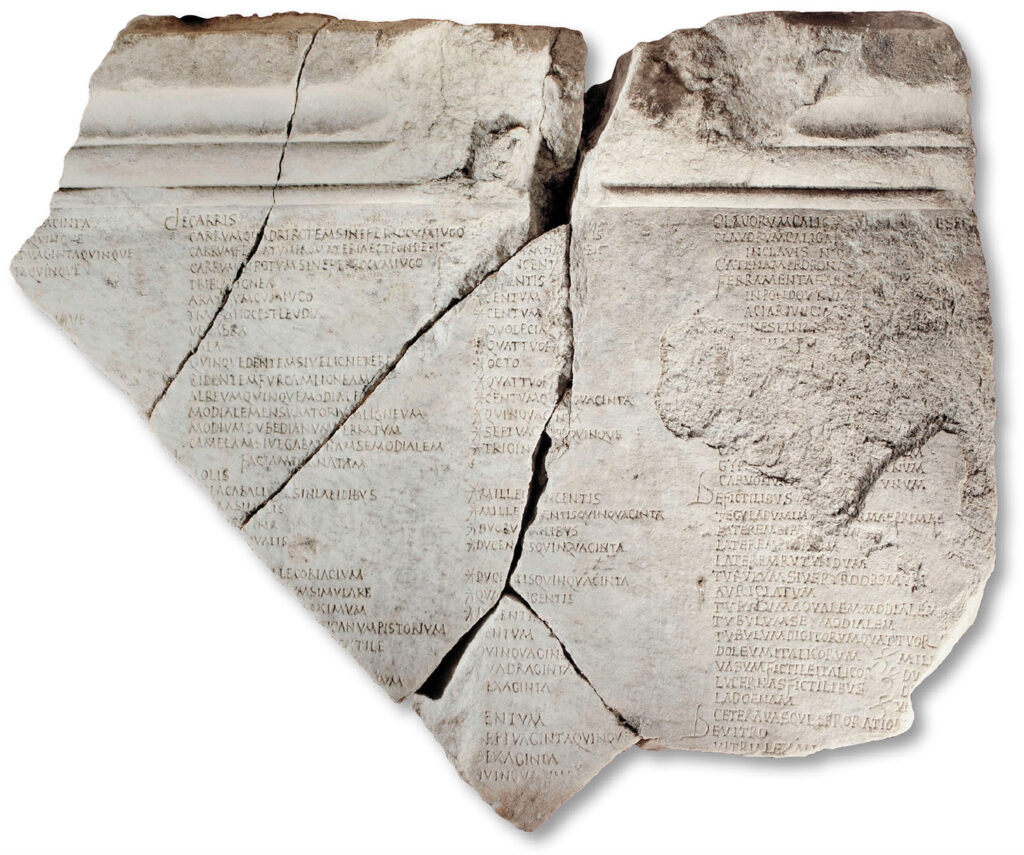
Next, the researchers attempted to estimate where sections of the edict’s text known from other sites but not found on the Aphrodisias fragments would have been positioned. Certain questions regarding the basilica made this tricky. “We didn’t know its exact height,” says Stinson. “The columns are fragmentary.” As he excavated new pieces of the facade and reevaluated its architectural elements, Stinson was repeatedly forced to adjust his estimate of the building’s height. Crawford, in turn, then had to add or subtract lines of text. Salway, meanwhile, chased down pieces of the edict stored in three local depots, trying to match broken edges. Somersan pondered how to translate the edict’s Latin words for long-extinct products into modern Turkish.
All this work over a quarter century unlocked meaningful insights. The edict’s preamble, in large letters, and the first seven chapters, pricing staples and services, began on the lower levels of the facade’s leftmost panel, about 13 feet above ground level, leaving the space above blank. Aphrodisias’ Latin tutors would have been able to read the text at that height. The letters in the lengthy clothing chapters, however, were squeezed to less than half an inch tall and inscribed high up under a lintel next to the columns’ capitals. Paleographic analysis—the study of ancient script—has helped the team understand how the engravers tackled the Prices Edict. The carvers may have used two different types of chisels: one that could scratch a line and the other, punch a curve. “With straight lines and a sort of C-shape, you can produce the entire Latin alphabet,” says Salway. It appears that the carvers worked simultaneously on a given section of the facade rather than following the text strictly left to right or beginning to end. Salway identified at least three carvers by idiosyncrasies of their scripts—their F’s gave them away. “Because so much of the Aphrodisias text needed to be reconstructed from fragments, it was necessary to look much more closely at the hands in order to see which bits went together,” he says. “No one’s really looked into that at other sites where the edict was inscribed, because it wasn’t a problem.”
Whether the Edict of Maximum Prices worked at Aphrodisias depends on what “worked” means. The governor presumably won laurels from higher authorities for his inscriptive initiative. It’s possible that shoppers checked the list. The preamble and most commonly purchased items were deliberately positioned on the most legible parts of the facade, and a Greek translation might have been made available on parchment or papyrus inside the basilica. “You could drag someone across to it and say, ‘Look, on line so-and-so, it says: This is the maximum price you can charge me,’” says Salway.
The prices, though, were not the only point the emperor was trying to make. Using 3D digital modeling, Stinson has created a new vision of the Civil Basilica, enabling people to view it from the steps of its north facade, from the city park, and from its interior. Viewers can experience the spectacle of the edict on the facade when sunlight would have illuminated it. “This huge display of all these letters and 1,400 prices is primarily conveying a fairly simple message,” Stinson says. “‘The emperor is on the job. The tetrarchy is ready to solve the problems of the economy.’”
By around a.d. 314, reviews on Diocletian’s economic policy would have been in, but only one contemporaneous mention of the Prices Edict exists, in the Christian author Lactantius’ hostile On the Deaths of the Persecutors—Diocletian being one of the persecutors. “For the sake of tiny and trivial things, much blood was spilled,” Lactantius snarls, alleging that the edict simply frightened people into quitting their commercial activities, causing inflation to skyrocket. The edict, he writes, was repealed. The new coin values set out in the Currency Dossier, though, seem to have been honored until the emperor Constantine (reigned a.d. 306–337) implemented a more durable solution, a gold standard, around a.d. 312.
Whatever other pocketbook issues persisted, on September 1, a.d. 301, Aphrodisians had twice the cash in their purses as they had had the day before. The letter carvers would have quickly moved on to other jobs. Skilled marble workers were in high demand for building projects and renovations around the city, including further work on the basilica. Aphrodisias’ high-status residents would have been sure to make appearances there. For such occasions, they would need to have their cloaks cleaned. Perhaps they looked up at the basilica’s facade to check the maximum price for this service.
Slideshow: A Roman Emperor’s Most Unusual Monument
The Roman Empire may have been fracturing by the end of the third century a.d., but the city of Aphrodisias, in present-day southwestern Turkey, was on the rise. The town’s sculptors were renowned across the empire, and archaeologists excavating there have found exquisite Roman statuary and architecture from before, during, and after this period, in many cases preserved in situ. Aphrodisias had shrewdly cultivated its relationship with Rome for centuries. An Aphrodisian friend of the emperor Augustus (reigned 27 b.c.–a.d. 14), who claimed lineage from Aphrodite, funded a lavish new temple in the city’s sanctuary of the goddess. Aphrodisias’ extravagant baths were dedicated to the emperor Hadrian (reigned a.d. 117–138). In a.d. 301, the emperor Diocletian (reigned a.d. 284–305) and his deputies ordered that a long, cumbersome edict—a list of maximum prices for 1,400 goods and services—be prominently displayed in cities across the empire. Local leaders in Aphrodisias could not let slide the opportunity to impress the emperor. The text, which scholars call the Edict of Maximum Prices, or the Prices Edict, was inscribed across the facade of the stateliest and most important administrative building in the city, known to archaeologists as the Civil Basilica.
Archaeologists have discovered more than 40 copies of the Prices Edict, most in fragmentary form, around the Roman world. The Aphrodisias inscription of the edict is among the most complete, but it exists in hundreds of marble pieces that fell from the Civil Basilica’s facade. In the late 1990s, archaeologists, epigraphers, and architects undertook an ambitious project to reconstruct the edict, reassembling the 250-square-foot inscription and reimagining the appearance of the collapsed building on which it was emblazoned.