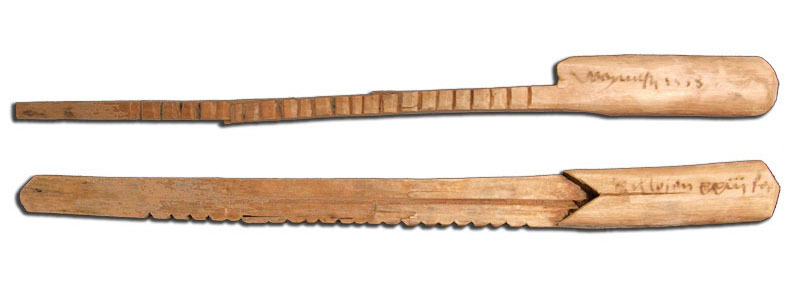
What is it?
Tally stick
Culture
German
Date
1558
Material
Wood
Found
Wittenberg, Germany, summer 2011
Dimensions
8 1/4 inches by 3/4 inch
Imagine going to the local store in Wittenberg, Germany, in the midsixteenth century and not having enough cash to pay for the pig you wanted to roast for dinner. You might have to borrow some money and, in order to record your debt, the person making the loan would use a tally stick like this one. The stick was notched in the presence of both the lender and the borrower and then split in two, so that each person retained half. According to Andreas Hille, the state archaeologist responsible for Wittenberg, the contours of the stick and the distinct split guaranteed that only these two particular halves could be fit back together—insurance against anyone trying to cheat by adding more notches. When the borrower was ready to repay his debt, the two halves were put back together. The stick was then thrown away or destroyed.
City records indicate that the house—specifically the latrine—in which the tally stick was found was owned by a Georg Masseck between 1548 and 1563, but Hille says there is no way to prove the stick belonged to him. Even after conservation, the writing is illegible except for the date and the amount, 23, which matches the number of notches on the stick. Whoever the stick belonged to, and whatever the money was used for, the artifact's presence in the toilet suggests that the borrower's obligation had been fulfilled and the stick was no longer needed.