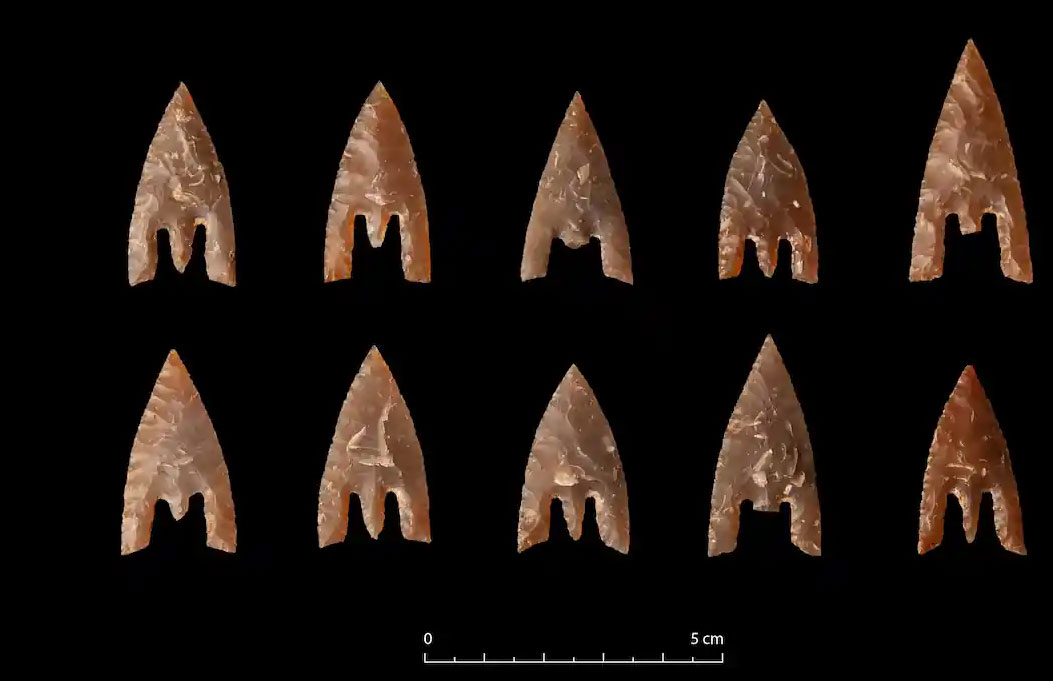
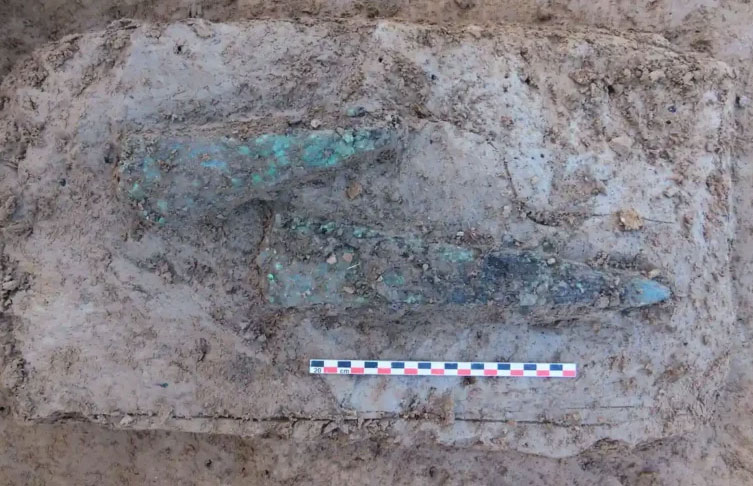
NORMANDY, FRANCE—La Brujula Verde reports that a burial pit dated to between 1900 and 1800 B.C. has been discovered on the slopes of the community of Écouché-les-Vallées, near the Orne River in northwestern France, by researchers from the French National Institute for Preventive Archaeological Research. The burial, once covered by a mound, has been linked to the Bronze Age Armorican Tumulus Culture, and other nearby sites. No human remains were found in the acidic soil, but 31 flint points, two bronze daggers, and a carved piece of rock crystal that may have been worn as a pendant were recovered. The points had been carefully finished to resemble each other by master flintknappers, and were likely made as a sign of wealth or power for a member of the ruling elite. The blade of the larger of the two daggers measures about 12 inches long. Traces of its leather sheath have been detected. The blade of the smaller dagger, which had a sheath made of basketry, measured about eight inches long. Both daggers are thought to have been attached to wooden handles with rivets. To read about a remarkable artifact discovered in northern France dating to the same period, go to "Bronze Age Map."