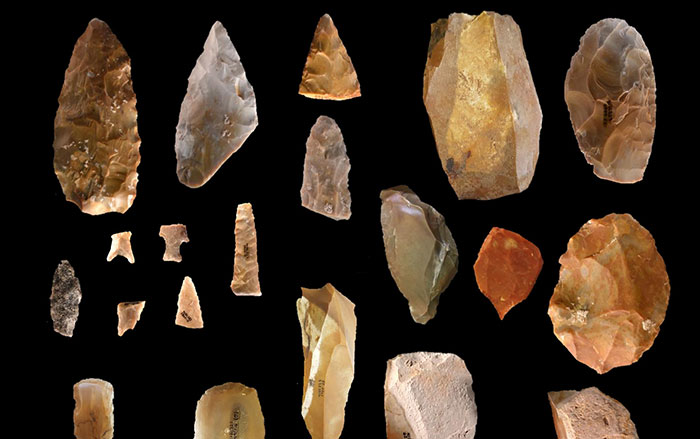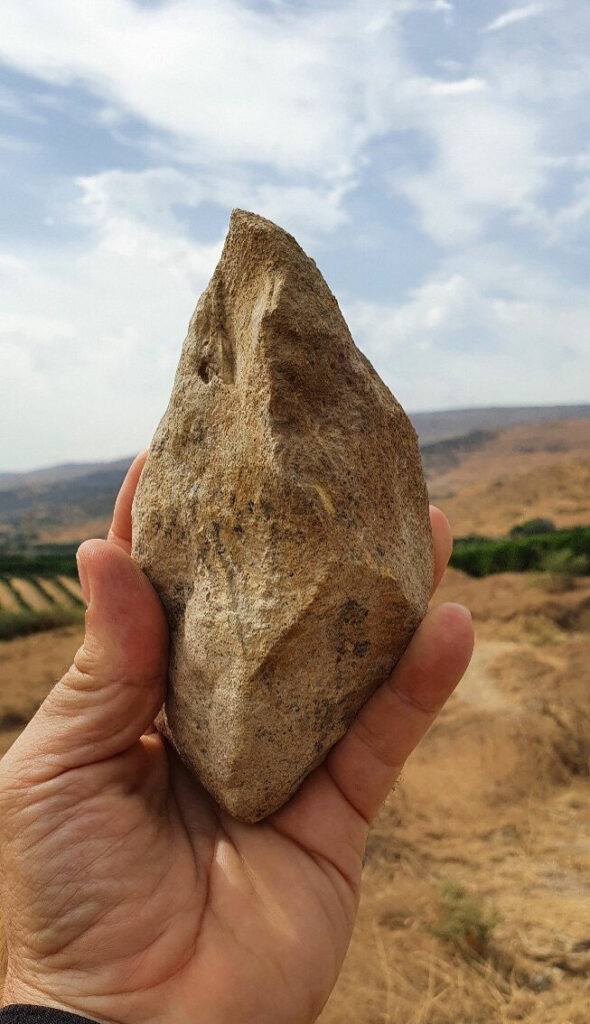
JERUSALEM, ISRAEL—According to a statement released by the Hebrew University of Jerusalem, a new study conducted by Ari Matmon of the Hebrew University of Jerusalem, Omry Barzilai of the University of Haifa, and Miriam Belmaker of the University of Tulsa suggests that the site of ‘Ubeidiya in the Jordan Valley is at least 1.9 million years old, making it one of the oldest known early human sites outside of Africa. Large bifacial stone tools of the Acheulean tradition and the remains of animals from Africa and Asia have been found at the site, which had previously been dated to between 1.2 and 1.6 million years old. The scientists employed cosmogenic isotope burial dating to measure how long the rocks had been underground, analyzed traces of the Earth’s ancient magnetic field preserved in the site’s lake sediments, and used uranium-lead dating on fossilized snail shells found in the same layer as the stone tools to obtain the new date. Some 1.9 million years ago, different groups of hominins may therefore have been spreading across different regions, such as Georgia’s Dmanisi site, the researchers explained. These groups may have also been carrying different toolkits—either similar Acheulean tools or simpler Oldowan tools, including choppers, scrapers, and flakes, the researchers concluded. To read about an Acheulean tool depicted in a fifteenth-century painting, go to "Portrait of an Ancient Ax."