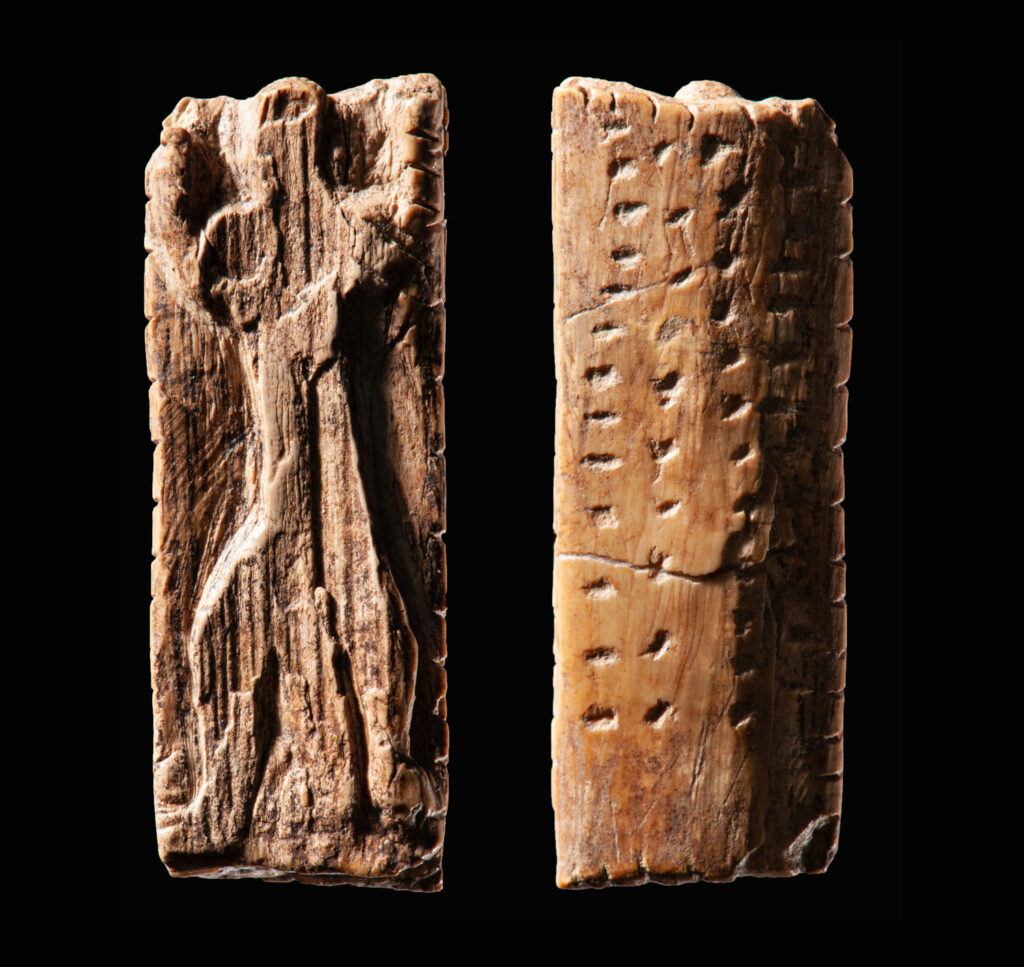
SAARBRÜCKEN, GERMANY—According to a statement released by Saarland University, repeated lines, notches, dots, and crosses etched on Paleolithic artifacts some 40,000 years ago exhibit the same level of complexity and information density as proto-cuneiform script, which emerged around 3000 B.C. Linguist Christian Bentz of Saarland University and archaeologist Ewa Dutkiewicz of the Museum of Prehistory and Early History in Berlin used computers to analyze the statistical properties of more than 3,000 signs on 260 Paleolithic artifacts. “We hypothesized that the early proto-cuneiform script would be more similar to the writing systems of today, especially due to their relative proximity in time,” Dutkiewicz said. “Yet the more we studied them, the clearer it became that the earlier proto-cuneiform script is very similar to the much older Paleolithic sign sequences,” she continued. The study may eventually help researchers narrow down potential interpretations of what information the marks might have conveyed to Paleolithic people, Dutkiewicz concluded. Read the original scholarly article about this research in Proceedings of the National Academy of Sciences. To read about the origins of an early script known from inscriptions found on the Sinai Peninsula, go to "Primordial Alphabet Soup."