What is it?
Figurines, or bronzetti
Material
Bronze
Culture
Nuragic
Date
950–800 b.c.
Dimensions
Up to 9.8 inches tall
Found
Sardinia

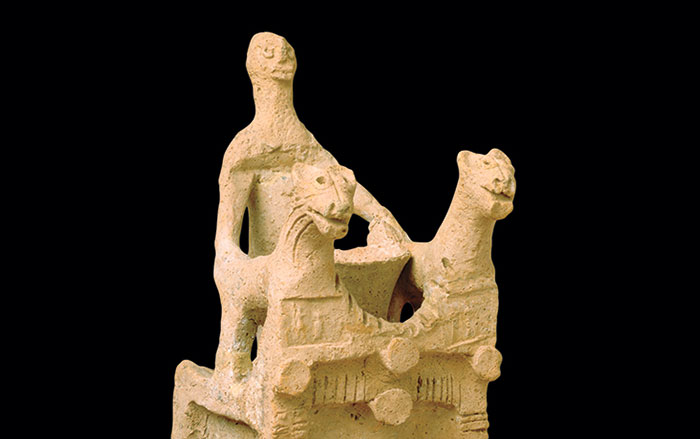
When scholars study the great copper-producing powers of the Mediterranean Bronze Age, they often focus on Cyprus and the Levant. (See “In the Time of the Copper Kings.”) But the source of the copper used in small bronze figurines called bronzetti found across Sardinia has perplexed researchers. Bronzetti were made by members of the Nuragic culture and depict everyday items and animals, as well as people engaged in daily activities and high-status members of society such as warriors.
Now, by combining conventional techniques with a rarely used method to identify the origin of the copper used to make the bronzetti, scientists are finally putting Sardinia firmly on the copper map. “The standard approach to narrowing down the origin of copper in archaeological artifacts is a combination of elemental analysis and lead isotope composition,” says archaeometallurgist Daniel Berger of the Curt Engelhorn Center for Archaeometry. “This method is generally well suited for provenance studies, but in many cases the lead isotope ratios of ore deposits overlap, making an unambiguous determination of origin impossible.”
Berger sampled for the mix of isotopes of the element osmium, which is a by-product of copper mining, and which appears to be particularly distinctive for Sardinian copper. He determined that much of the copper used in the bronzetti was sourced from local mines. This result, which could only have been arrived at using this unusual technique, has broad implications. It may now be possible to identify Sardinian copper far from its source. “It has become increasingly clear that prehistoric communities were willing to cover considerable distances to acquire highly valued copper,” says Berger. “Our findings will begin to enable us to trace Sardinian copper beyond the island, for example in Scandinavia, where close connections with Sardinia are likely to have existed.”
Read the original scholarly article about this research in PLOS One.