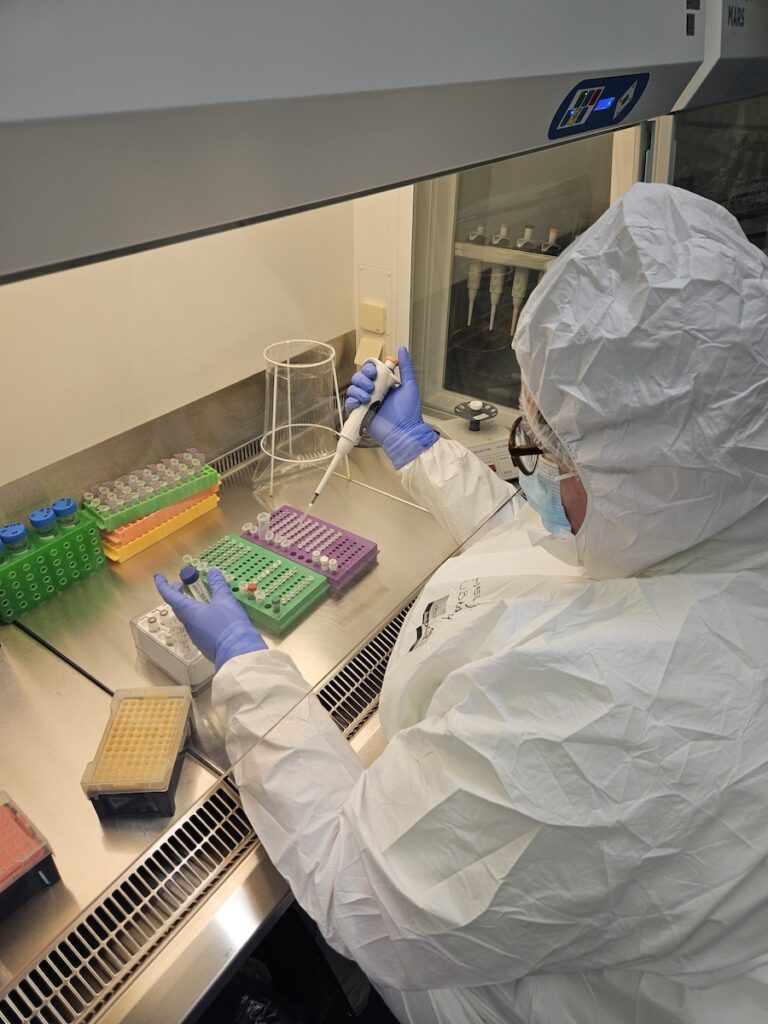
VIENNA, AUSTRIA—According to a statement released by the University of Vienna, a team of scientists from the University of Vienna, the University of Tartu, Cambridge University, and University College London have reconstructed the genomes of human betaherpesvirus 6A and 6B (HHV-6A/B) from samples taken from human remains recovered from archaeological sites in Europe. Today, HHV-6B infects about 90 percent of children by age two, causing roseola infantum, also known as “sixth disease,” an illness characterized by a rash and a fever. In addition to causing illness, these viruses are capable of integrating into human chromosomes and remaining dormant. Such inherited viral copies are found in about one percent of the modern population. An analysis of nearly 4,000 sets of ancient and historic human remains detected HHV-6A/B virus genomes in 11 samples. The oldest sample came from a girl buried in Italy between 1100 and 600 B.C. Both HHV-6A and HHV-6B were detected in remains from medieval England, Belgium, and Estonia, while the inherited form of HHV-6B was identified in several of the individuals from England. “Modern genetic data suggest that HHV-6 may have been evolving with humans since our migration out of Africa,” said Meriam Guellil of the University of Vienna. “These ancient genomes now provide the first concrete proof of their presence in the deep human past,” she explained. Read the original scholarly article about this research in Science Advances. To read about the study of diseases using ancient microbial DNA, go to "Worlds Within Us."