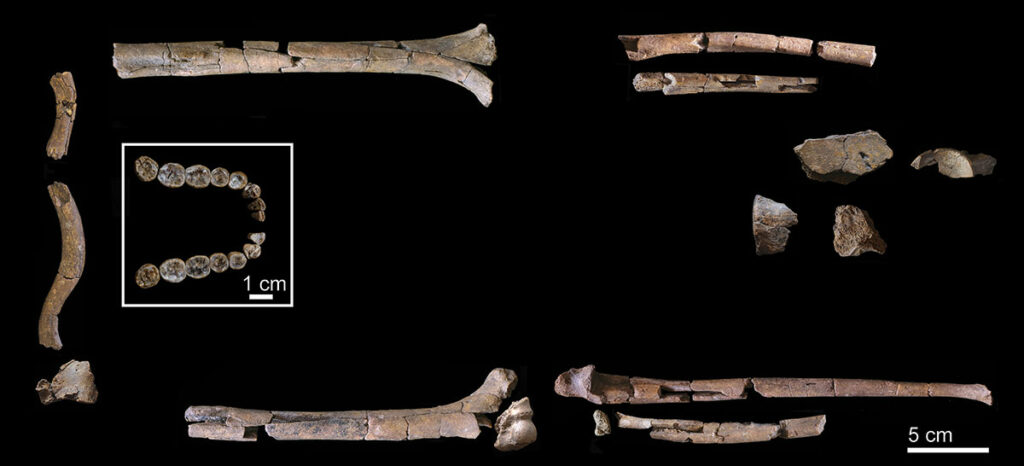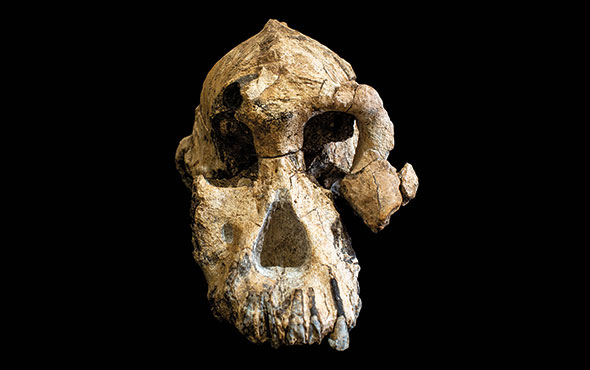
STONY BROOK, NEW YORK—Live Science reports that researchers have completed their analysis of two-million-year-old Homo habilis fossils discovered in 2012 on the shore of Lake Turkana in northern Kenya. The fossils, dubbed KNM-ER 64061, include a complete set of lower teeth; collarbones; pieces of shoulder blades; all of the upper and lower arm bones; and fragments of a vertebra, a rib, an upper leg bone, and the pelvis. “There are only three other very fragmentary and incomplete partial skeletons known for this important species,” said Fred Grine of Stony Brook University. Grine and his colleagues suggest that this individual was a young adult who stood about five feet, three inches tall, and weighed around 68 pounds. They also determined that the arm bones of this H. habilis individual were heavy and thick like earlier australopithecines, with a forearm longer than that of the later Homo erectus. H. habilis may have therefore moved through trees more easily than H. erectus, but it remains unclear. The fragments of the individual’s pelvis suggest that it may have walked more like H. erectus, however. “Going forward, we need lower limb fossils of Homo habilis, which may further change our perspective on this key species,” said team member Ashley Hammond of the Catalan Institute of Paleontology Miquel Crusafont. To read about tools uncovered in the Turkana Basin predating those made by H. habilis by 700,000 years, go to "Earliest Stone Tools," one of ARCHAEOLOGY's Top 10 Discoveries of 2015.