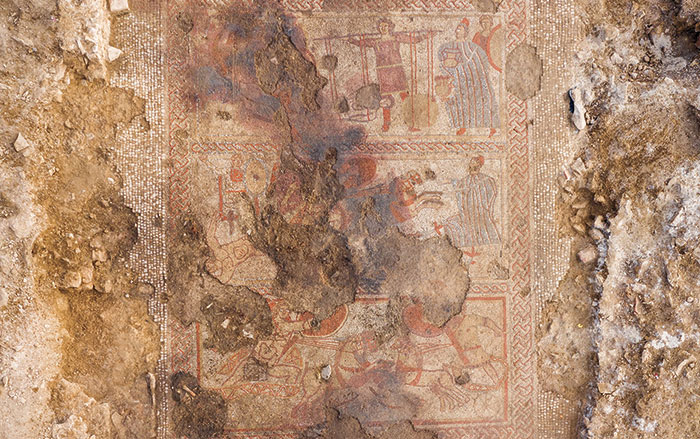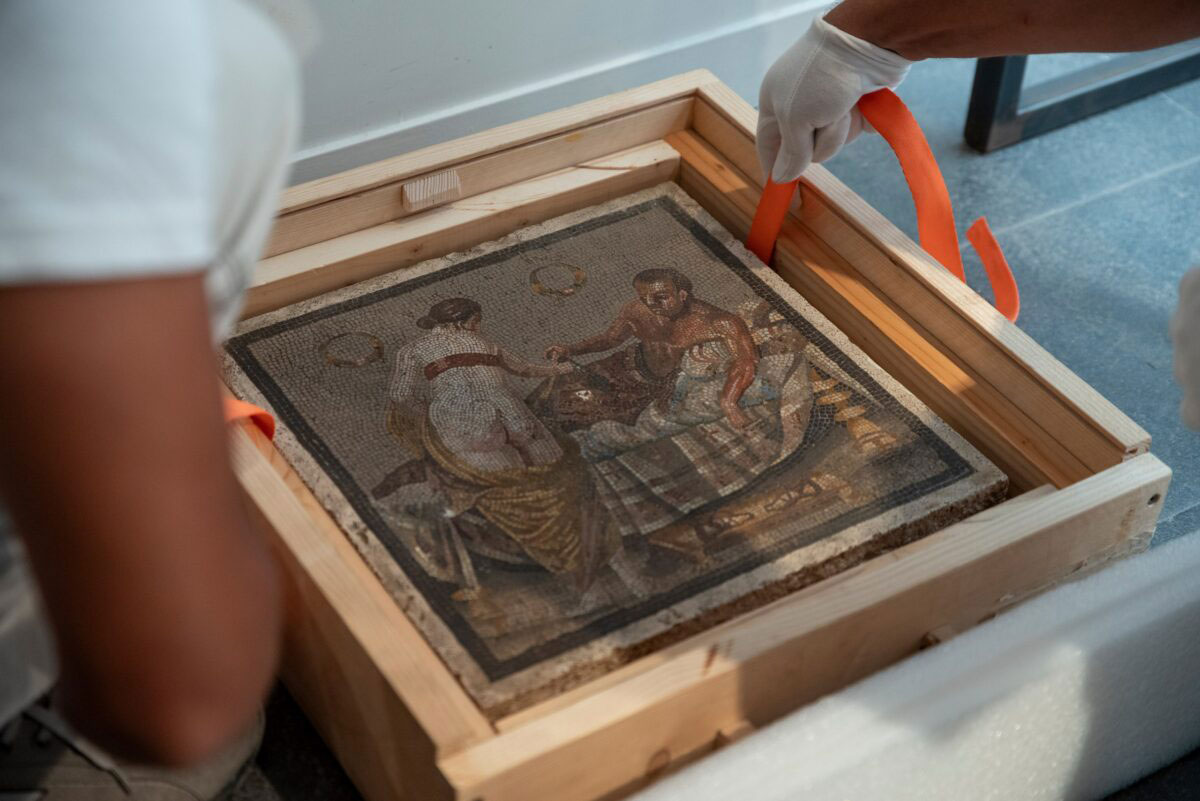
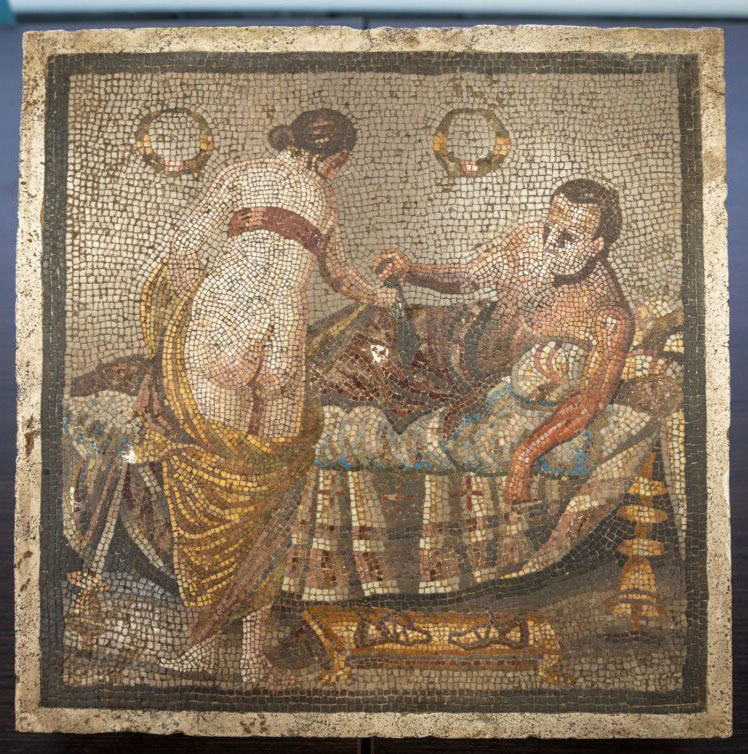
NAPLES, ITALY—According to a statement released by the Archaeological Park of Pompeii, the original home of a mosaic taken to Germany by a Wehrmacht captain who worked as a military supply chain officer during World War II has been identified. The mosaic, which depicts an erotic scene, was returned to Italy by his heirs. The Carabinieri’s Cultural Heritage Protection Unit handed the artwork over to the Archaeological Park of Pompeii last summer. Research conducted by archaeologists from the Archaeological Park of Pompeii and the University of Sannio has now determined that the mosaic was produced in a workshop in Lazio, exported in antiquity to the Marche region, and eventually looted from a Roman villa in Rocca di Morro. The mosaic was first documented there in the late eighteenth century, and it was also seen by painter and archaeologist Giulio Gabrielli, who sketched it in his notebook with a record of its location in the nineteenth century. Gabrielli’s notebook is now held in the Municipal Library of Ascoli Piceno. “The reconstruction of the story of this mosaic demonstrates how the protection of cultural heritage does not end with the physical recovery of the work, but continues with rigorous study, scientific verification, and the restoration of historical truth,” explained Italian Minister of Culture Alessandro Giuli. For more on ancient Roman home decor, go to "Pompeii's House of Dionysian Delights."