
In the early fall of 3909 b.c., residents of an Alpine village that included some 60 homes were busy stocking up for the winter ahead. The settlement was located in a sheltered inlet of Lake Constance, in southwestern Germany, and the homes were perched atop wooden pilings that raised their floors a few feet above the water. Villagers had socked away a bumper crop of wheat, emmer, and einkorn—more than 22,000 pounds of grain in all, plenty to last until springtime. Then disaster struck. A fire quickly spread through the tightly packed wooden houses. The blaze carbonized their contents and burned through their timber floors and wattle-and-daub walls, plunging everything into the cold lake.
The village’s resourceful residents sprang into action. Within weeks, they had scoured nearby forests for anything edible to sustain them. Nearly 6,000 years later, archaeologists combing the mud at the bottom of the lake would find a layer of hazelnuts immediately above the remnants of burned houses. “They must have had everyone who could move gathering hazelnuts,” says archaeologist Gunter Schöbel, director of the Pile Dwelling Museum in the nearby village of Unteruhldingen. Deer, wild boar, and fish helped supplement the hazelnut rations until the weather warmed.
After the fire, the village seems to have bounced back, if only briefly. Damaged houses appear to have been quickly repaired or replaced. Debris atop the burned layer is evidence that people were hunting more wild game, relying more on fishing, and gathering more plants than they had before. They were also producing more shell beads, perhaps as trade goods. The last houses on the site were built seven years after the catastrophic blaze, and the village was later abandoned. As homes collapsed over the following years, mud from their walls covered the site, sealing it for millennia.
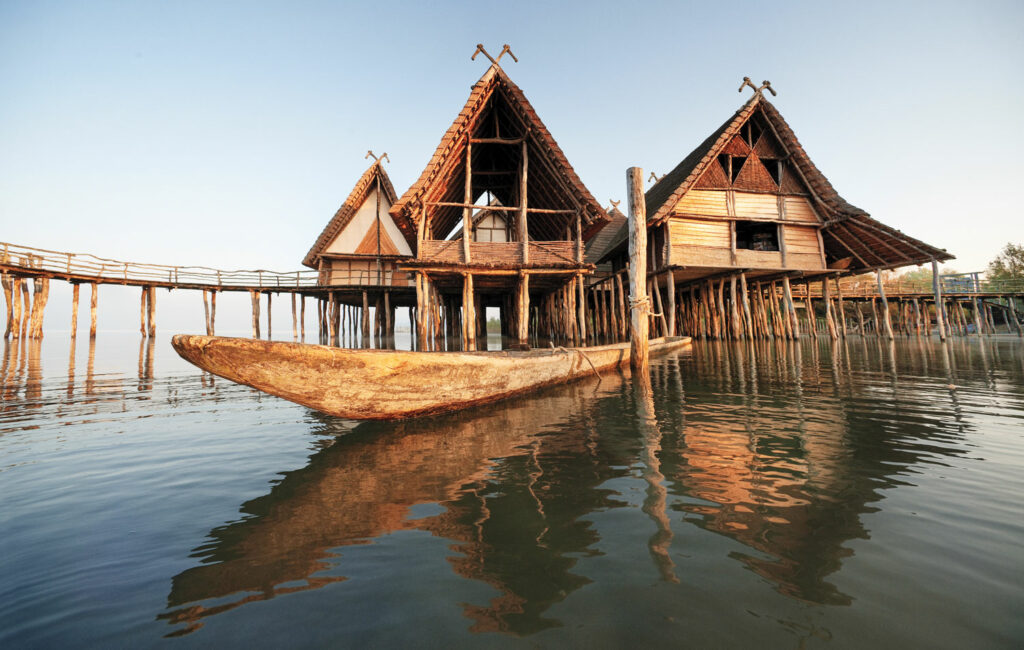
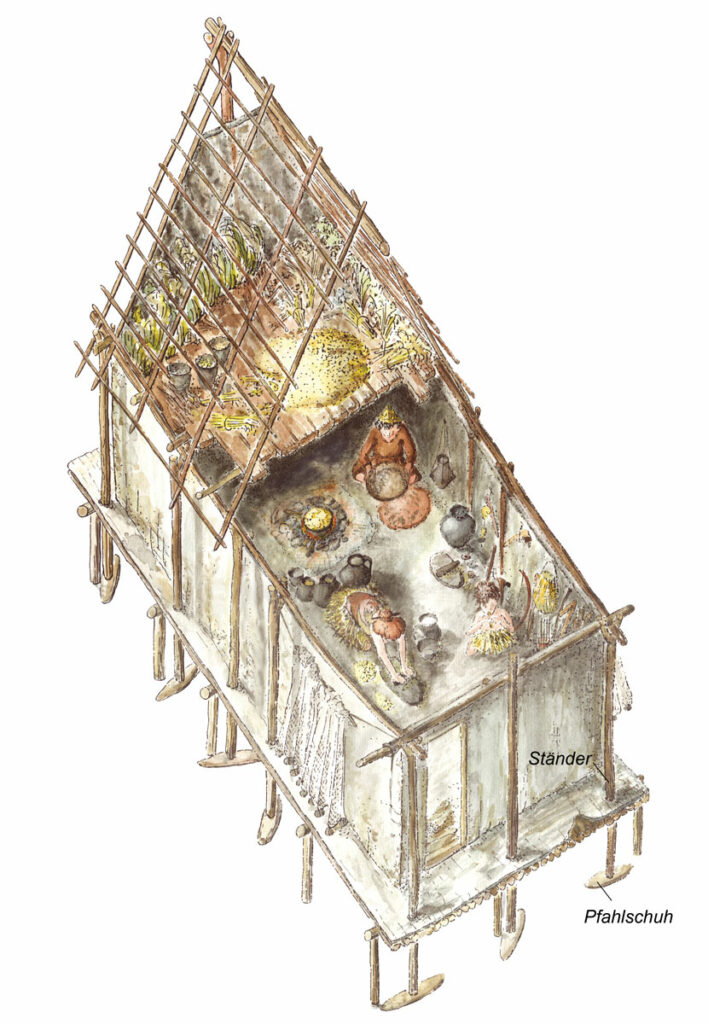
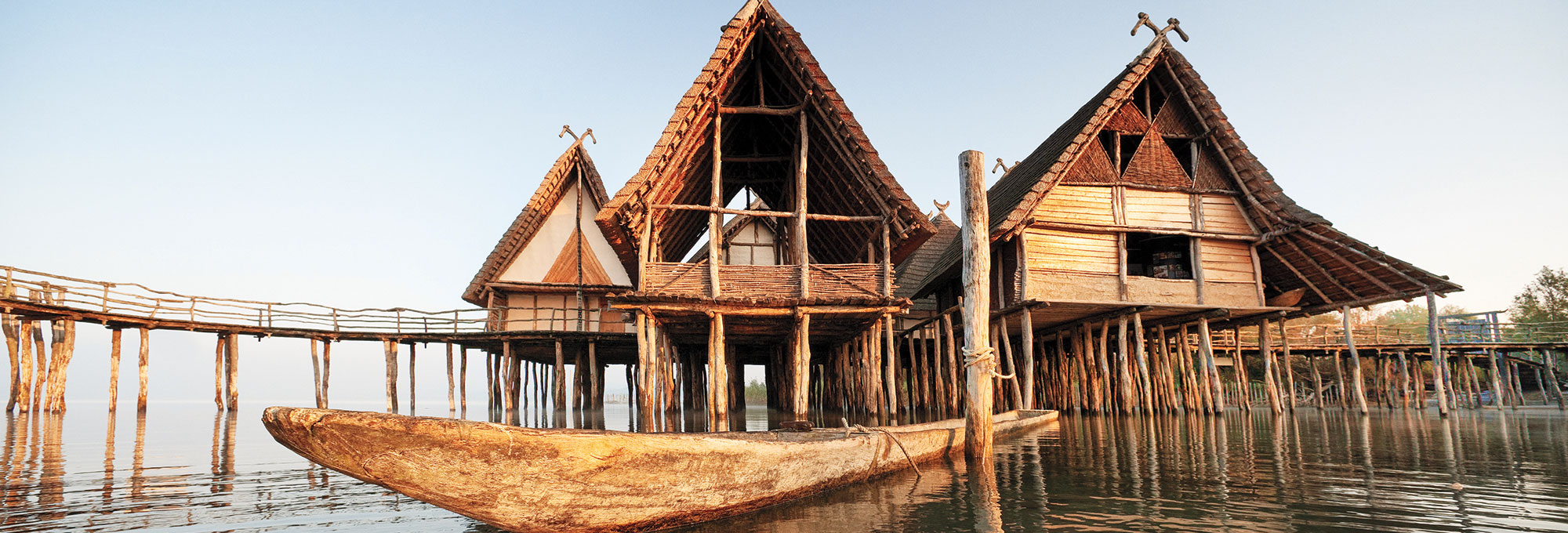
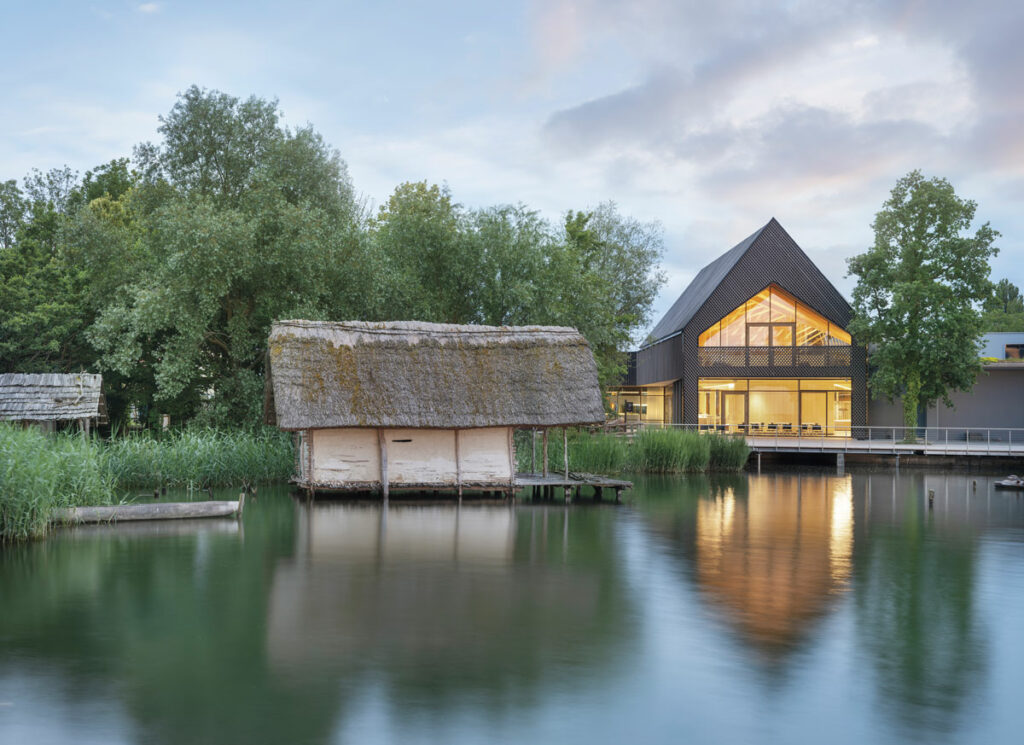
Six miles away in Unteruhldingen and nearly 6,000 years later, terns splash through reeds close to the lakeshore and swans glide silently among dozens of log pilings. Fat trout cruise through the clear, shallow water, in and out of shadows cast by the 23 houses of the Pile Dwelling Museum. Squint north across the blue-green of Lake Constance and it could be the Neolithic era. The only clue that it’s the twenty-first century a.d. are the bright nylon jackets and backpacks sported by visitors strolling among the wooden houses. Models of thatched-roof homes at the open-air museum perch atop thick pilings and are connected by wide platforms and long walkways. Some dwellings are modeled on those that burned at the nearby settlement, which is known as Hornstaad-Hörnle. The smallest structures are re-creations of some of the first houses built on the lake by Neolithic farmers and are barely more than toolsheds on stilts. Others are patterned after spacious Bronze Age dwellings, with multiple rooms and lofts for storage and sleeping. Each ancient dwelling had a hearth insulated from the pilings below using layers of hardened mud.
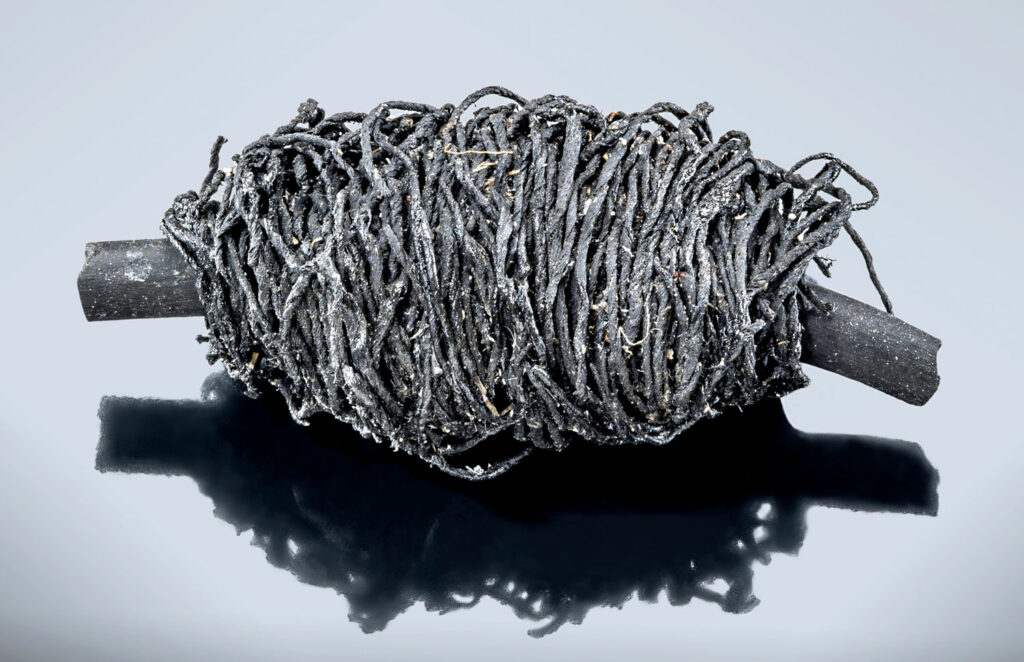
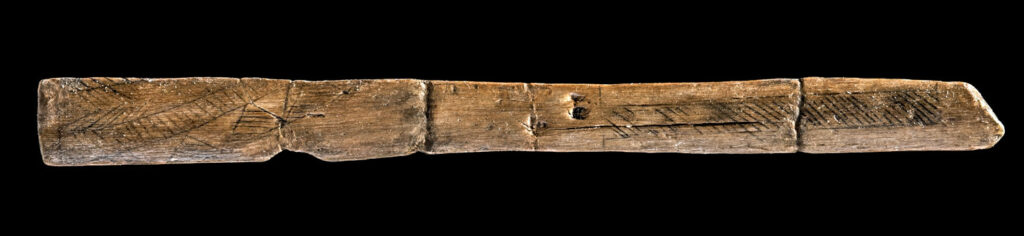
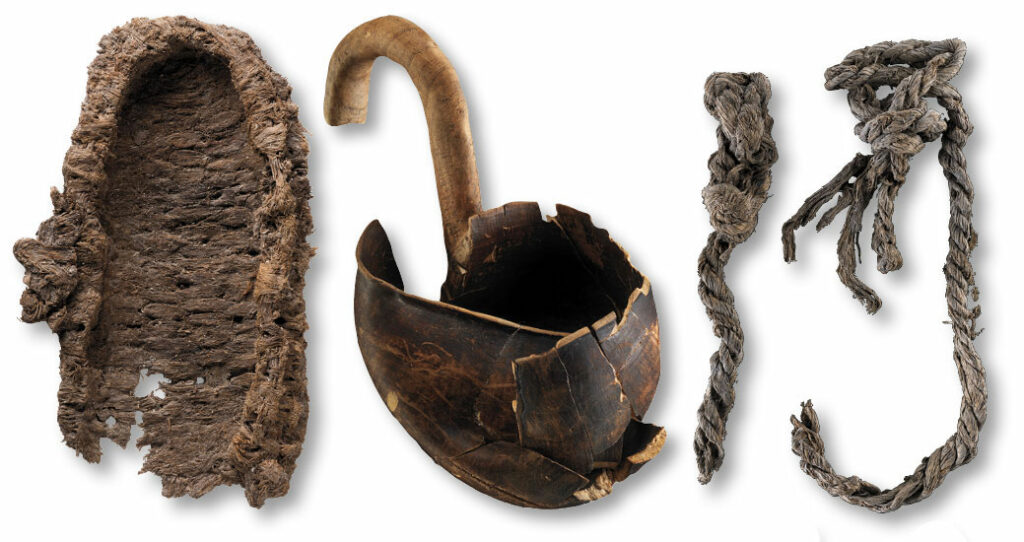
Called Pfahlbauten, or “pile dwellings,” these types of houses were a common sight along Alpine lakefronts from around 4000 b.c. until around 800 b.c. Because their remnants often fell into cold water with low levels of oxygen, the sites preserve some of the best evidence of daily life in the Neolithic period (5500–2200 b.c.) and the Bronze Age (2200–750 b.c.). Findings range from one of the world’s oldest wheels and burned grains of wheat to combs, flutes, sandals, hats, and cloaks discarded or lost millennia ago. “We have organic material and remains that just don’t exist in sites on dry ground,” says Schöbel. “We can peek into the smallest details.” Some of those details suggest that, despite the beautiful view and abundant resources, lakefront life wasn’t necessarily as idyllic as archaeologists once imagined.
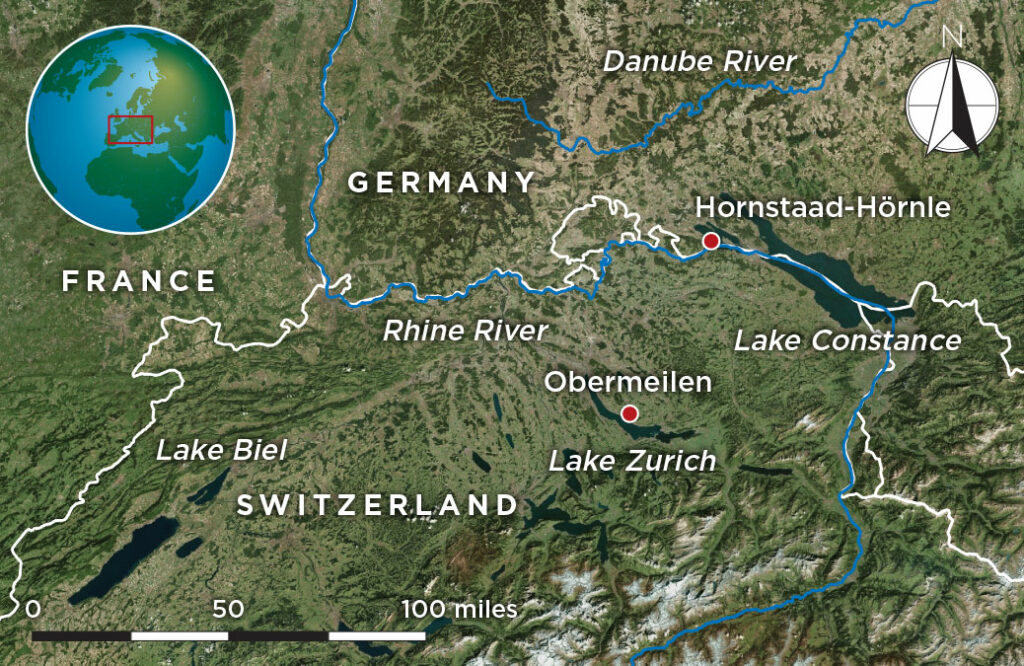
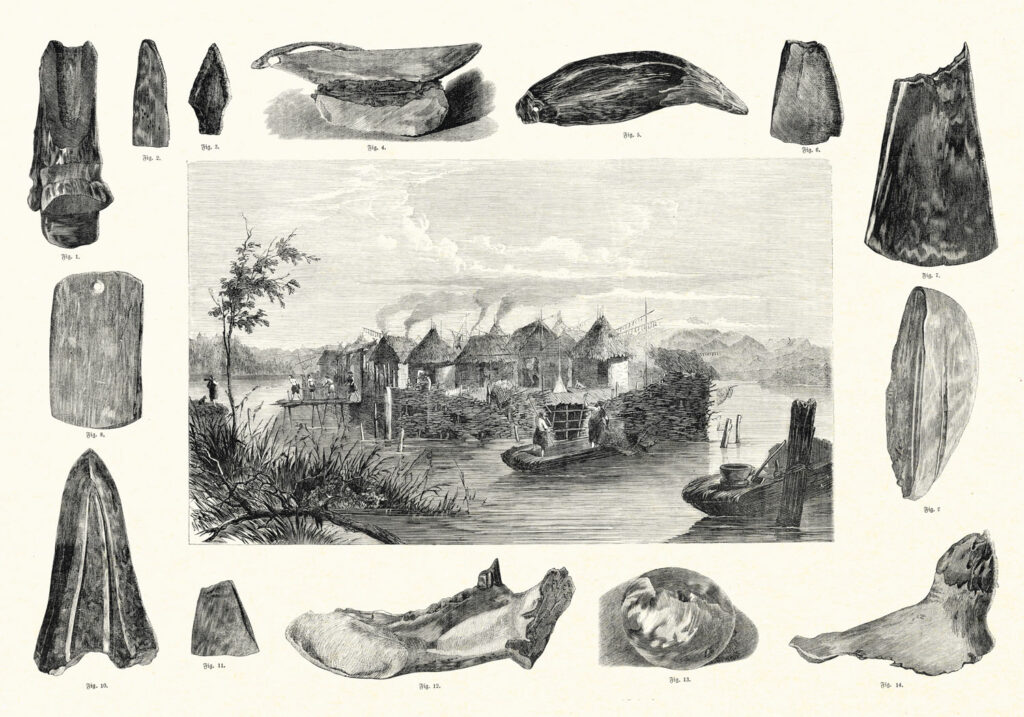
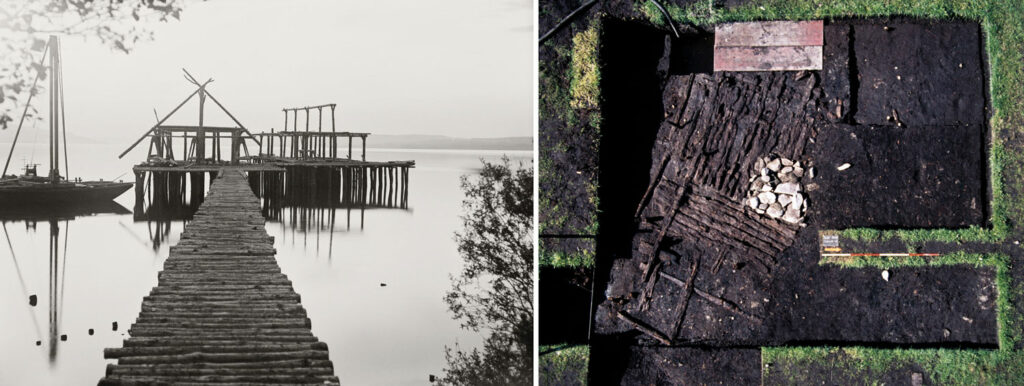
In the winter of 1853, unusually cold temperatures and lower-than-normal precipitation caused water levels in Switzerland’s Lake Zurich and surrounding lakes to drop several feet. Children playing on the shore of Lake Zurich near the town of Obermeilen noticed hundreds of wooden posts jutting from the frozen mud. Scattered among them were objects made of antler, stone, wood, and bone. After local newspapers reported the strange finds, similar accounts started pouring in from across the region. Local historians and archaeologists, who had long relied on grave goods and burials, realized they had something new and special to help illuminate the region’s past.
Drawing on ethnographic reports from the South Pacific, Swiss and German scholars concluded that the pilings had once supported houses. They saw the settlements as evidence that there were sophisticated societies in the Alps predating the classical civilizations of the Mediterranean. Enthusiasts flocked to the exposed lakeshores, scouring them for artifacts. Museums as far away as the Smithsonian and the Hermitage acquired items for their collections. In the decades that followed, dams and other waterworks designed to lower the level of Alpine lakes to create new farmland exposed additional remnants of pile dwelling settlements.
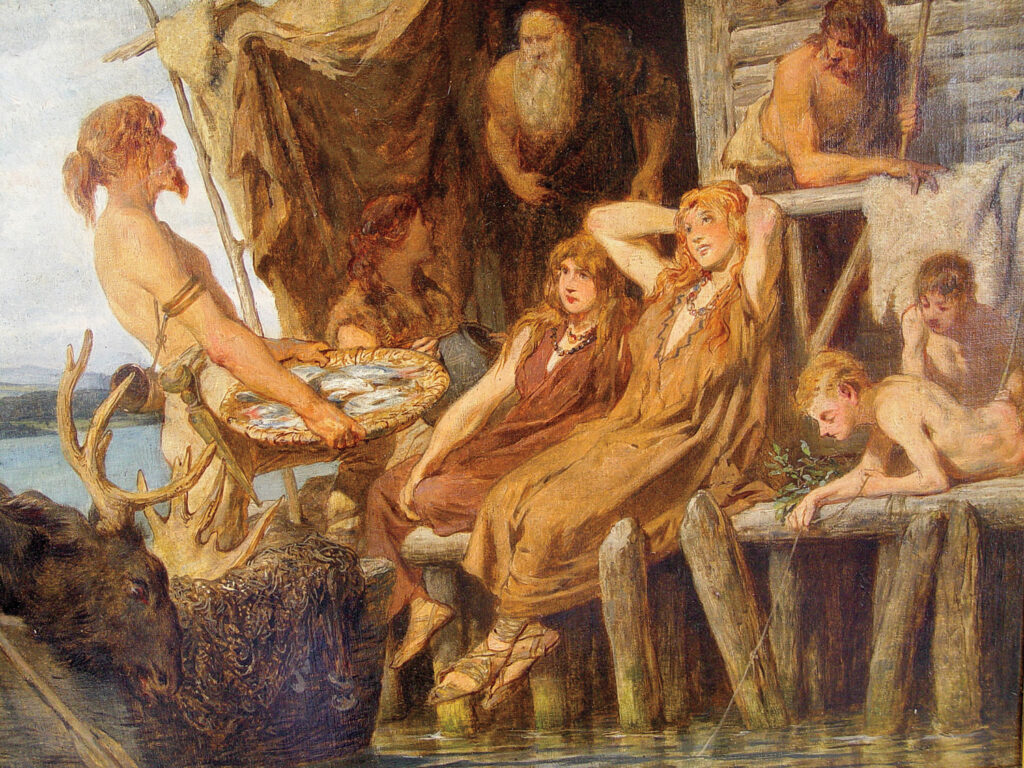
Archaeologists working in the region had long focused on Roman ruins and burials, along with stone tools and skeletal remains from even earlier periods, so finds that illuminated daily life deep in the past were a revelation and an immediate source of national pride. Pfahlbauten were featured on calendars and in newspapers. Swiss and German schoolbooks of the time included imaginative drawings of the settlements’ tall, blond residents. “The Swiss saw this as their origin myth,” Schöbel says, a peaceful golden age of egalitarian, independent lake dwellers whom the nation could claim as ancestors.
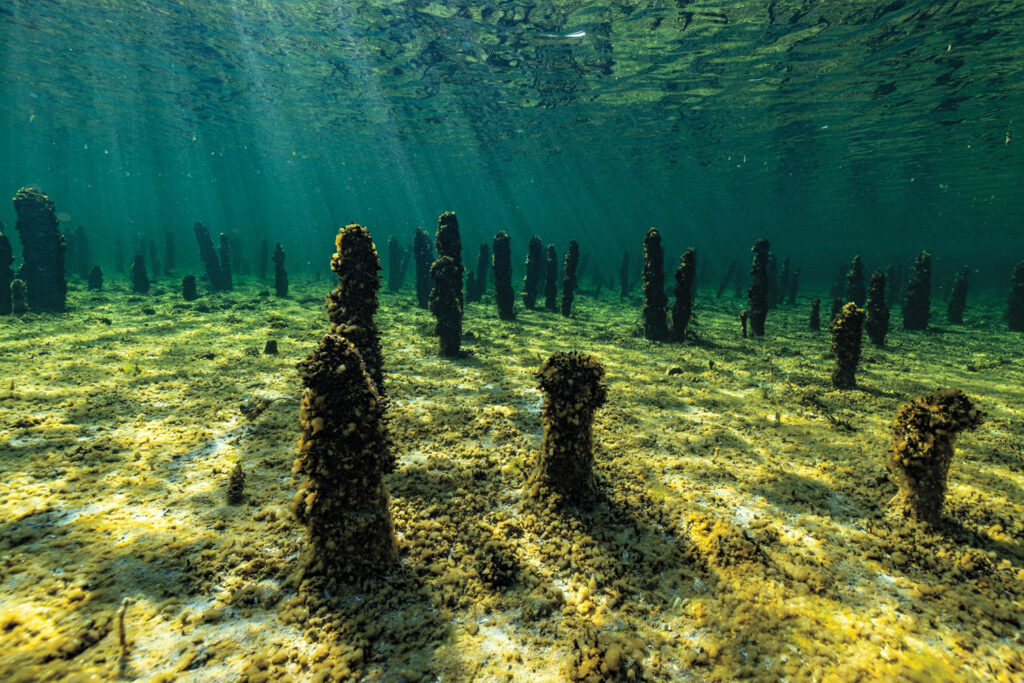
Soon archaeologists and antiquarians across Europe began searching their own lakefronts for the characteristic waterlogged remnants of pile dwellings. Neolithic and Bronze Age settlements were identified by the hundreds. In nearly two centuries since the Obermeilen discovery, archaeologists have found pile dwelling settlements across the Alps, everywhere from backwater bogs in France to the Zurich Opera’s parking lot. The list of Alpine pile dwelling sites now spans six countries—Switzerland, Austria, Italy, Germany, France, and Slovenia—and hundreds of separate locations, almost none of which can be visited by the public because they are underwater or underground. “That’s one of the problems with educating people about the sites—you can’t see them,” says curator Susanne Rau of the Archaeological State Museum of Baden-Württemberg in Konstanz. “When you stand in front of the Egyptian pyramids, the achievement is pretty clear, but for us, you could be standing in the middle of a settlement and not know it.”
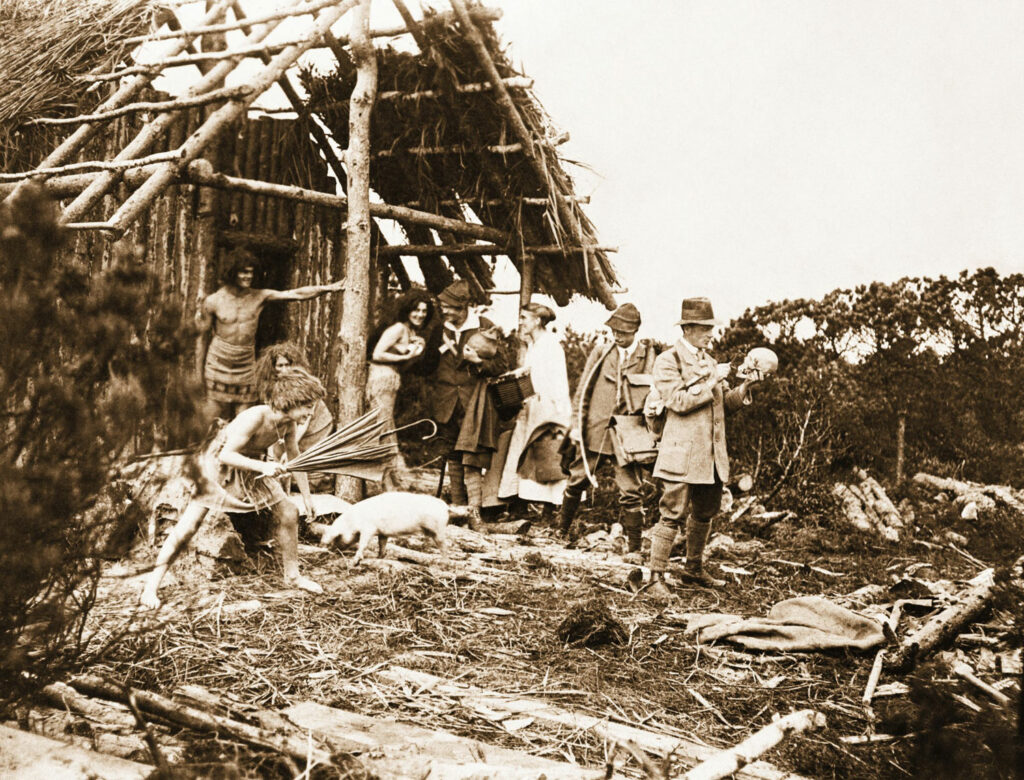
That has been a large part of the Unteruhldingen museum’s draw since the first two replica stilt houses were built at the site in 1922. Originally a tourism gimmick dreamed up by the mayor, the houses were constructed under the supervision of archaeologists from the University of Tübingen. The site was used as a filming location during the Depression for a racy, now-lost movie titled Nature and Love set in a pile dwelling settlement. Later it was visited by Nazi higher-ups, including Heinrich Himmler, who was eager to highlight the achievements of ancient Germans. Hundreds of thousands of visitors still come each year to get a sense of what life was like in a Neolithic lake house. The site has also served as an experimental archaeology lab for generations of researchers who have used it to test their theories about how tools were used or how different building materials might have been employed in the past.
Since scholars first began studying pile dwelling settlements, they have largely assumed the structures were built by a single group. They believed these people were precursors of the Celts, who lived in the region beginning around 600 b.c. Over the last 25 to 30 years, however, by analyzing artifacts using a combination of radiocarbon dating and dendrochronology, scholars have shown that the Alpine pile dwelling tradition is far older, didn’t belong to a single culture, and wasn’t a continuous practice. Instead, over the course of roughly 4,000 years, different groups repeatedly built houses on stilts near lakeshores and on marshy moors.
During those four millennia, waterfront living seems to have periodically gone in and out of fashion. Excavators have found that there were centuries-long periods when pile dwellings disappeared, only to return, often in slightly different locations and with different architectural styles and types of artifacts. “There are always gaps,” Rau says. “We don’t know where people go or what’s happening.”
Pile dwelling settlements seem to have hit their zenith during the late Neolithic. In this period, evidence shows that their residents were plugged into Europe-wide exchange routes. When their houses burned down, the fisher-farmers of Hornstaad-Hörnle lost a copper disk from eastern Europe, stone axes from the Hungarian Plain, amber beads from the Baltic, and shells from the Mediterranean. “They weren’t sitting in their little huts and ignoring the world,” Rau says. “They were actively trading all over the continent.”
According to Schöbel, trade was one reason people settled by the water. “Waterways are the highways of prehistory,” he says. “A day’s journey from here is the Danube, which takes you all the way to the Black Sea. In the other direction is the Mediterranean.” Over time, people’s reliance on travel by water ebbed. By the end of the Bronze Age, the introduction of horses and widespread use of the wheel shifted trade to overland routes. The importance of waterfront settlements diminished until pile dwellings faded out entirely in the Iron Age, beginning around 750 b.c.
It took decades to understand the chronology of the pile dwelling sites, and tree rings were the key. Dendrochronologists start with modern trees and count their rings back to match the innermost rings with the outermost rings of older trees. By working backward, they have compiled a record in the Alps stretching from modern times to more than 10,000 years ago. That has made it possible to date individual logs and pieces of wood to the precise year the trees were felled and has revolutionized the study of pile dwellings and their occupants. Analysis of tree rings from wood used to build pile dwellings at Hornstaad-Hörnle showed the fire occurred in 3909 b.c., and the presence of so much unthreshed grain suggests the blaze occurred in early autumn.
At a pile dwelling site in Switzerland’s Lake Biel, near Bern, archaeologists sampled 60,000 preserved pilings over the course of 25 years. “Even now, that number is amazing to me,” says archaeologist Albert Hafner of the University of Bern. Evidence from this and other sites in the Alps has made it clear that not all the pilings at a given site were built at the same time. What looked to nineteenth-century antiquarians like one vast network of contemporaneous pilings was in fact often the result of multiple phases, as houses collapsed and were rebuilt on new pilings in the same spot or close by. “Dendrochronology was a total breakthrough,” says Hafner.
The study of tree rings forced scholars to reevaluate their assumptions about how long individual houses had lasted. Although some of the museum’s replicas have been used since the 1920s thanks to constant repair and maintenance, tree ring data shows that most ancient pile dwellings were abandoned far more quickly. Researchers have found that clusters of posts date from the same year and that some overlapping or nearby clusters date from a decade or two later as people cut fresh logs to build new houses. When their houses started to fall apart, ancient residents sank piles for new ones in the same spot or moved to another inlet or stretch of shoreline and started again. An accidental experiment at Unteruhldingen provided additional evidence of how short-lived the structures could be. When a severe storm hit the open-air museum a decade ago, it pushed one house off its pilings. Schöbel and his team roped the house off and began tracking its decay. Made of mud, wood, and reeds, the dwelling deteriorated quickly and is now mostly submerged. “The houses don’t last forever—pilings rot, walls fall apart,” Schöbel says. “Often they were only used for ten or fifteen years and then collapsed.”
Scholars have analyzed the materials early builders used and discovered that they were partial to whatever was close at hand. Most of the wood, reeds, and mud were sourced from within a mile and a half of the settlements. “When the area was fully exploited, people just moved a little further on,” Schöbel says. However, Renate Ebersbach, the Baden-Württemberg Heritage Office archaeologist in charge of pile dwelling and wetland archaeology, thinks there might have been other factors that caused people to change location. “You can imagine that there were personal conflicts inside the settlement, and some people just paddled to the next bay and started again,” she says. “The Neolithic wasn’t a hierarchical society, and nobody could forbid people from moving two lakes over.”
By using tree rings to demonstrate that individual planks from different dwellings were cut from the same trees, archaeologists can guess at which houses were built by the same families or clans. And, while no single Neolithic pile dwelling house is noticeably bigger or better equipped than any other, artifacts recovered from Hornstaad-Hörnle and other sites provide evidence that within a single settlement, people often had specialties. Stone drills and unfinished beads in one house reveal that its residents focused on perforating shells to make jewelry. Wild game remains and copious arrowheads in another show where the village’s best hunter may have lived. “It’s very exciting because we can get down to the level of single households and see what they were doing,” says Ebersbach. “We can see how connected they were to the rest of the settlement.”
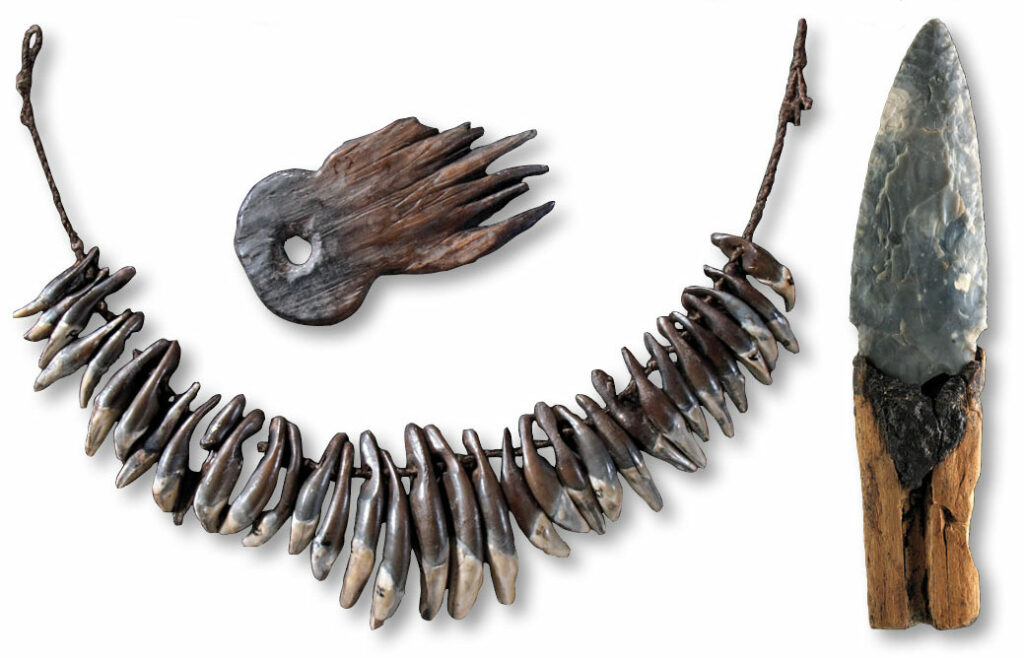
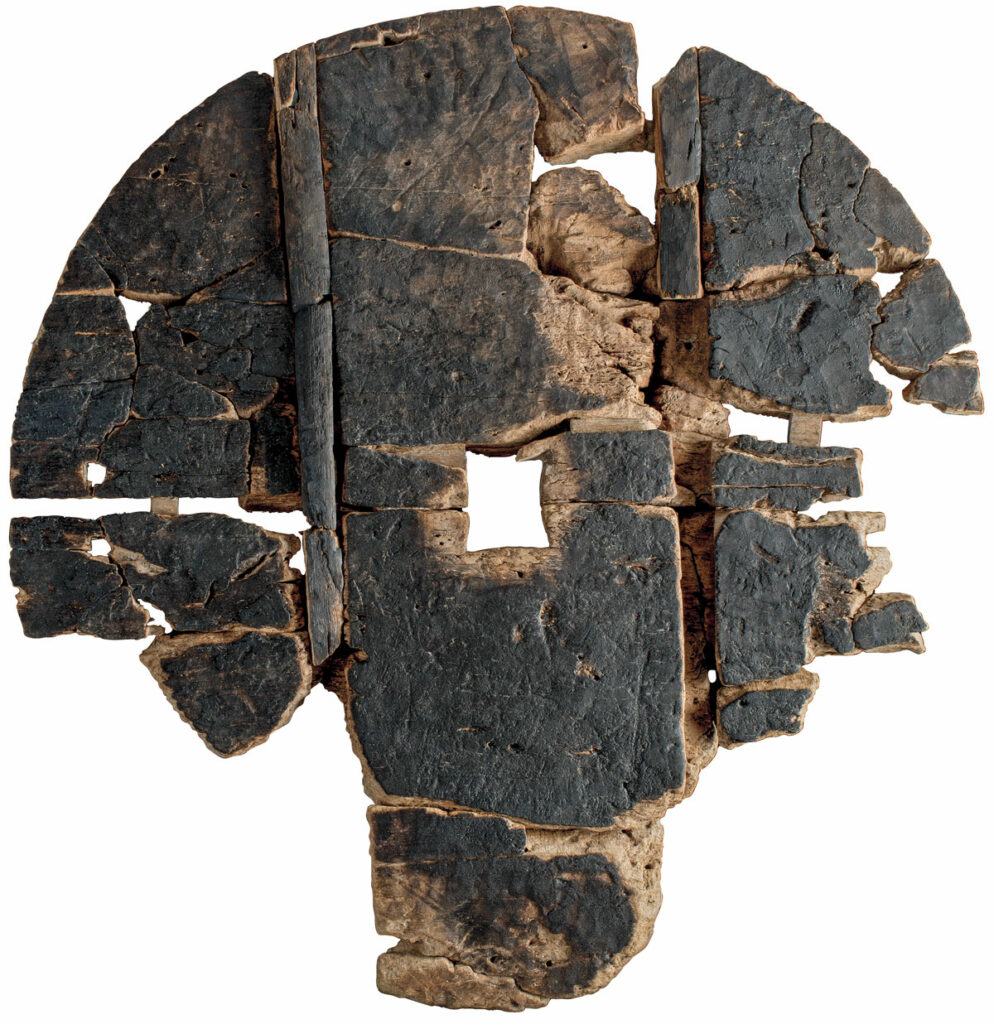
The cold waters of Lake Constance have even given archaeologists a glimpse into the religious beliefs of pile dwelling communities. In Konstanz, a short ferry ride across the lake from Unteruhldingen, the archaeological museum has an entire gallery devoted to pile dwellings. There’s a child’s hat—or possibly a pot warmer—a flint dagger with a wood handle, and what looks like a wooden pizza peel scorched from a hearth fire lit around 2,900 years ago.
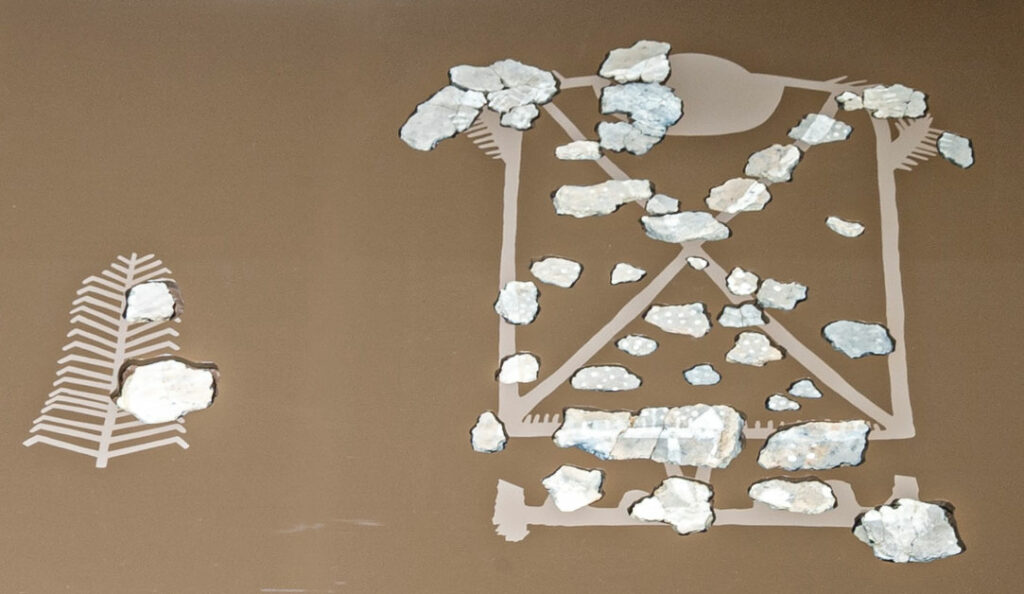
One long, flat vitrine houses a particularly eye-catching artifact: the oldest wall art ever found north of the Alps, which was discovered underwater just a few miles from Unteruhldingen in 1990. This 26-foot-long artwork once decorated the interior wall of a house in a large pile dwelling settlement. The painting depicts eight female figures whose prominent clay-molded breasts jut out from the wall. It took years for archaeologist Helmut Schlichtherle to puzzle together fragments of this prehistoric fresco after divers recovered them from the lake bed. He relied on impressions of branches on the backs of the plaster shards to determine how the pieces fit together. Schlichtherle believes the figures represent ancestors, a sort of grandmother cult celebrating generations of women whose fertility was key to the community’s survival. Similar motifs and raised breasts on pottery found near the fresco fragments as well as at contemporaneous settlements in the region suggest such practices were widespread.
Except for the October chill in the air, the Unteruhldingen museum might resemble a tropical resort. Tourists take a break on rough-hewn wooden benches under the shade of thatched roofs that jut out over wooden platforms smoothed by the passage of thousands of feet. From their seats, there’s nothing to see but the waters of Lake Constance stretching out toward the horizon and the roofs of the small city of Konstanz just visible to the south.
The peaceful scene is deceptive. Over the past few decades, discoveries have undermined scholars’ conception of pile dwellings as serene waterfront real estate. Excavations have revealed that many pile dwelling settlements were ringed with palisades made from closely set wooden posts constructed from up to 3,000 trees. “That’s a whole forest,” Hafner says. Such fortifications surrounded settlements and protected them from assaults from both land and lake. Many pile dwelling settlements were also strategically located just out of arrow range from the shore and were connected to land by narrow footbridges several hundred yards long. All this adds up to a picture of people living in anticipation of attacks or raids from neighboring groups. “When we consider the general picture, there’s no doubt there was a lot of violence,” Hafner says. “These were definitely not peaceful times.”
Direct evidence of violence—smashed skulls or bones perforated by arrows, for example—is difficult to come by. For all the well-preserved organic artifacts that have been found at pile dwelling sites, human remains are conspicuously missing. There are close to 2,000 known pile dwelling settlements, at which archaeologists have located fewer than 100 graves. “We really have no idea how they were burying their people,” Ebersbach says. “It’s a big gap.” That has forced scholars to guess at the cultural identity of the people who built the settlements based on their tools and pottery. Ebersbach believes they were no different from people living at sites farther inland from lakes. As various cultures came and went across the region, some people simply settled near lakes and adapted their lifestyle to their new locations. With few graves or human remains to study, however, it’s hard to know. “We are pretty certain that they were Neolithic farmers, but we didn’t have any genetic data for them until now,” says geneticist Hannes Schroeder of the University of Copenhagen. “Really, it’s a blank spot on the map in terms of who they were and how they related to other groups.”
Schroeder says that an unusual type of evidence has begun to help. Archaeologists have found wads of birch-tar “chewing gum” at hundreds of sites across the Alps that pile house dwellers used as an all-purpose adhesive to repair broken ceramic pots, attach arrowheads, or affix stone blades to wooden handles. “It was the superglue of its time,” says Schroeder. “It’s incredibly sticky and hard to get off.” Because people softened birch tar by chewing it, the lumps contain DNA from saliva. Over the past three years, Schroeder and his team have applied techniques usually employed to extract DNA from ancient bones to recover genetic material from the wads of masticated birch tar. Thus far, they have investigated more than 100 lumps and have learned that the chewers were both men and women who ate foods that included wheat, barley, fish, and wild boar. Schroeder has access to hundreds more samples and hopes to eventually recover sufficient amounts of DNA to determine how ancient residents were related. “I think the chewing gum is going to show long-distance connections between and among settlements,” says Ebersbach, ties already hinted at in the form of artifacts, artistic motifs, and pottery.
More than a century and a half of archaeological research has made clear that what once looked like small, isolated settlements dotting European lakefronts were in fact communities connected not only by familial ties, but also trade networks that spanned the region and beyond. What they left behind is remarkable evidence of how creative, and also how resilient, these communities were. Fire didn’t crush the people of Hornstaad-Hörnle, it just challenged them to shift strategies. And though their village on stilts lasted just a few more years, it’s safe to imagine they moved on to another stretch of shoreline. Perhaps they told stories about the winter of hazelnuts to their children and grandchildren while paddling past the submerged remains of the place they once called home.
Slideshow: Stilt Houses of the Alps
For thousands of years in the Neolithic period (5500–2200 B.C.) and the Late Bronze Age (2200–750 B.C.), many people across northern Europe built their houses on stilts. Archaeologists have excavated villages featuring this style of house, known as pile dwellings, on lakes and in moors in Switzerland, Austria, Italy, Germany, France, and Slovenia. In some locations, replicas of the houses have been built. When the houses were first discovered more than a century ago, Swiss and German scholars—who had previously relied on graves and grave goods for their understanding of the region’s prehistory—believed that the pile dwellings provided evidence of a sophisticated European civilization that had flourished before those of the ancient Mediterranean. Because the lakes and marshes where the pile dwellings and their contents were found are cold and very low in oxygen many unusual artifacts have survived for more than 5,000 years, including one of the world’s oldest wheels.