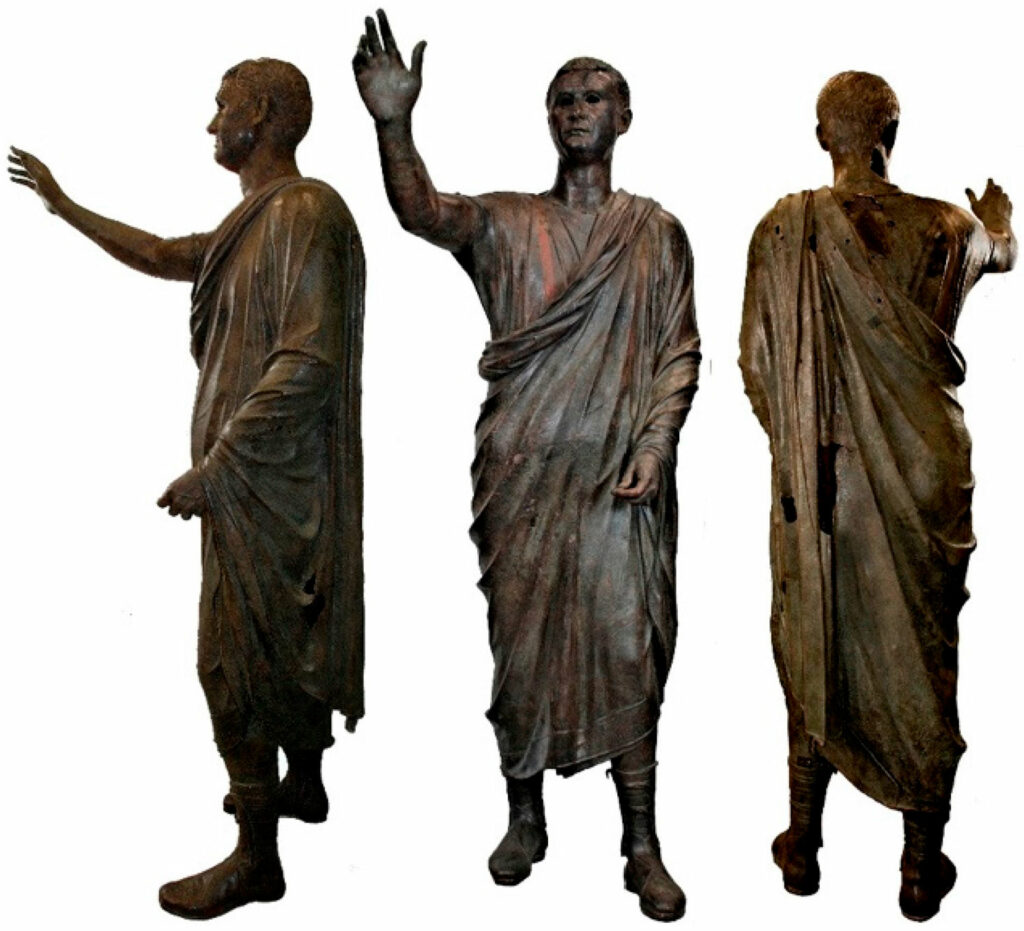


FLORENCE, ITALY—A bronze statue of an Etruscan man wearing a toga found in 1567 may have been deliberately turned black some 2,200 years ago, according to the Greek Reporter. Historical accounts of the discovery indicate that the sculpture was green when it was unearthed. It had been previously thought that the statue, known as the Arringatore (“Orator”) of Pila, turned black over time through a natural corrosion process. Conservators, including Salvatore Siano of the Institute of Applied Physics “Nello Carrara” and Sonia Mugnaini of the University of Siena, removed brown coatings on the statue, and found smooth, nearly black areas on the sculpture’s face, hair, clothing, and arm. The researchers analyzed 15 samples of these black patches with microscopy, X-rays, and Raman spectroscopy. They identified tenorite, a dark copper oxide, over a red layer of cuprite, another copper oxide, in several of the samples. These layers of patina are thought to have been produced by heating, although the scientists were not able to reconstruct the process. X-rays also revealed that the sculpture was assembled from eight hollow sections. Originally, it likely had glass-paste eyes as well, the researchers concluded. Read the original scholarly article about this research in the journal Heritage. To read about 14 Etruscan bronze sculptures recovered from a sanctuary site in Tuscany, go to “Sacred Spring,” one ARCHAEOLOGY’s Top 10 Discoveries of 2023.