

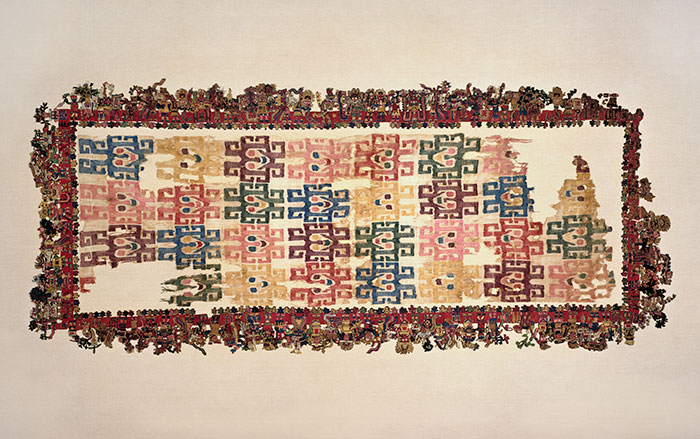
LIMA, PERU—Phys.org reports that the remains of an infant who suffered from cyclopia, a rare birth condition affecting the developing brain and facial bones, have been discovered in southern Peru at a Nazca cemetery dated to between A.D. 325 and 440. Elsa Tomasto-Cagigao of Pontifical Catholic University and her colleagues explained that most children born with the condition die before or soon after birth. The remains of this child were found in a ceramic vessel with the remains of another infant who did not have any skeletal abnormalities. Genetic analysis of the remains indicate that both children were girls, but they were not maternally related. The baby with cyclopia had a smaller than expected skull with a single eye socket in the center of the forehead, no nasal bones or nostrils, and the openings of her optic nerves had fused. Her shoulders were unusually curved, and two of her spinal bones were malformed. She also had an extra copy of chromosome 13, which could explain her rare developmental condition, the researchers concluded. Read the original scholarly article about this research in PNAS. For more on the Nazca culture, go to “Mapping the Past: The Paracas Textile.”
Remains of Two Infant Girls Found in Peruvian Nazca Cemetery
News November 12, 2026
Recommended Articles
Digs & Discoveries January/February 2021
Cat's Eye View

Digs & Discoveries September/October 2019
Partially Identified Flying Objects

Mapping the Past May/June 2019
The Paracas Textile
Digs & Discoveries November/December 2026
Moche Pottery Pros
More to Discover
Features November/December 2026
Kingdom of Fortresses
How diverse and far-flung Iron Age chiefdoms united to challenge the Assyrian Empire
-
Features November/December 2026
A Tomb of One’s Own
Life behind the scenes in Egypt’s Valley of the Kings
 © Matjaz Kacicnik/Project TT 217–The Tomb of the Sculptor Ipuy in Context (JGU Mainz, IFAO Cairo)
-
Features November/December 2026
Outfitting Viking Voyagers
In Denmark, archaeologists have discovered a massive factory that equipped an innovative fleet
 Moesgaard Museum
-
Features November/December 2026
Stone Age Stargazers
Did artists 12,000 years ago illuminate a cave in Tajikistan with their vision of the Milky Way?
 ˝© Nodir Tursun-Zade
-
Features November/December 2026
Unearthing the Outlanders
New discoveries challenge ancient prophecies about the peoples living on China’s borders three millennia ago
 Courtesy Shaanxi Provincial Institute of Archaeology