
(Courtesy the Ludwig Boltzmann Institute for Archaeological Prospection and Virtual Archaeology)
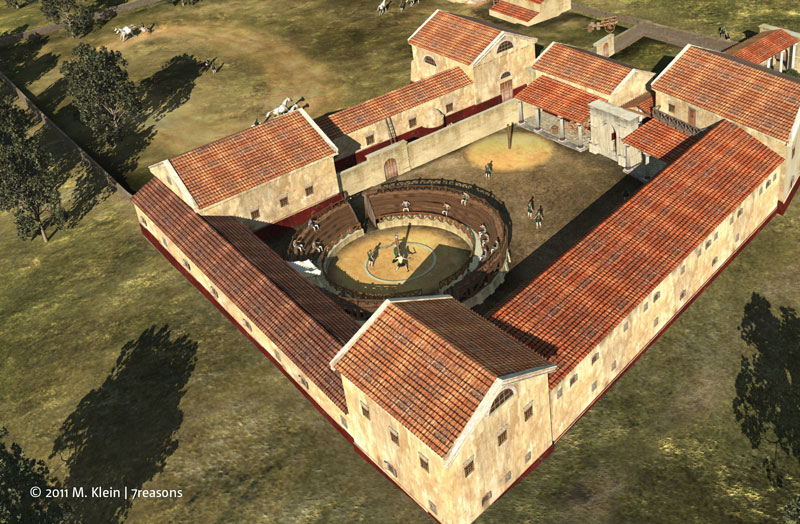
Ground-penetrating radar (GPR) technology has allowed an international team of researchers from the Ludwig Boltzmann Institute for Archaeological Prospection and Virtual Archaeology (LBI-ArchPro) to both identify a ludus (gladiator school) at the Roman city of Carnuntum in Austria and bring it before the public in an unprecedented way. What was once a vibrant city of 50,000 residents is now the site of an immense archaeological park. The newly discovered fourth-century A.D. gladiator school, the fourth largest ever found in the world, located just west of the largest amphitheater outside of Rome, is a self-enclosed complex that includes an inner courtyard, circular training area, living quarters, and a cemetery. The high-resolution images collected from the GPR survey show an under-floor heating system, bathing area, and walking paths within the complex. With the improved GPR technology developed by LBI-ArchPro, a complete picture of gladiator life is starting to emerge. Digitally re-created images of the ludus allow visitors to see how the school fit into the city's landscape, and it's possible to view them on a smartphone by using the free Wikitude World Browser software.