
The broad river valleys of northern France are renowned for having some of the most fertile soil in Europe. Farmers in this region, known as the Paris Basin, produce most of the country’s winter wheat, and the area is often called France’s breadbasket, or even Europe’s granary. This farming tradition stretches back to some 7,000 years ago, when farmers began planting and harvesting wheat in the Paris Basin at a scale their ancestors had likely never imagined possible. These farmers, who lived during the region’s Middle Neolithic period (ca. 4700

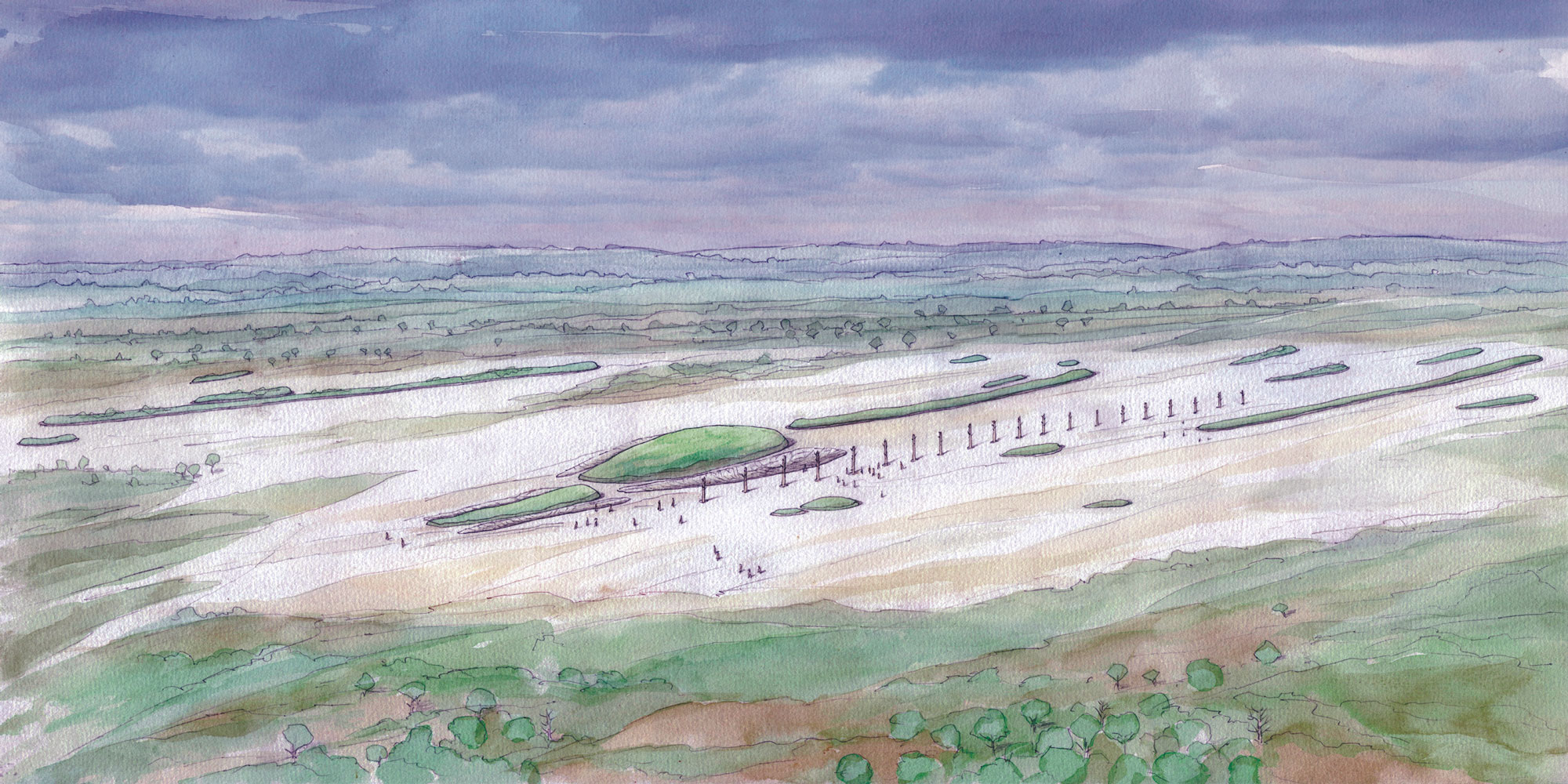
The Cerny people were, however, clearly capable of building large structures. Along the Seine and Yonne Rivers, and more recently at the village of Fleury-sur-Orne on the Caen Plain in Normandy, archaeologists have unearthed massive burial mounds dating to the Middle Neolithic period. First identified some 70 miles southeast of Paris near the village of Passy, these linear earthen mounds measure up to 30 feet wide and can stretch more than 1,000 feet long, the length of more than three football fields. “There are no hints of similar burials in earlier Neolithic cultures,” says archaeologist Philippe Chambon of the French National Center for Scientific Research. “They were a kind of creative and ideological explosion.”
Together with archaeologist Aline Thomas of France’s National Museum of Natural History, Chambon recently surveyed all the evidence to have emerged from these Passy-type tombs since they were first discovered in the 1980s. The researchers have developed a new understanding of the moment when Cerny farmers made the decision to start building these enormous structures. “Archaeologists were initially astonished at the scale of Passy-type tombs,” says Chambon. “We’re now able to contextualize the phenomenon and come to grips with it.”

Previously, scholars had assumed the tombs were solely built by descendants of pioneering Anatolian farmers who reached the Paris Basin by following the Danube River into northern Europe. Perhaps, some thought, these farmers absorbed the Mesolithic hunter-gatherers who lived in northern Europe before the advent of farming, and the result was a new ideology represented by the Passy-type tombs. By synthesizing data from archaeological excavations and incorporating insights gleaned from ancient DNA studies, Chambon and Thomas have developed a more nuanced picture of the people who built and were buried in the Passy-type monuments. Chambon notes that, even today, these are the largest funerary structures to have been discovered in Europe. “The question is,” says Chambon, “what were the ideas that motivated them to build these enormous tombs.”

Despite their size, Passy-type tombs have largely vanished from the visible landscape of northern France, having been plowed under by farmers in the millennia since they were constructed. But their traces remain in the soil. In the 1950s, archaeologists noticed long linear crop marks in aerial photographs of the Paris Basin. Lacking any context for the crop marks or knowledge of any comparable sites, scholars did not follow up on these first clues to a previously unimagined Neolithic landscape. In the 1980s, a team studying aerial photographs of the region noticed that a cluster of linear crop marks intersected with a gravel pit being dug outside the village of Passy. They took the opportunity to excavate the area around the crop marks. To the researchers’ surprise, they discovered that the crop marks traced ditches that had once marked the edges of Neolithic burial monuments. Some of these mounds still held remains of people whose prominent positions in the monuments suggested they must have held high status in their communities.

Archaeologists were quick to establish that the layouts of the monuments all hewed to a broadly similar pattern, despite varying in length. Most tombs found at Passy were oriented on an east-west axis, as were those at some 20 other sites where linear crop marks have revealed the existence of similar monuments. In the middle of many of the monuments, archaeologists found a man’s burial. In some cases, children were buried near the man’s grave, and women were interred at the periphery of the mound. “Men were the main characters in the tombs,” says Thomas. Sometimes the skeletons of other men were unearthed near the central burial. Archaeologists have found numerous arrowheads in these men’s burials that suggest they went to the afterlife outfitted as archers. Recent biomechanical analysis of some of these men’s bones has revealed that they do, in fact, show signs of stress consistent with the repetitive arm movements associated with archery. Because there is very little evidence of interpersonal violence during the Middle Neolithic period in the Paris Basin, it’s unlikely these archers used their arrows as weapons of war, and scholars doubt they were primarily warriors. “We think they were hunters,” says Chambon, “and that hunting was clearly being celebrated somehow in the Passy tombs.”

More evidence that Cerny farmers were focused on hunting has emerged in the form of the few artifacts, including tools and jewelry, that archaeologists have found in Passy-type tombs. These items were all fashioned from the bones or teeth of wild animals such as deer, bears, wild boars, and possibly wolves. One such necklace included deer teeth and what is likely a wolf vertebra carved into the shape of a bird’s head. Some of the most prominent men discovered in the tombs were buried with curious pointed objects archaeologists call Eiffel Towers because of their uncanny resemblance to the Parisian monument. All known examples of these particular artifacts were also carved from the bones of deer and other wild animals. Archaeologists still debate the meaning and utility of the Eiffel Towers. “Whether they were tools or had symbolic importance, we aren’t sure,” says Thomas.

Earlier archaeologists hypothesized that Passy-type tombs were built beginning around 4500 b.c. and were created atop the remains of the houses of the first Neolithic people to have arrived in the Paris Basin, just after 5000 b.c. Perhaps, reasoned scholars, the tombs were houses of the dead meant to memorialize or draw symbolic strength from their ancestors’ homes. Thus far, however, this seems to have been the case at only one site, a Cerny cemetery outside the village of Balloy, some 20 miles north of Passy.
The most recent radiocarbon dating of Passy-type tombs suggests they were actually first built as much as 200 years earlier than previously supposed, around 4700 b.c.—or possibly even earlier. Chambon notes that this means the tombs were built soon after the pioneer phase of the Neolithic expansion into northern Europe came to a close. After assessing the data archaeologists have collected from the Passy-type tombs, and considering it in the context of wider events in the Neolithic period, Chambon and Thomas believe the tombs were built soon after two different groups of farmers came into contact in northern France. The Cerny culture and the Passy-type tombs its members built were likely the result of this meeting of related peoples after each had completed a millennium-long journey across Europe.
The events that set in motion the phenomenon of the Passy-type tombs have their roots thousands of years earlier in the Near East’s Fertile Crescent. After the earliest farmers developed agriculture there around 9600 b.c., their descendants quickly spread out in all directions. One group headed west across Anatolia, reaching mainland Greece by about 6700 b.c. From there, farmers followed two separate routes across Europe beginning around 6000 b.c. One group traveled north, establishing farming villages along the Danube River and its tributaries, venturing into the heart of northern Europe. Called the Linear Pottery culture, after designs found on their ceramics, these farmers reached the Paris Basin around 5000 b.c. A second group of migrants is called the Cardial Ware people, after decorations on their pottery fashioned by imprinting clay with the shells of cockles, which belong to the Cardiidae family. These people moved west along the northern Mediterranean coast, settling Italy, Iberia, and southern France, before turning north. They appear to have arrived in the fertile lands of the Paris Basin at around the same time as their distant Linear Pottery relatives.
According to Chambon and Thomas, the meeting of these two cultures at the edge of the continent resulted in the development of a stratified agricultural society that placed a high priority on segregating genders and prized hunting wild animals. “These were new ideas for the Neolithic people in Europe,” says Chambon. While archaeologists have excavated relatively few Cardial Ware graves, those that have been found are quite modest in scale and feature men and women entombed together. Many more Linear Pottery burials have been excavated in France, Germany, and elsewhere in central Europe, and their contents suggest that these people, too, did not segregate the dead by gender. There is also little evidence for special burials of elite men among the Linear Pottery people. They may have had a hierarchical society with chiefs or other leaders, but archaeologists haven’t found burials reflecting this.

The Passy-style tombs are a dramatic departure from earlier Neolithic burials not just in terms of their scale, but in what they suggest about the beliefs of at least some people who lived in northern France in the Middle Neolithic period. Chambon notes that Neolithic farmers would not venture to the British Isles until 4000 b.c. For 1,000 years, the Paris Basin marked the northwestern extent of the Neolithic world. With no new lands beyond the horizon, perhaps limited access to prime stretches of what would become the breadbasket of Europe led to stricter hierarchies in Cerny communities. Perhaps a powerful class of rulers came to control this valuable farmland. “For some reason they generated a new value system,” says Chambon. The melding of two farming cultures separated for a millennium must have led to the development of innovative beliefs to sustain this new order. “They likely created a new religious universe,” Chambon says. He notes that hunting may have taken on prestige in a culture so focused on cultivating the best lands the continent had to offer. Studies of ancient DNA suggest that local Mesolithic hunter-gatherers contributed only a fraction of the Cerny people’s DNA, thus it’s unlikely the Passy-type tombs reflect much in the way of local Mesolithic beliefs. Still, the world of wild animals clearly fascinated the people buried in the Passy-type tombs and may have played a central role in the new hybrid religion that must have formed after the Cardial Ware and Linear Pottery people reunited after their 1,000-year separation.

The most recent Passy-type tombs to be excavated were unearthed at Fleury-sur-Orne in Normandy, some 200 miles northwest of Passy. There, a team led by Chambon and archaeologist Emmanuel Guesquière of the French National Institute of Preventive Archaeological Research identified 32 mounds of varying lengths, the longest of which stretched 1,200 feet. In the tombs, they found the remains of 19 Neolithic people. The team worked with archaeogeneticists to analyze the DNA of 14 of these individuals and found that one of the monuments held the skeletons of two men who were father and son. The pair was, however, unrelated to any of the other people buried at Fleury-sur-Orne, and researchers were unable to establish familial links among any of the other individuals buried at the site. Scholars believe that each mound represented a separate patrilineal clan.

One person stood out from the rest of the burials at Fleury-sur-Orne. The team’s analysis showed that a prominent individual interred at the site was a woman. She was buried with four arrowheads, a type of artifact that previously had only been discovered with elite men in Passy-type tombs. “The only woman there was buried with a symbolic male artifact, suggesting that some aspects of male identity were required to get access to the site,” says Thomas. No other women were identified in the tombs, and the team found no child burials or Eiffel Tower objects at the site. Thomas notes that, unlike at other Cerny funerary sites, sheep and goat bones were found in some tombs at the Fleury-sur-Orne cemetery. This could mean that the people buried there did not have the same single-minded ritual focus on wild animals as their Cerny neighbors in the Paris Basin. These finds suggest there was some degree of flexibility to the belief system associated with the Passy-type tombs.
However flexible it may have been, the Passy-type tomb tradition did not endure for long. “It only lasts a few hundred years,” says Chambon. “Ultimately, it was too extreme, and the tradition couldn’t go on.” It’s possible the power of the elite people who commissioned and were buried in the tombs faded for some reason, or that a different ideology arose to replace the one forged when the Linear Pottery and Cardial Ware people first encountered each other.
After Middle Neolithic farmers ceased building Passy-type tombs, the people of inland northern France began to bury their dead in small stone-lined chambers. On the Atlantic coast, including Normandy, farmers developed a new tradition of building megalithic tombs. These included passage tombs—stone chambers covered by cairns or earthen mounds that were accessed through long halls. The remains of many men, women, and children were commingled in these tombs, and unlike in the Passy-type tombs, no single individual dominated a particular monument. Neolithic farmers from northern France took this burial tradition with them when they moved to the British Isles around 4000 b.c. Genetic studies of people buried in some passage tombs in England and Ireland show that these graves held the remains of several generations of related people. At least for a time, it seems, the days of raising a single vast monument to glorify one patriarch were gone.