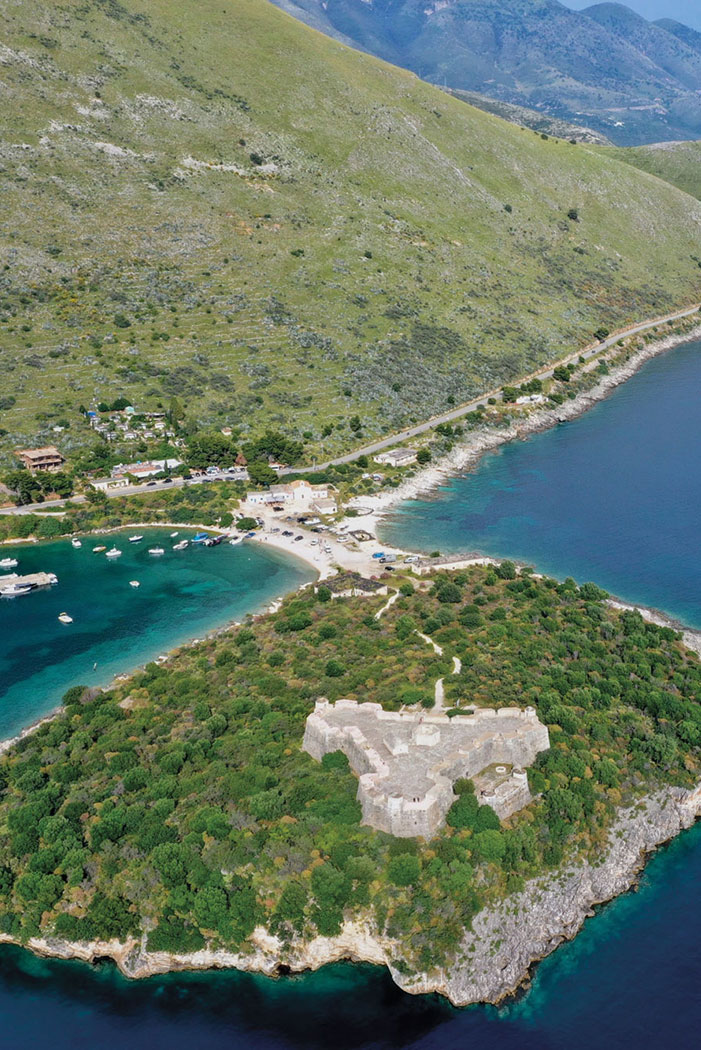
On a squat peninsula along southern Albania’s Ionian coast, Porto Palermo Castle, a three-sided fortress of neatly dressed masonry fringed with notches for cannons, commands the sea from nearly 100 feet above azure waves. A picture-postcard spot, the castle evokes its builder, Ali Pasha of Tepelena, the infamous conqueror of huge swaths of today’s Albania and Greece. It’s a popular stop for thousands of tourists who descend upon the Albanian Riviera in search of an inexpensive seaside lounge chair and an Instagram-worthy cocktail amid the aura of long-ago pirates and princesses. But on a mid-February afternoon, only a few curious travelers are poking around the castle with its seasoned caretaker, Aleksandër.
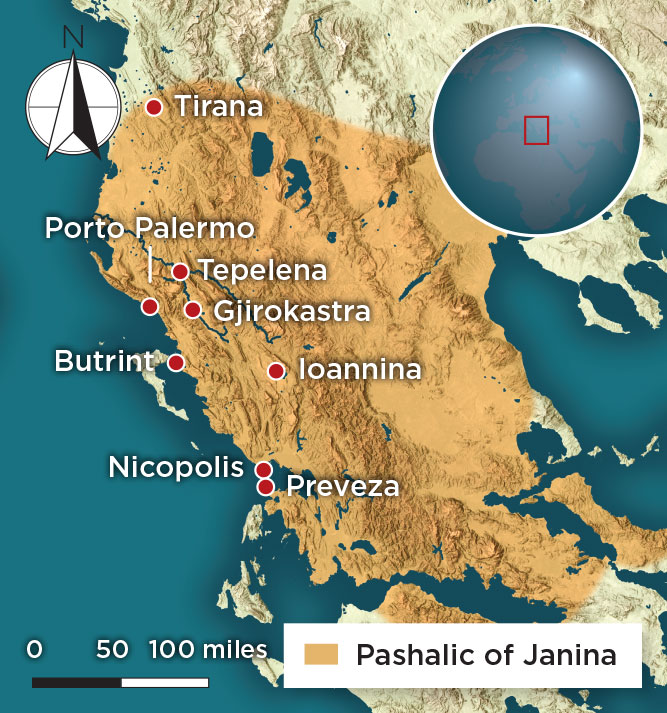
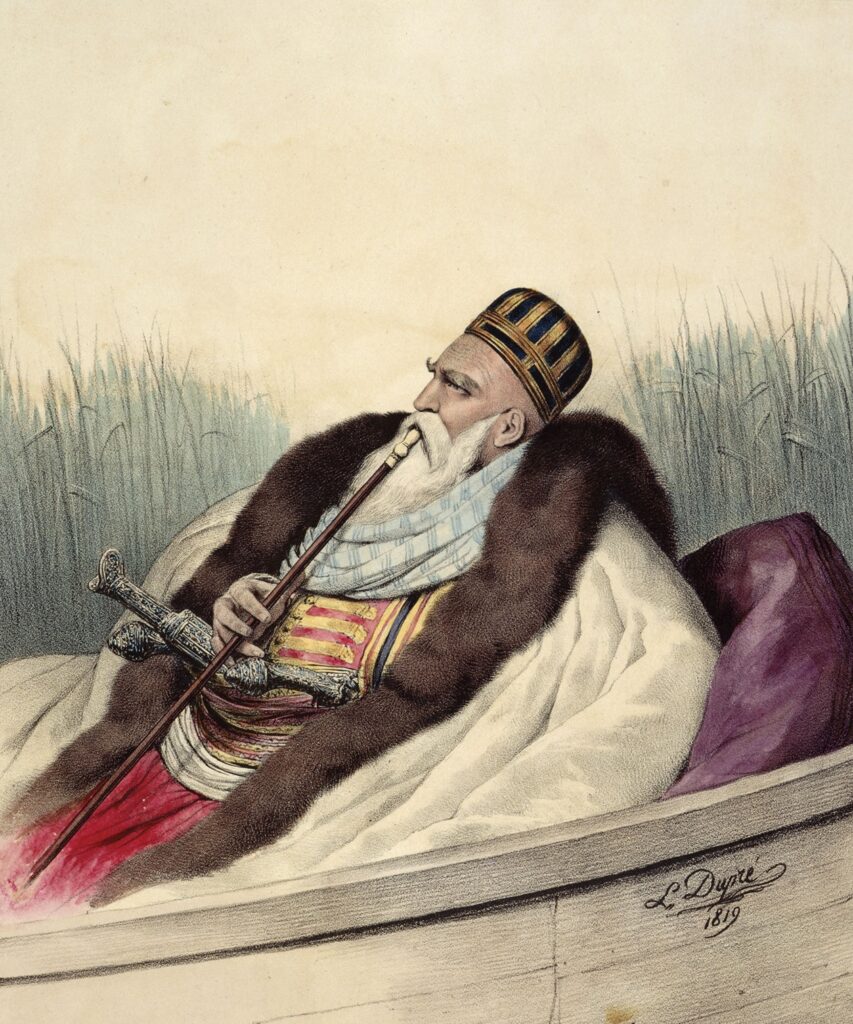
Ali Pasha ruled the Pashalic of Janina—now Ioannina in northwestern Greece—as governor from 1788 to 1822. He became a living legend across Europe and the Ottoman Empire for his battlefield tenacity, extravagant appetites, and inventive cruelties, a reputation he encouraged. With just a few charges today, Aleksandër has time to air the extended cut of his well-honed Ali tales. “In this room, Ali Pasha imprisoned tax evaders,” he says, pausing in a dank corridor pockmarked with holes where shackles were once mounted. “And this next one was the execution room, where he had them beheaded if they refused to pay up.” Just as the holidaymakers start to feel the clammy walls close in, Aleksandër presses on. “This well descended to a secret escape tunnel,” he says. “Ali Pasha executed all the castle’s engineers, so no one could leak the plans.” Or so claims Aleksandër. The visitors finally exhale in a more spacious barrel-vaulted room. Their enthusiastic guide explains that women from Ali’s travel harem took turns performing for the governor and his officers while they feasted here, with the most alluring dancer clinching the honor of overnighting with the Albanian pasha. Ali’s wife Vassiliki always won.
After the tour, under the dome of a hexagonal chamber, Aleksandër reveals a surprise: In 1983, he won the national championship for a style of traditional Albanian folkloric singing known as iso-polyphony. Troubadours of this genre composed odes, ballads, and dirges about Ali Pasha and his exploits both during and after his time. The caretaker sings one here, in the heart of the castle. It’s called “Aman Mike, Aman Nure,” or “Oh My Friend, Oh My Enemy.” One easily imagines the anonymous bard had tried to keep his name in Ali’s friend column.
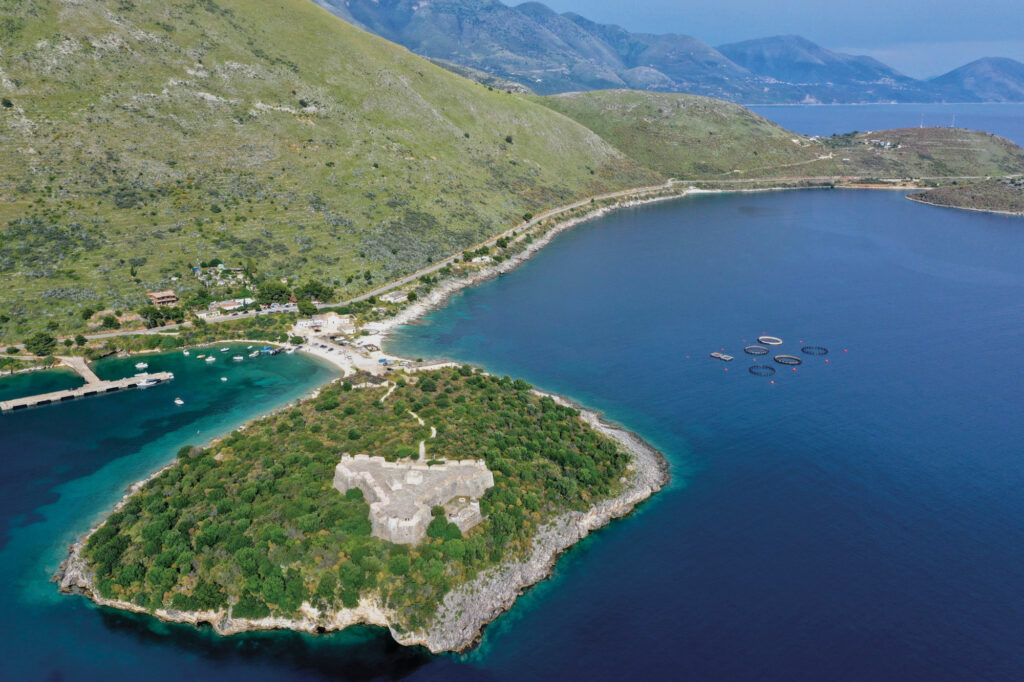
Porto Palermo Castle was built sometime between 1804 and 1814 and is just one of at least 11 coastal fortresses Ali Pasha established along the Ionian seafront. At the height of his power in the 1810s, the Pashalic of Janina stretched south from central Albania through Greece’s Peloponnese and from the Ionian to the Aegean Sea. Ali was an Ottoman governor who, at least nominally, answered to the Sublime Porte, or central government, in Istanbul. Always one to make up his own rules, however, Ali enacted bespoke legal and tax systems, which were tailored to the 1.5 million Greeks, Albanians, and Turks making up a patchwork of Christians, Muslims, and Jews under his authority. Independent of the Ottoman sultan, he engaged in diplomacy, trade, and even occasional armed conflict with Europe’s great powers, such as France, Britain, and Russia. Across his domain, Ali built simple forts, towering citadels, palaces, roads, bridges, causeways, aqueducts, drainage systems, schools, libraries, Sunni mosques, Sufi houses of worship, and Orthodox churches in a 15-year frenzy of stone and timber. Among his works, Porto Palermo Castle is rare in one respect—it’s intact. Most of Ali’s whirlwind of construction lies in ruins.
But ruins can tell stories, and they’ve inspired archaeologist Luan Përzhita to undertake a project nearly as ambitious as Ali Pasha’s building program. In 2022, Përzhita set out on a mission to document, survey, map, and excavate all of Ali’s surviving sites in Albania. Përzhita, the former director of the Albanian Institute of Archaeology, has been joined in this undertaking by his archaeologist son, Ardit, and they are using the latest tools to reconstruct a realm spanning more than a dozen sites and structures across the southern half of the country. Under the aegis of Arkeo, a private archaeology firm founded by Ardit, the Përzhitas aim to establish a complete stratigraphy of the sites in Ali Pasha’s territory, tracing their transformation from ancient to medieval to pashalic times.
In the mid-1960s, Albania suffocated under Communist dictator Enver Hoxha. At this time, Gjerak Karaiskaj, then a young draftsman at the Institute of Cultural Monuments, was tasked with identifying and designating historic sites to be officially protected. Surveying and measuring everywhere he went, Karaiskaj was, in effect, the first archaeologist to formally study and map most of Ali Pasha’s castles in Albania. “Working for a mostly apolitical agency was a privilege,” says Karaiskaj, “but due to the extreme isolation of Communist Albania, there was no way to obtain necessary literature or visit similar monuments outside Albania.”
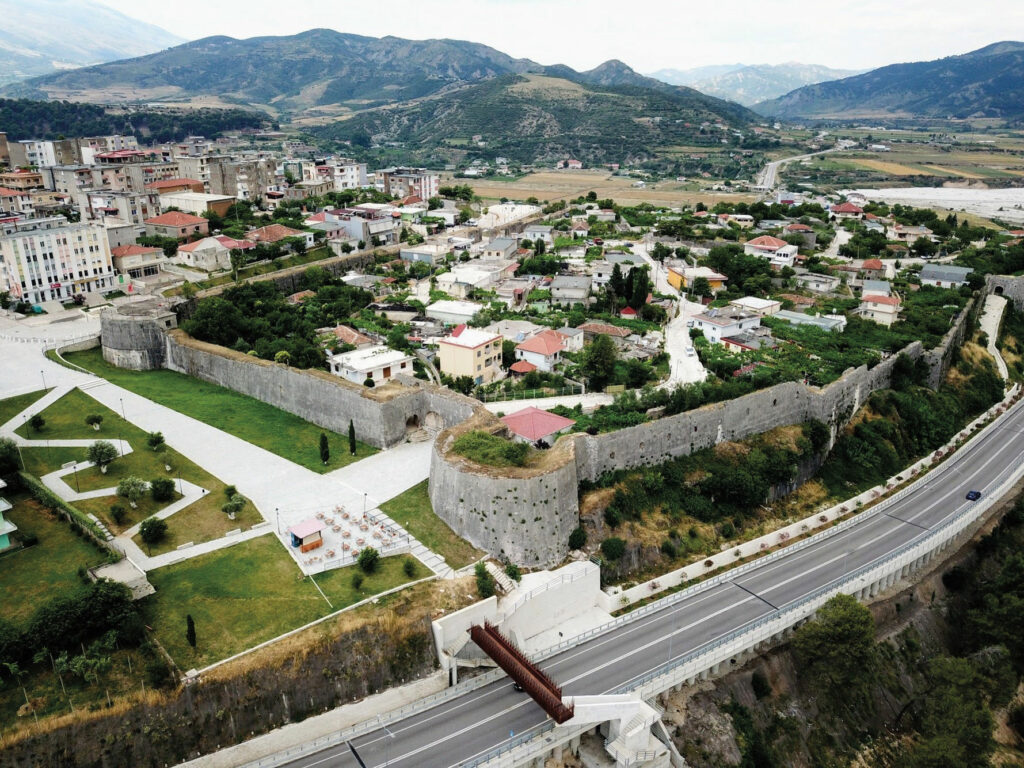
Nevertheless, Karaiskaj made some important observations about Ali Pasha the builder. Some of the governor’s fortresses were purpose-built to menace cities he coveted. From one fortress, troops could harass Gjirokastra, the wealthy population center of the Drino Valley, two miles away. When Ali took Gjirokastra in 1811, he overhauled its magnificent ship-shaped citadel, which had existed there for centuries. In his reimagining, some of its towers stood nearly 100 feet tall, and some walls were 11 feet thick. Other castles that Ali built appeared to Karaiskaj to be mostly residential.
By the late 1970s, Karaiskaj had amassed enough material to write his magnum opus, 5,000 Years of Fortifications in Albania. As they did with all books, government censors combed through it before publication—and very nearly shredded it. But when the definitive work saw the light of day, it provided a blueprint for up-and-coming archaeologists, including Luan Përzhita. Like Ali Pasha, the Përzhitas must work quickly. New development, neglect, and the erosive effects of centuries threaten many of the sites. Step one, a full survey and digital documentation of each site, is well underway, and the results are inspiring intriguing new interpretations of Ali Pasha’s reign and works.
Twenty miles northeast of Porto Palermo, the landscape of Tepelena is all crags, peaks, and gorges in shades of sienna, pine, and slate, riven by the Vjosa, Drino, and Bënça Rivers. Where they meet, the rivers carve out a bluff, atop which sits the town of Tepelena, birthplace of the future pasha.
Ali’s path to power was neither guaranteed nor straightforward. He was born in around 1750 to local chieftain Veli Bey and his wife Esmihan Hanëmi, but Veli died when Ali was young, leaving the family highly vulnerable. From the 1770s through the 1790s, Ali and his men fought both alongside and against Albanian pashas to the north and Greek backcountry clans to the south. Ali secured his base in the city of Ioannina and widened the scope of his imperium slowly, via handshakes and massacres. As he extinguished and lit fires around northwestern Greece and southern Albania. Ali kept a watchful eye on his borders, just beyond which much larger empires were slugging out Europe’s new geopolitical order. In 1797, French forces claimed the enclaves of Butrint and Preveza. With that, Napoleon’s army was at Ali Pasha’s doorstep.
In 1798, Ali saw an opening to attack the French at Butrint and Preveza simultaneously. Perched above the site of ancient Nicopolis, the “Lion of Janina” supervised the battle for Preveza from roughly the same spot where Octavian, the future emperor Augustus, had watched his ships rout Mark Antony at the Battle of Actium 1,828 years earlier. Amid the ruins of Nicopolis, Augustus’ “Victory City,” Ali Pasha’s soldiers delivered the same humiliation to Napoleon. Within a few years, Britain sent a consul directly to Ali Pasha’s court, as did France.
As Ali expanded his pashalic, his architects got to work. The pasha was unquestionably a great warrior, but his bold and heterodox constructions are emblematic of a leader who devised a strategy for defending, enlarging, and enriching a new Balkan polity. “He was passionate about building and rebuilding, and that’s very attractive for an archaeologist,” says Luan Përzhita.
“You have to look at it through a lens of power, because I think that’s ultimately what Ali Pasha’s trying to telegraph in all his monuments,” says historian Emily Neumeier of Temple University. “They not only represent who Ali Pasha is, but who Ali Pasha wants to be. They represent ambition.”
Once western European powers began courting Ali Pasha’s favor and sending envoys in the first decades of the 1800s, he gained access to the expertise of French, Italian, German, and British architects. His castles, with their many-sided bastions, inclined ramparts, and geometrical plans, look less like imperial architecture in Istanbul and more like Venetian, Prussian, or French fortresses, specifically those of the Marquis of Vauban, the military engineer to Louis XIV (reigned 1643–1715). Vauban’s designs were still the gold standard, and Ali had to have that.
The pasha could be an overbearing boss on the construction site. When a French engineer at Preveza presented him with plans for a fortress to protect the entrance to the Ambracian Gulf in 1807, Ali scrutinized them with dismay. Why weren’t the towers cleanly geometric, like a proper castle? And why did the engineer insist on putting this misshapen thing up on a hill instead of right on the shore, where everyone could get a good look at the pasha’s firepower? The engineer’s design may have been strategically sound, but it failed on style points. “You can imagine him saying, ‘Didn’t you learn about Vauban? What is this crap?’” says Neumeier. “Ali Pasha clearly had his own idea of what something should look like if you wanted to impress people. He was the ultimate showman.”
With his chief architect, an Albanian named Petro Themeli, usually at the helm, Ali built up his dominion in a distinctive style. “He always used a combination of Western and Eastern architecture,” says Luan Përzhita. Appearance was a calculated consideration, infrastructure was cutting-edge, public needs were satisfied—and no one could mistake who’d paid for it all.
The Përzhitas launched their operation with fresh surveys of Tepelena, beginning where Ali Pasha had. Tepelena Castle, Ali’s northern headquarters, was built and renovated between 1800 and 1819. Today, it stands as both a marvel of engineering and a faded reminder of a storied past. The castle’s ramparts are eight to 16 feet thick at the base, clad in strictly aligned, smooth-cut stonework, with behemoth polygonal towers. Two centuries ago, those admitted to the castle through its monumental south gatehouse crossed a drawbridge and entered a fortified portal with a soaring barrel-vaulted ceiling. They then proceeded to the courtyard of the palace, where they found an opulent seraglio, gardens, a mosque, and living quarters for the pasha’s retinue. The English poet Lord Byron, who met the pasha at the palace in 1809 when he was on his Grand Tour, was dazzled by the flurry of activity he encountered. He describes Albanians, Turks, and “Tartars” in their finery, as well as African slaves, “two hundred steeds ready caparisoned to move in a moment, couriers entering or passing out with dispatches, the kettle drums beating, boys calling the hour from the minaret of the mosque.”
Today, the grand gatehouse is frequently graffitied and virtually nothing of the palace survives. Houses and streets occupy the 10 acres inside the citadel walls, a major obstacle to archaeological investigation. On a sign that announces planned “revitalization and improvement” works, the projected date of completion reads 2024, but the 4 is smudged out and a 6 is scrawled over it. Unlike Porto Palermo Castle, Tepelena is not a popular tourist stop.
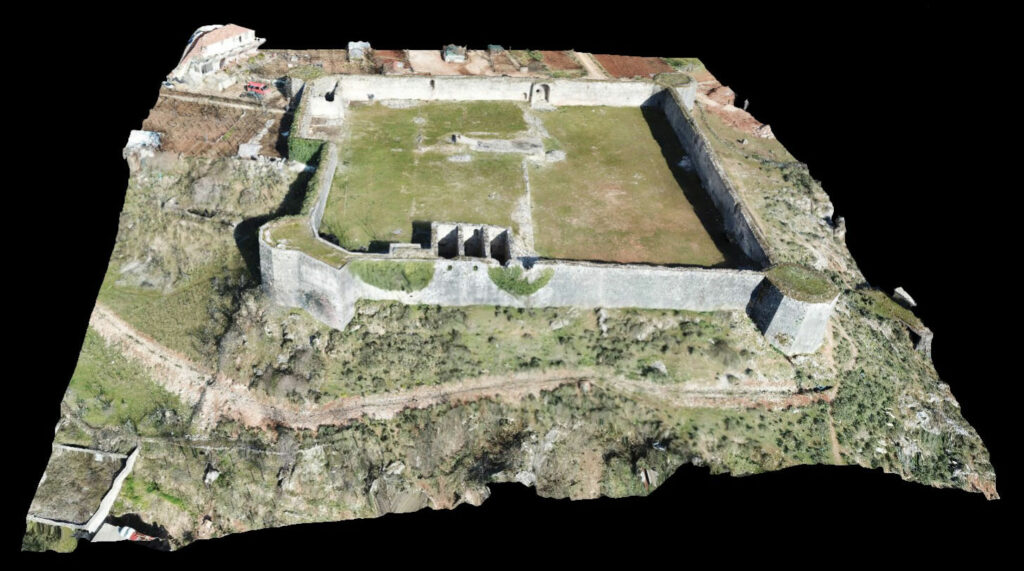
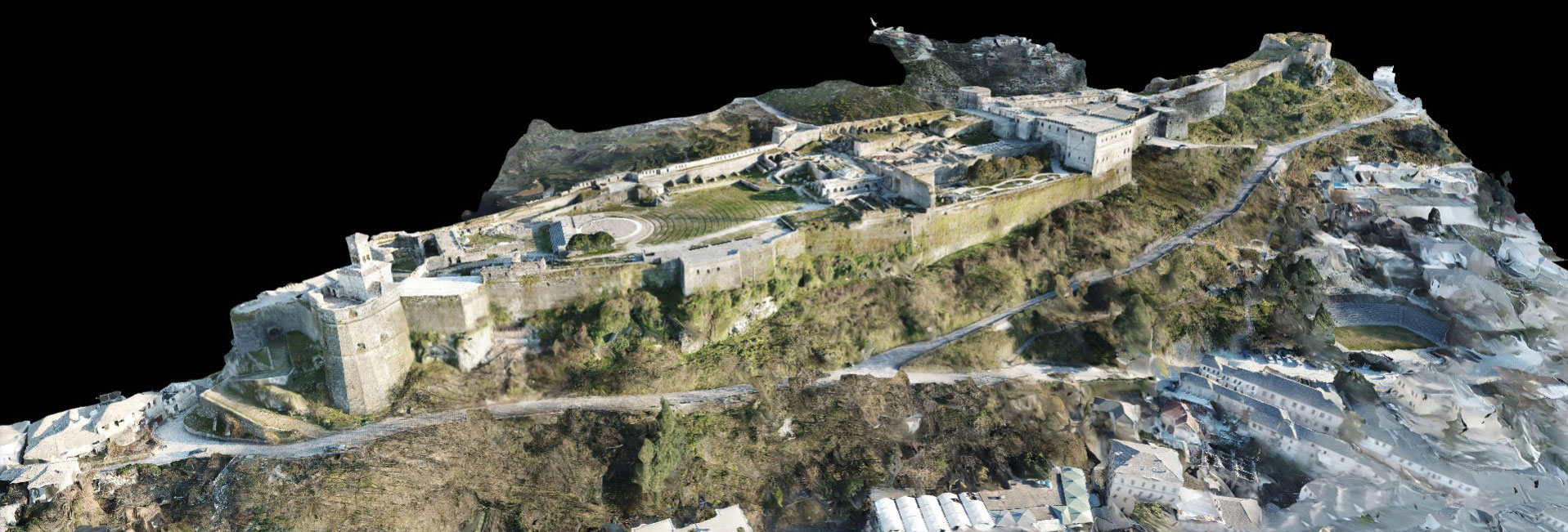
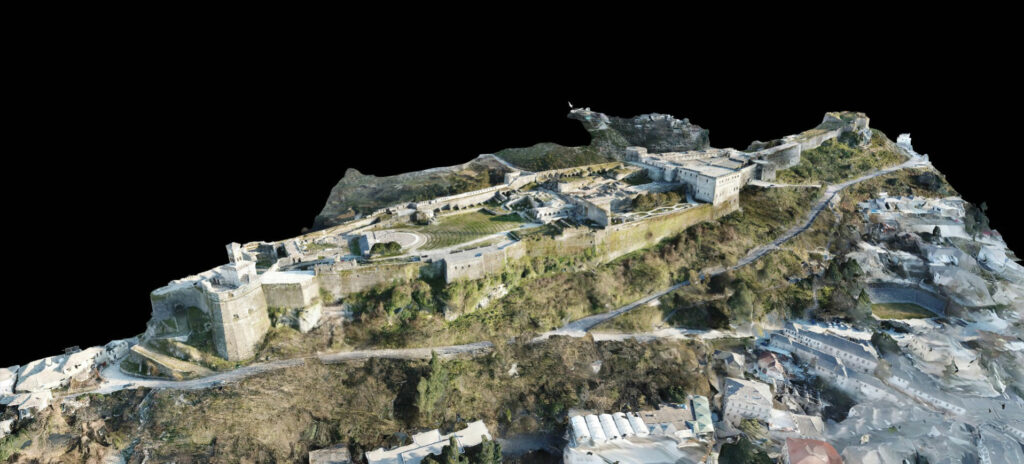
At a site such as Tepelena, archaeologists need advanced tools and technologies to penetrate the centuries, and the first phases of research have turned up some surprises. Using a drone to take thousands of photos and create lidar maps, the Përzhitas have started digitally reconstructing Tepelena Castle. These photos are now being assembled to create extremely high-definition 3D models. With these models, Luan Përzhita has identified the outline of a much smaller, older castle, now covered by both the citadel’s ruins and homeowners’ gardens. The hodgepodge of brick-and-stone masonry of one wall remnant suggests that the structure was probably built in the late thirteenth or early fourteenth century, but perhaps as early as the twelfth. Below the medieval castle, Përzhita speculates, lies a Roman castrum, or fort. “Maybe,” he says.
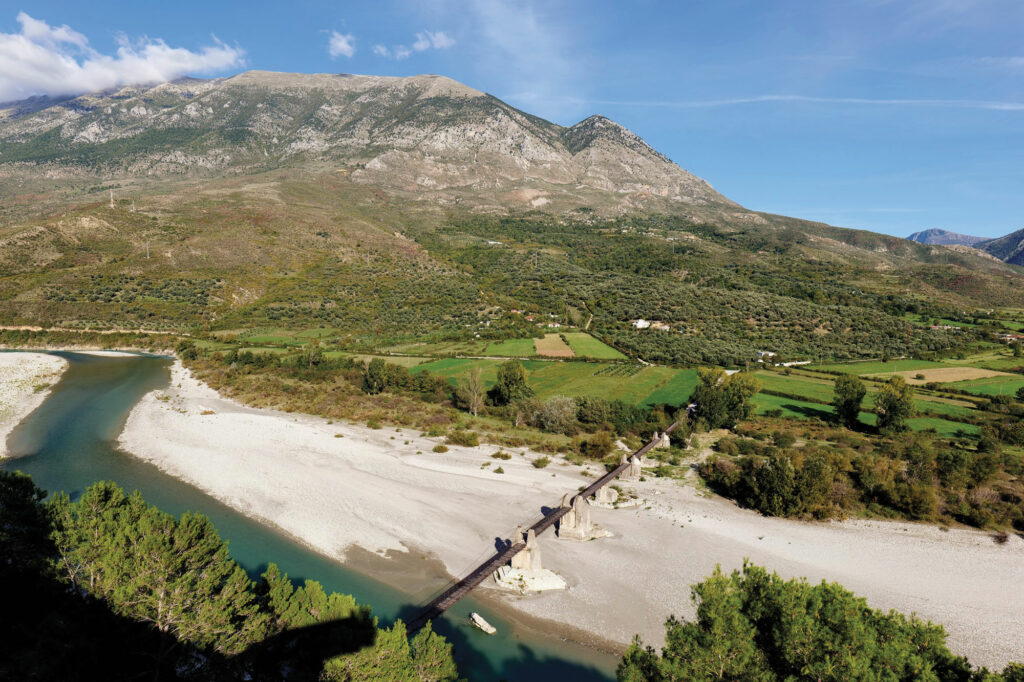
It’s a strong maybe, though. A nearby bridge spanning 850 feet above the Vjosa River has Roman foundations. The bridge, Përzhita thinks, was part of a north-south branch of one of the largest Roman roads, the Via Egnatia, which, in this part of the empire, ran from the city of Aulon—now Vlora, on the Albanian Adriatic coast—to Nicopolis. Ali Pasha revamped this bridge and others on the Vjosa as part of his extensive road network, which he made a point of traversing in an Italian-made horse-drawn carriage to emphasize the smoothness of the highways he built through the region’s jagged topography.
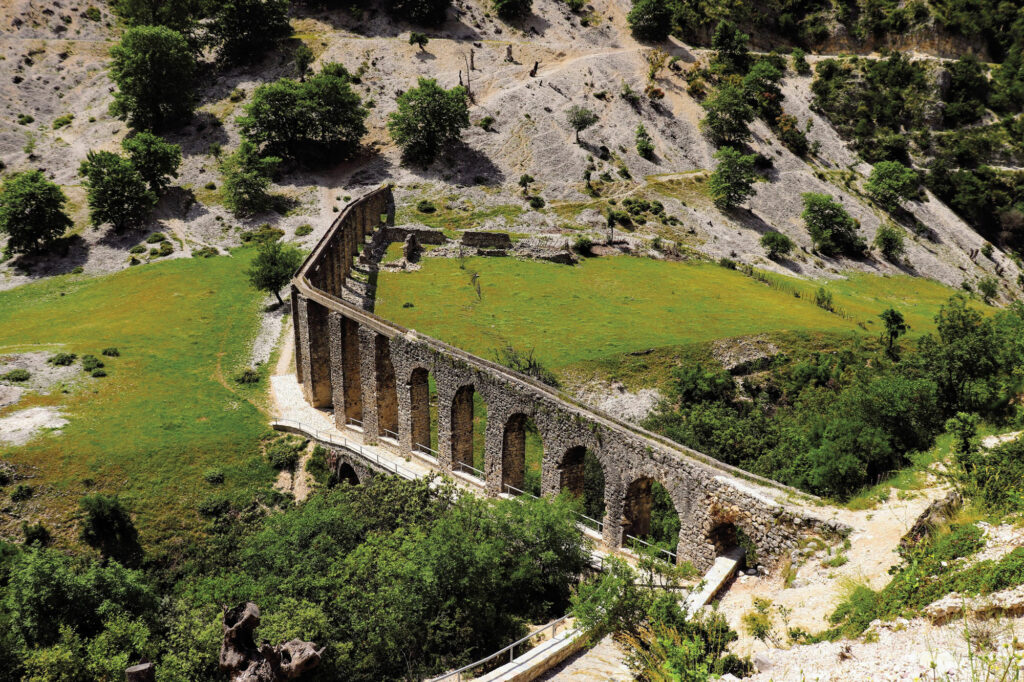
Perhaps the most ingenious of Ali Pasha’s civil engineering feats were his aqueducts. He constructed dual-purpose aqueduct-bridges in the region, and the one that served Tepelena remains in relatively good condition, an evocative centerpiece for the cloud-shrouded Bënça River Gorge. Përzhita believes there was a second, secret water source from a hidden well in case besiegers poisoned the primary one. Road construction in 2021 unearthed large clay pipes from Ali’s hydraulic system, a discovery that helped Përzhita trace the flow of water from its source to the valley and up to the city.
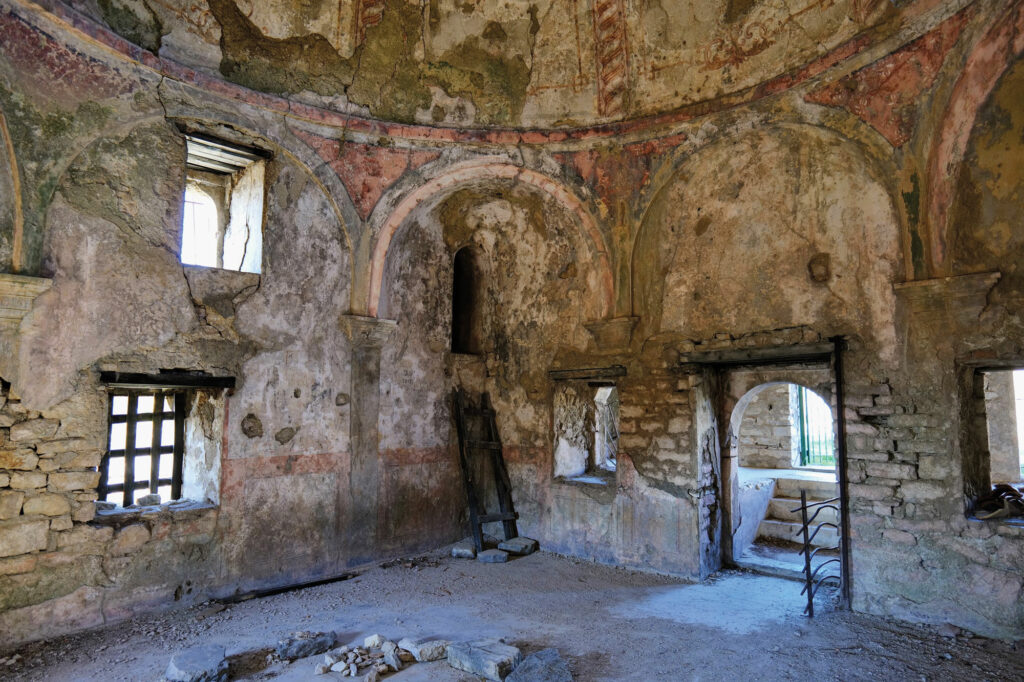
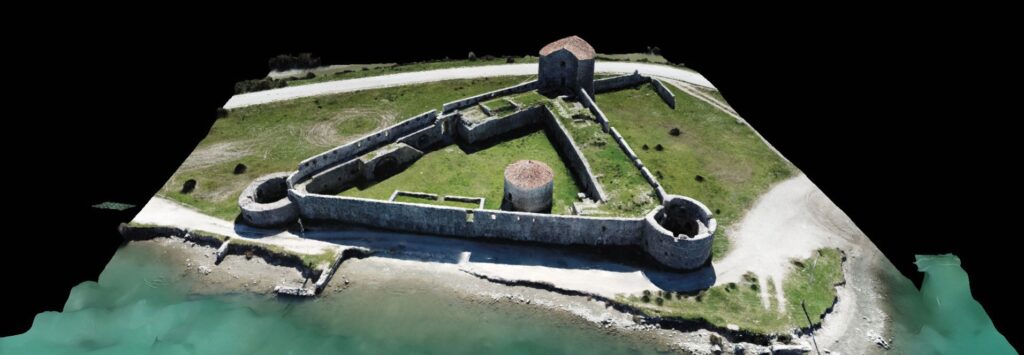
An orderly bookshelf dominates the Arkeo office in eastern Tirana, and more than a few volumes were authored or edited by Luan Përzhita over his 45-year career. But his and Ardit’s latest work is displayed on a computer screen. With a few clicks, Ardit hovers over the Triangular Castle across the Vivari Channel from Butrint. When Ali Pasha conquered the city, its modest fort was centuries old and badly damaged and had been made redundant by another fortification. Yet for some reason, Ali chose to renovate it. Ardit zooms in on the 3D model on the screen to reveal how a three-story roofed tower was grafted onto older walls. The tower boasts a sizable fireplace, and, in the bailey, a one-room cylindrical building closely matches the tower’s style. It, too, is a later addition that Luan Përzhita thinks served as a mosque. It seems that Ali Pasha refurbished the castle as a residence.
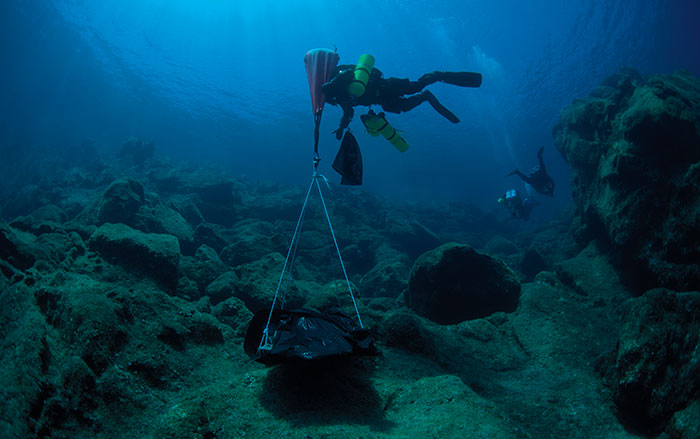
As their work progresses, the Përzhitas will use a drone for thermal imaging, allowing them to see buried foundations. Stone typically absorbs and stores more heat than soil, a difference the sensor can detect. Government funding for their research is hard to come by. “Albania has other priorities,” says Luan. “There’s a saying here: ‘When you are busy painting your house, you cannot read a book.’”
At least one Ali Pasha site may get priority for research funds, though. In Gjirokastra, 16 miles south of Tepelena, Ali’s storybook citadel crowns a promontory 500 feet above a warren of cobblestone streets and a historic bazaar district. In 2024, 263,000 visitors climbed to the citadel, the second record-breaking year in a row. It’s a gargantuan, unwieldy structure, and signs of strain are tough to spot. The Përzhitas can position their drone close to a wall and pinpoint where medieval construction transitions to early Ottoman building and then to Ali Pasha’s renovations. They will also be able to see how the citadel’s walls change over the years ahead, monitoring for erosion, fissures, or other emerging weaknesses.
By the 1810s, amid the rapidly shifting alliances and chaos of the Napoleonic Wars, Ali Pasha was plotting his endgame: leave the Ottoman Empire and create an independent state. Conveniently, Lord Byron ignited Albania mania and a fashion for all things Ali Pasha in western Europe around this time, with the fictionalization of his travels in the epic poem Childe Harold’s Pilgrimage. Other young aristocrats made their own pilgrimages, some calling themselves antiquarians and excavators. The gold rush era of mercenary archaeology had come to Ottoman Greece, and Ali Pasha wanted a piece of the action.
Sculptures and columns translated into hard cash, of course, but to achieve his greatest ambition, Ali needed broad buy-in for the idea of a shared identity, or at least political unity, among his motley subjects. He had already proclaimed himself the spiritual heir and direct descendant of King Pyrrhus of Epirus, who ruled the region for most of the period between 307 and 272 b.c., and Ali imagined that digging up the area's past could burnish his bona fides.
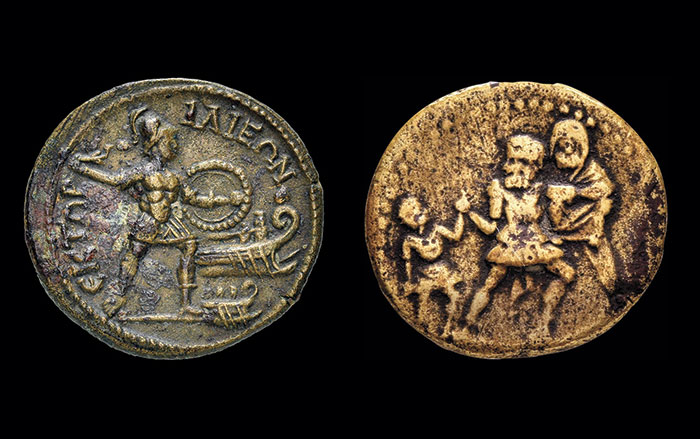
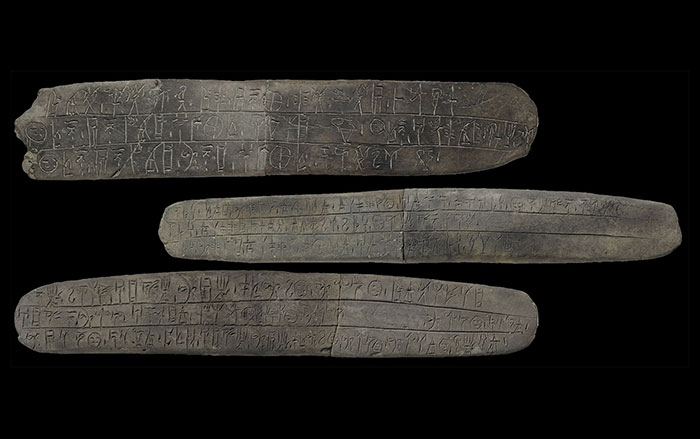
“His excavators have discovered a very fine bust of [the Roman emperor] Trajan,” an English visitor to the Preveza seraglio noted; another spied a marble head of Alexander the Great. A Danish archaeologist, Peter Oluf Brøndsted, paid a visit to Ali Pasha in 1812 and found himself obliged to survey Nicopolis with his new friend. Brøndsted recounted that a team of diggers appeared at Ali’s beckoning—the day’s haul would be three ancient marble slabs and two Roman medallions. “The [pasha] gave me the last, and pocketed the other himself, laughing at this augmentation of his treasury,” Brøndsted wrote. Ali’s son Veli Pasha apparently took up archaeology with genuine gusto, directing excavations at the Bronze Age sites of Mycenae and Argos in Greece’s Peloponnese.
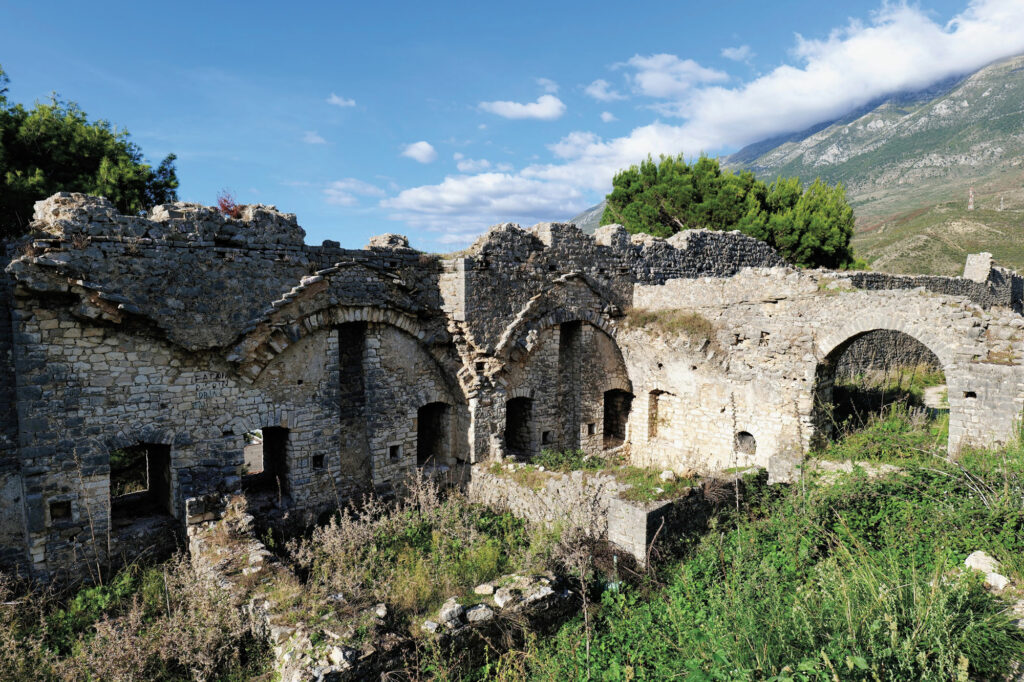
Ali’s continuing incursions, extortions, and executions of rivals within the Ottoman Empire, however, made him a headache for Sultan Mahmud II (reigned 1808–1839). His blatantly roguish behavior and 80,000 soldiers made him a threat. In 1820, the Sublime Porte found—or created—a premise to declare Ali Pasha an outlaw, alleging that he had tried to have a politician in Istanbul assassinated. For two years, Ali ruled in open rebellion, his castles finally seeing action against the Ottoman army after three decades of waiting. But, by 1822, Ali, now in his 70s, had few friends and many enemies. In a monastery near the city of Ioannina, he is said to have made one last stand in a dramatic shootout—or, perhaps, he was betrayed and stabbed.
The sultan’s agents quickly destroyed as much of Ali Pasha’s built legacy as they could. His seraglios were looted and burned, and inscriptions proclaiming his power and patronage were torn down. “This was a very clear damnatio memoriae,” says Neumeier. Most of Ali Pasha’s buildings were in ruins within a century of his death.
The Ottomans found that revolution was a bell they could not unring, says historian Irakli Koçollari of the Academy of Sciences of Albania. Following the Greek War of Independence, which lasted from 1821 to 1829, former members of Ali Pasha’s court became prominent intellectuals, bankers, and even a prime minister in the new Greek state. Schools founded in Ioannina with Ali’s support educated many of the leading figures in the Albanian National Awakening of the late nineteenth century. The ideas they imbibed and then spread about common identity, religious coexistence, and the importance of literacy set the table for Albania’s foundation.
Luan Përzhita is a scientist, and he speaks modestly. But he and his son have taken on an enormous endeavor to decipher and safeguard a constellation of sites belonging to an era and a figure that defy easy narratives. “I think the Ali Pasha project will contribute to the understanding of Albanian tradition and cultural heritage,” he says, providing a new text for educating the next generation about the history of this place. “A place that they are a part of,” says his son Ardit. Ali Pasha was a pooh-bah and a pain, a yarn spinner who bent reality to his vision through his sprawling works. He’s inescapable, even two centuries later, in the stones and songs of the Albania he shaped.
Slideshow: An Ottoman Ruler Reimagines his Realm
From 1788 to 1822, Ali Pasha of Tepelena ruled large swaths of what is now Greece and Albania as the regional governor of the Ottoman Empire. His reign was marked by his prowess on the battlefield and his love of luxury, but also for the enormous building campaign he initiated across his lands. This included restoring or building dozens of castles, schools, mosques, palaces, and aqueducts, to name just a few of his projects. After his death, Ali Pasha loomed in the Albanian imagination more as an insatiable conqueror than as a relentless builder, in part because many of his finest works were erased or degraded over the centuries. What’s left has given archaeologists enough to begin reconstructing the pasha’s achievements.