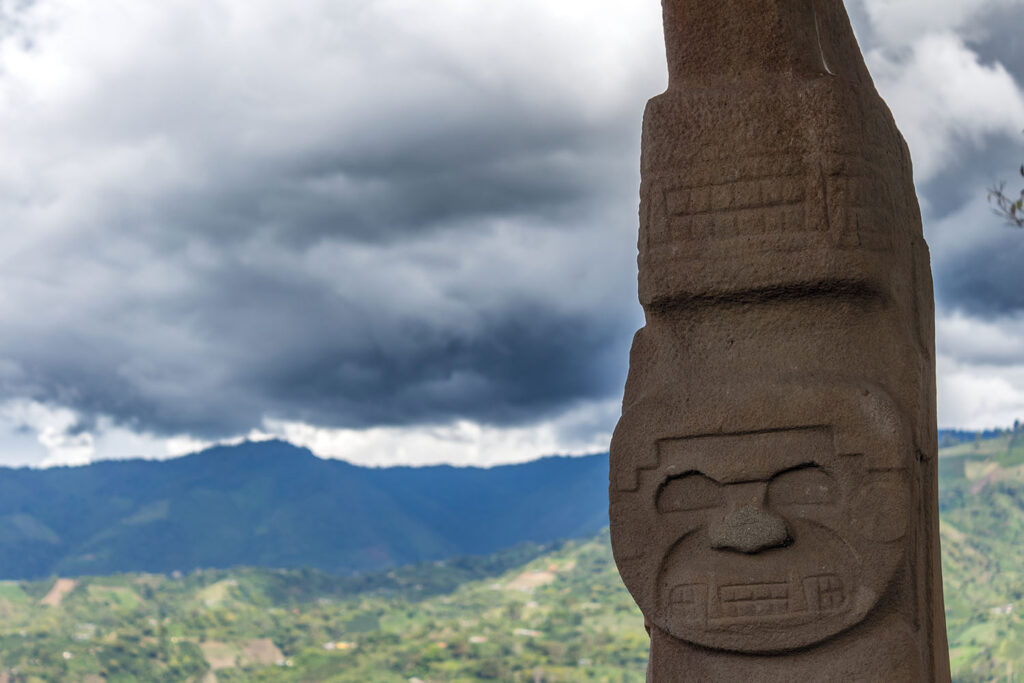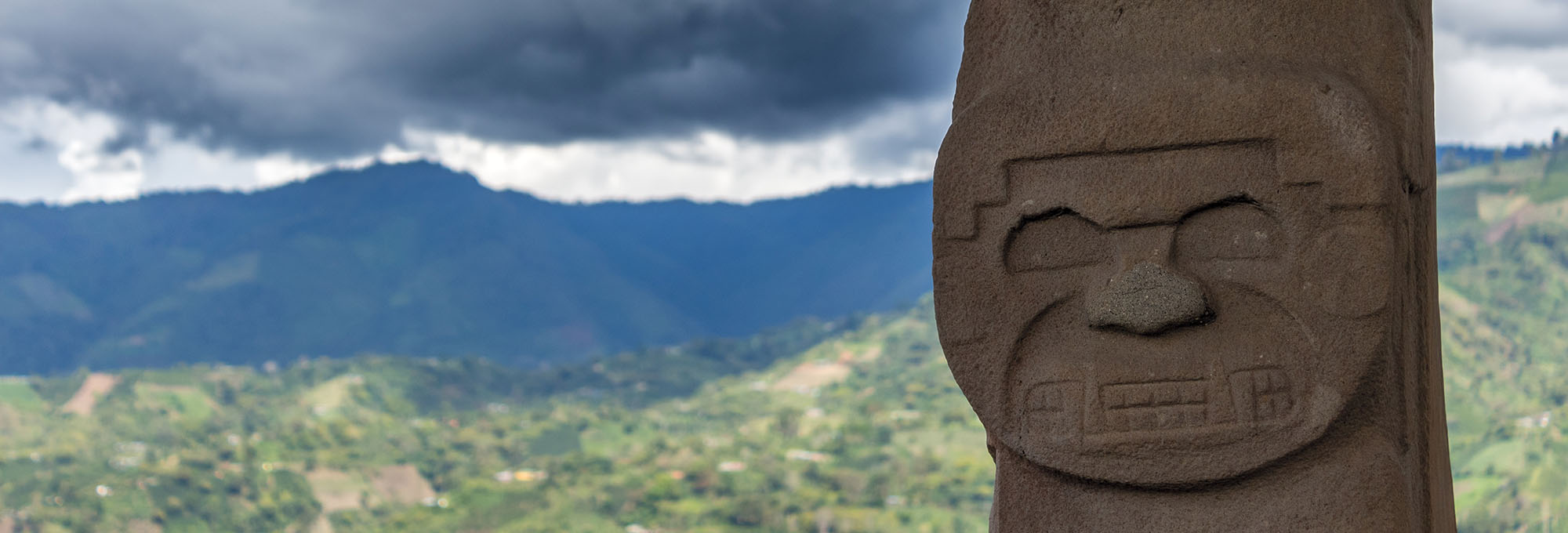
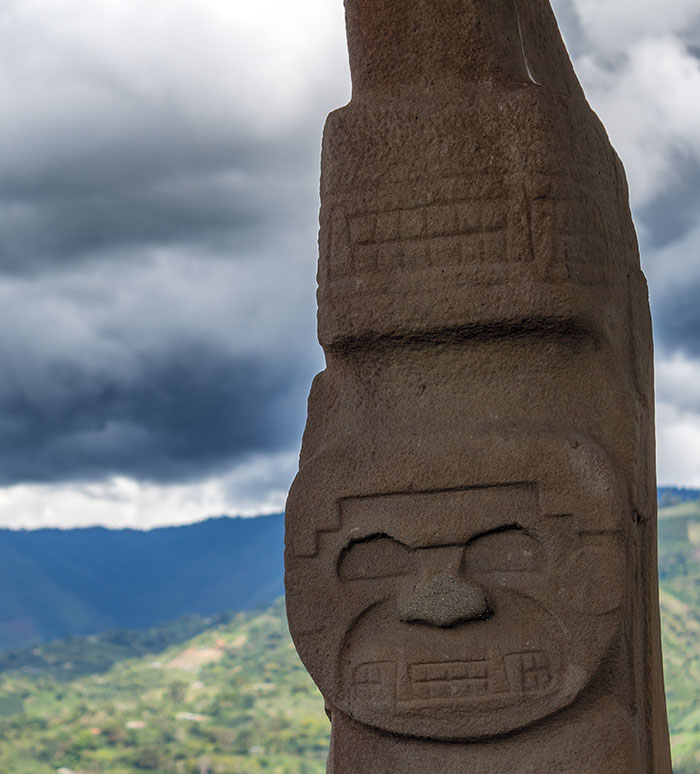
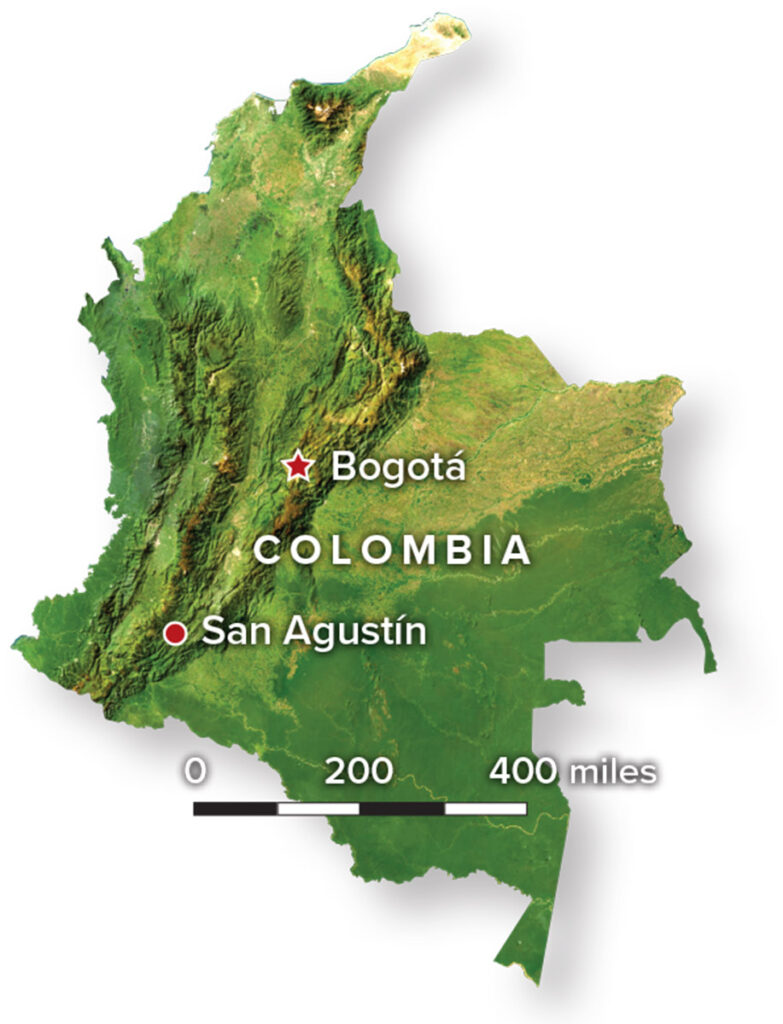
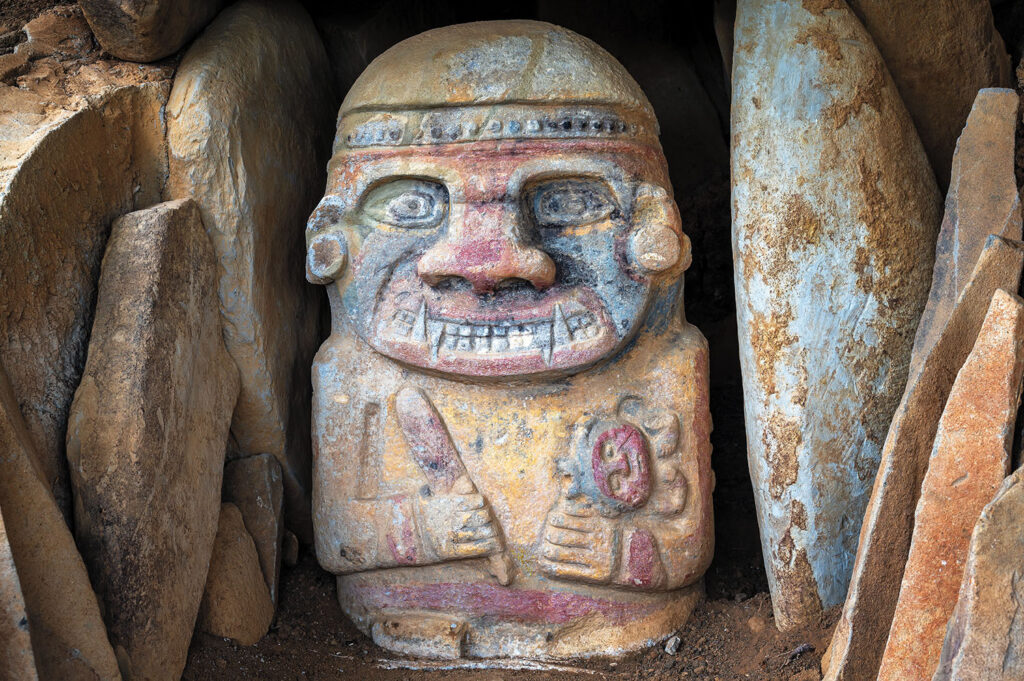
In the valleys of the Andes in southwest Colombia, people began carving large sculptures from volcanic rock around 2,000 years ago. Most stand five to nine feet tall, and many depict fantastical hybrids of humans and animals including jaguars, monkeys, snakes, caimans, vultures, and eagles. These statues were placed next to or inside stone chambers within funerary mounds in settlements where the people of the San Agustín culture lived. This culture’s artists produced their finest work in the first millennium a.d. More than 400 of their statues are known to exist, and no two are alike.
The San Agustín people had no written language, so archaeologist César Velandia of the University of Tolima endeavored to understand the meaning of the statues by consulting modern Indigenous Colombians. Velandia frequently visited the Tucano, Tanimuka, and Kurripako tribes for 25 years. “They never say, ‘A god came and brought fire,’” he says. “They’ll tell you the story of how the crocodile is the owner of fire. ‘Why?’ ‘He just is!’” The story goes that, one day, a mischievous monkey made the crocodile laugh, snatched the flame from its jaws, and spirited it to humans. “What is seen in the sculptures are moments of cultural exchange between animals and humans,” says Velandia. In another tale, which explains how people learned to hunt, a jaguar seduces a woman, and the son she bears is both man and predator. This story helped clarify the meaning of a statue in which a feline lies atop a woman and grasps a baby—human, but with fangs.
Some San Agustín tomb chambers preserve traces of pigment. Velandia thought that learning about these colors could help further demystify the culture’s symbolic language. The ancient artists used four colors—red, yellow, black, and white—and Velandia determined that the painted patterns matched those on the skins of coral snakes. In modern Amazonian cosmologies, he’d learned, snakes bring death. The statues, too, were once painted. One statue of a human figure wearing an animal mask has a red nose and forehead, black cheeks, and yellow under the eyes, suggesting an association with the king vulture. This local bird of prey has red, black, and yellow facial features arranged much like those on the mask, and Indigenous stories associate the scavenger with death and the underworld.
THE SITE
People of the San Agustín culture likely lived in chiefdoms controlling approximately 40 square miles each. Most of the culture’s archaeological remnants are now located in three archaeological parks. Burial mounds in the parks vary in size, the largest reaching 100 feet in diameter. Archaeologists have found that grave goods in larger and smaller tombs are similar, leading Velandia to propose that hierarchy was based on age, status, and social role rather than material wealth. At San Agustín Archaeological Park, visitors can find four clusters of mounds called Las Mesitas, as well as the Bosque de las Estatuas, which is home to 39 statues excavated in the region. Smaller sculptures, tools, and gold artifacts are housed in the on-site museum.
WHILE YOU’RE THERE
Go into the wild and get acquainted with the critters! The gateway to Cueva de los Guácharos National Park can be reached in under two hours’ drive from the town of San Agustín. Once there, the park can only be explored on foot. Three hundred avian species live in these Andean highlands and valley forests, including the guácharo, a nocturnal cave-dwelling bird. You can also spot monkeys, bears, tapirs, and tiny deer called pudus.