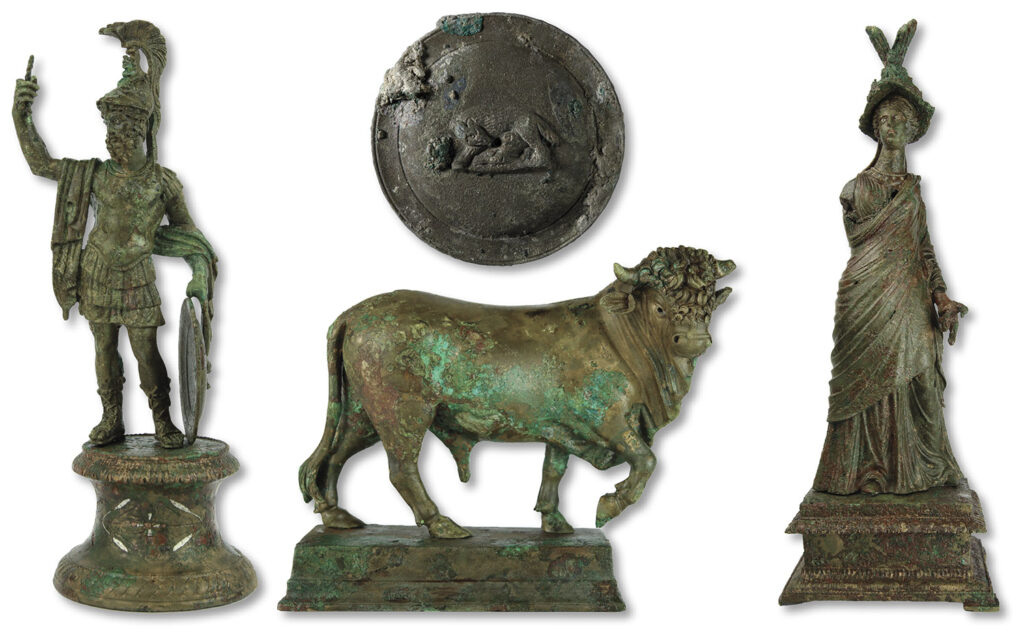
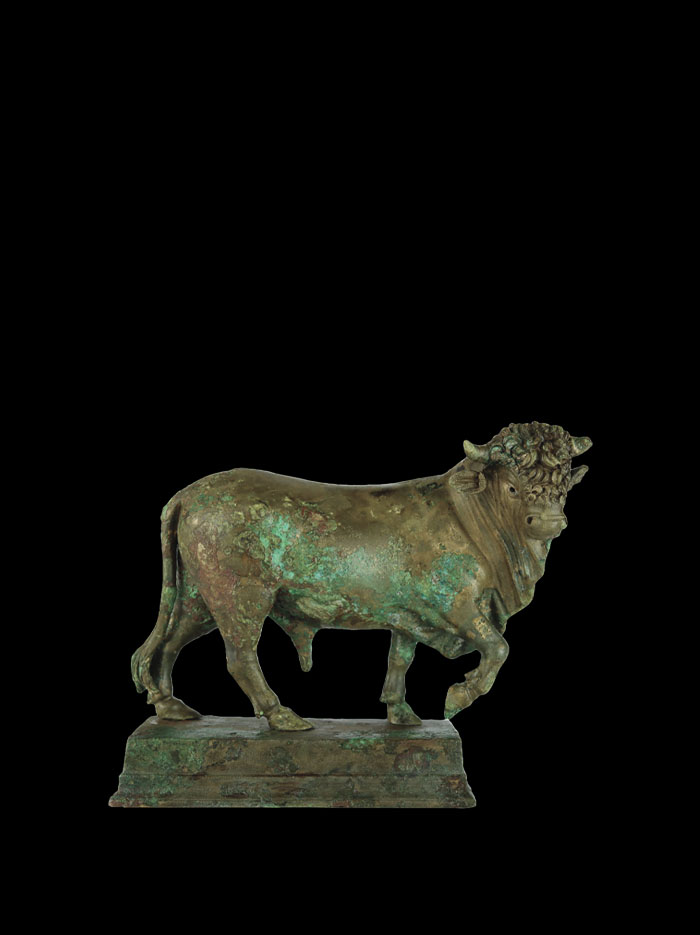
In the ancient Roman city of Durocortorum, in what is now Reims, France, archaeologists from the French National Institute of Preventive Archaeological Research (INRAP) unearthed three exquisitely crafted bronze statuettes representing a bull and two deities. The figurines were discarded in a room that was sealed off during renovations in the second half of the third century a.d. “The statuettes are typical of those used in private family cults in the Roman world,” says INRAP archaeologist Julie Léone. “They would have been placed on an altar somewhere in the house.”
One statuette depicts Mars, the god of war, wearing a breastplate decorated with a Gorgon’s head. His shield is emblazoned with images of Rome’s legendary founders, Romulus and Remus, and the she-wolf that reared them. Léone believes the other divine figurine likely represents the Egyptian goddess Isis. The Romans began to worship Isis in the first century b.c. and came to associate her with Roman divinities such as Fortuna. Léone notes that the goddess’ diadem is characteristic of Isis-Fortuna, though she wears a curious helmet that is likely a later addition.
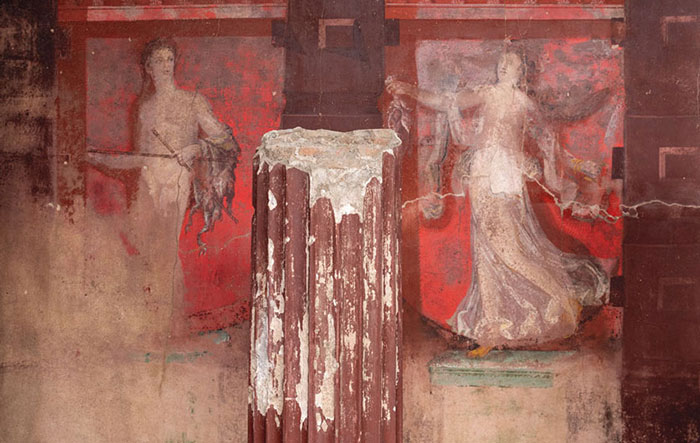
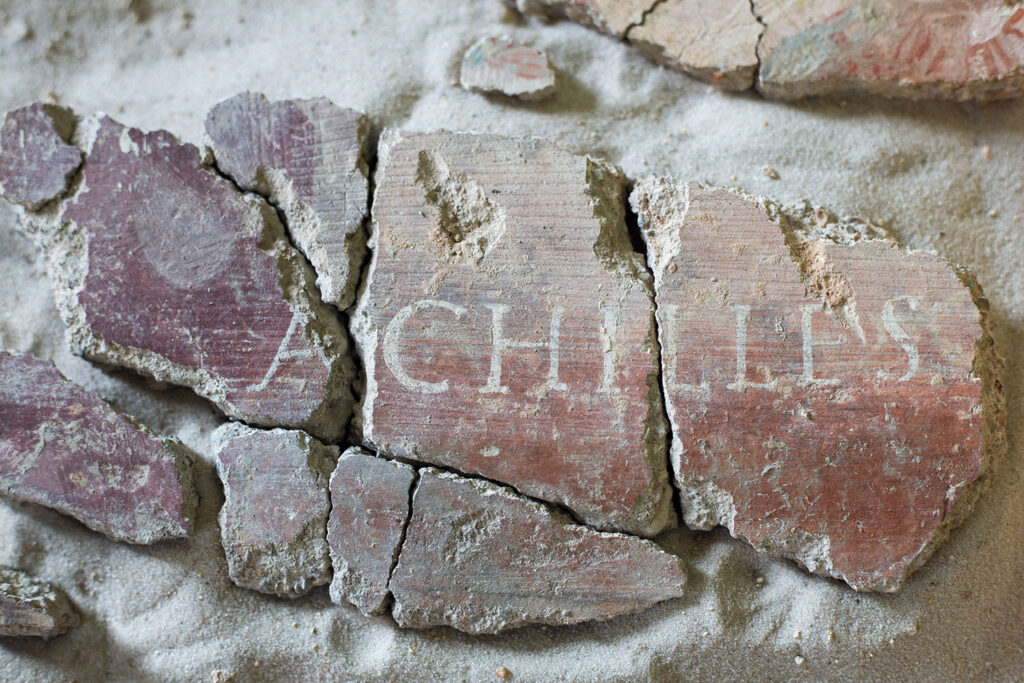
Amid the debris covering the statuettes, the team unearthed fragments of a fresco. Some fragments feature the names of Achilles and his wife, Deidamia, princess of the island of Scyros, whom he married before leaving for the Trojan War. The Reims fresco, says Léone, is one of only four painted depictions of this aspect of the hero’s story found in Roman homes, including one in the emperor Nero’s (reigned a.d. 54–68) lavish Domus Aurea. (See “Golden House of an Emperor.”) “Along with the statuettes,” Léone says, “this painting suggests that the homeowners were wealthy, cultured nobles with very strong, if not direct, ties to Rome.”