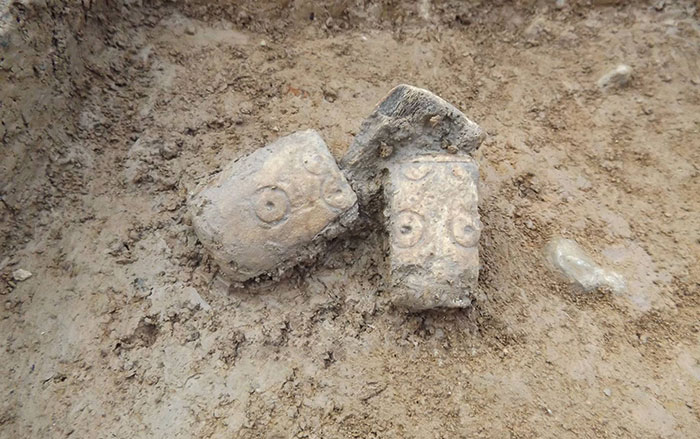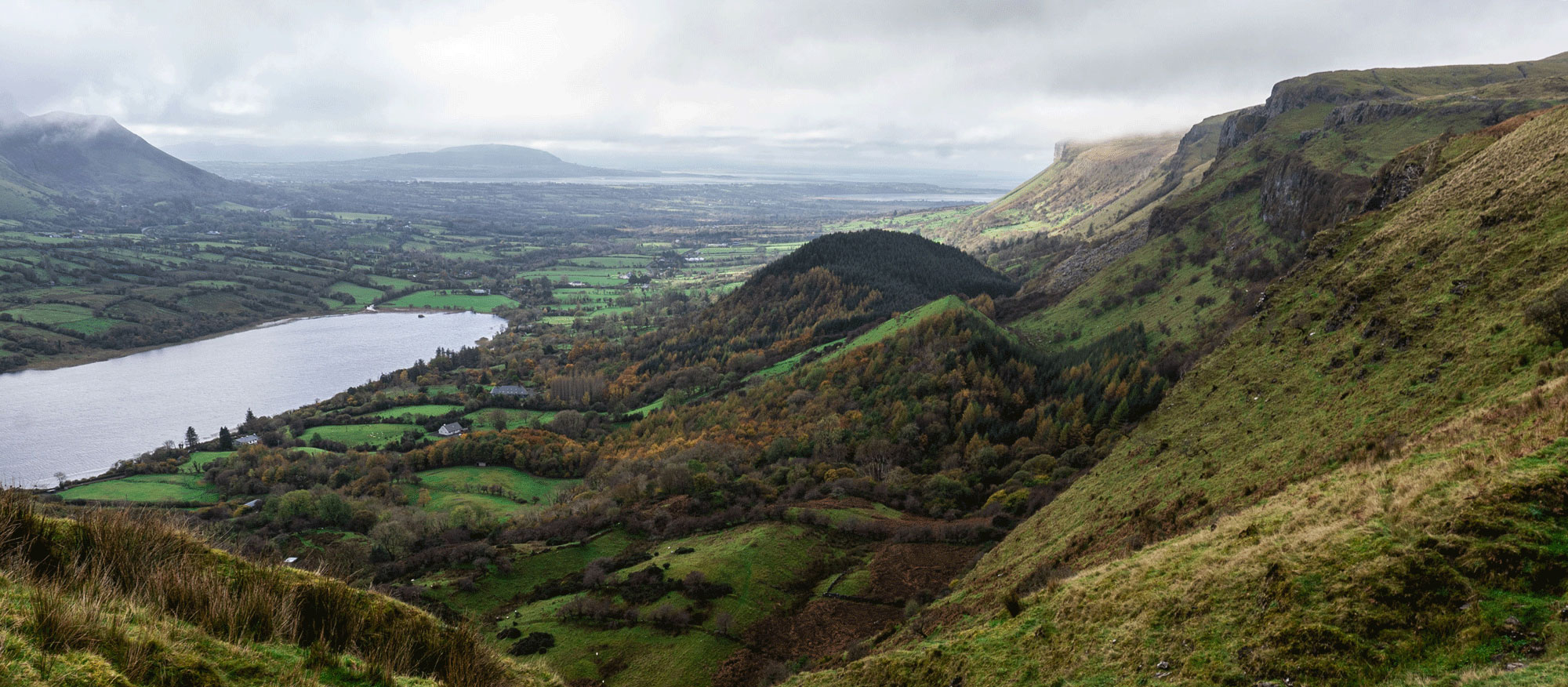
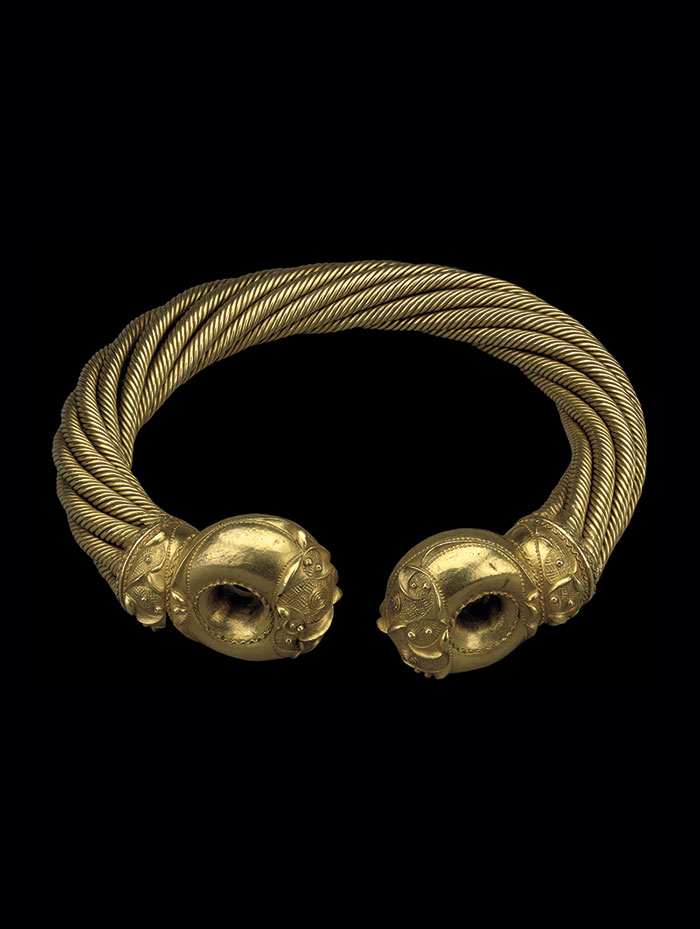
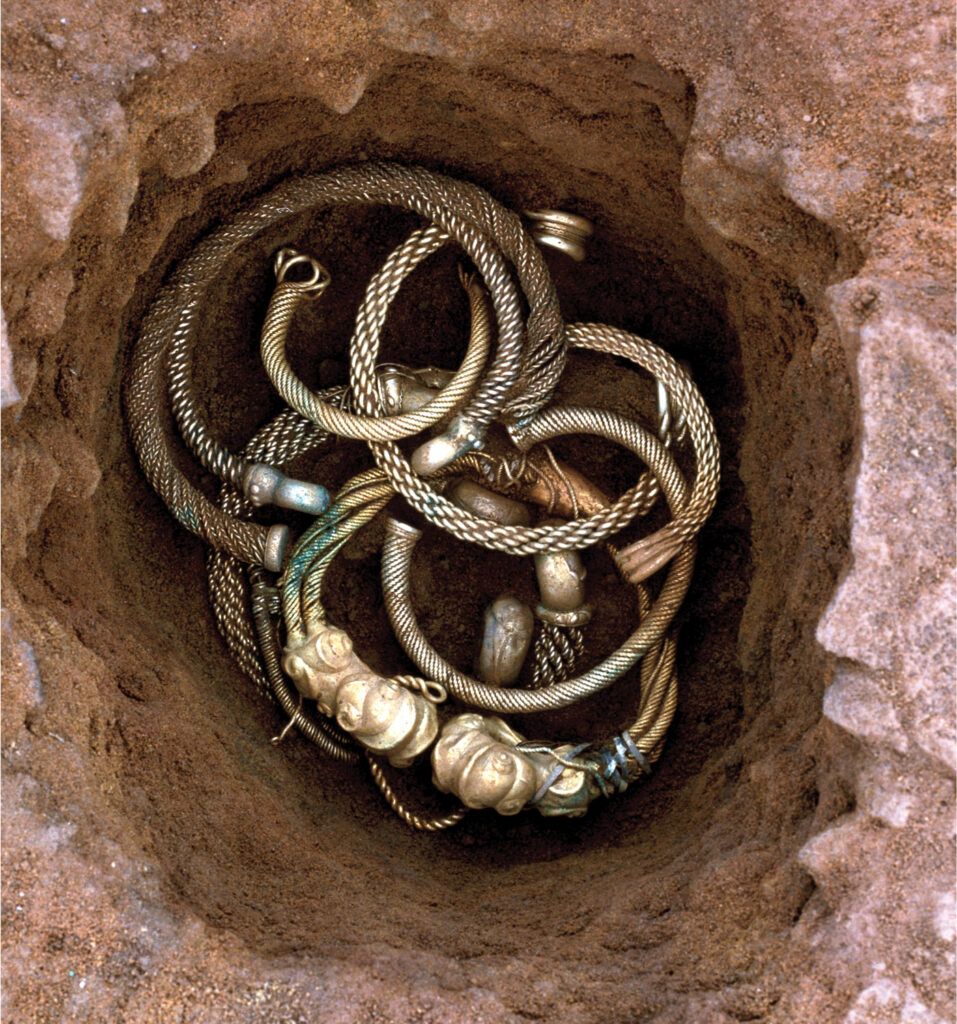
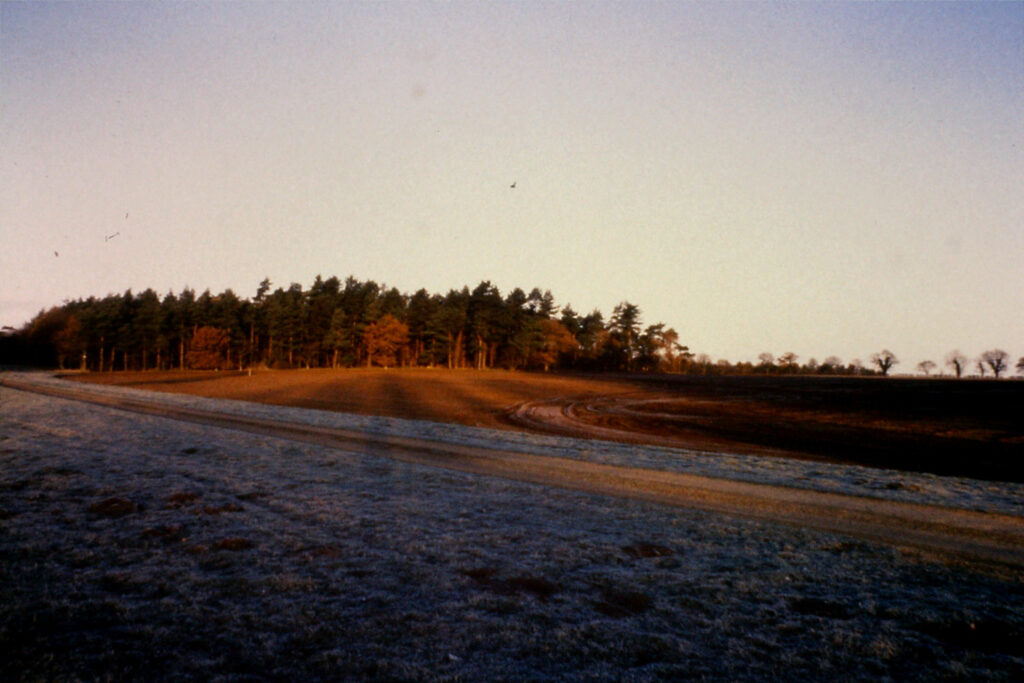
Rising to nearly 140 feet, a forested promontory called Ken Hill stands out from the otherwise flat terrain of Norfolk County on England’s east coast. In the late 1940s, farmers plowing a small field near the hill’s summit unearthed several hoards containing enormous quantities of gold, silver, and bronze metalwork. Similar discoveries continued to be made on Ken Hill over the next six decades—many in excavations conducted by the British Museum in the early 1990s. The site is now recognized as having yielded the greatest assemblage of prehistoric jewelry to have been found anywhere in Europe.
The Snettisham Hoards, named after the modern village at the foot of Ken Hill, include 12 caches dating to the Late Iron Age (ca. 350–60 B.C.). Weighing over 130 pounds in all, the caches contain rings, ingots, coins, bracelets, and torcs, or neck rings. More than 70 complete or nearly complete torcs and bracelets have been found at the site, along with fragments of hundreds more. In all, the finds from Snettisham represent about 80 percent of known torcs from Iron Age Britain. “It’s absolutely phenomenal,” says archaeologist Jody Joy of the University of Cambridge Museum of Archaeology and Anthropology. “Imagine gathering that amount of material together to put in the ground.” Along with archaeologist Julia Farley of the British Museum, Joy has undertaken an exhaustive study of the hoards and determined that, in addition to comprising an astounding accumulation of wealth and artisanship, they provide evidence of a major shift in how leaders in Late Iron Age Britain communicated their authority.

Since the first hoards were uncovered on Ken Hill, scholars have wondered why people chose to bury so many precious objects at this particular site. While the hill occupies a striking position in the landscape today, the site would have been even more compelling during the Iron Age. At the time, Ken Hill was a crooked, fingerlike projection surrounded on three sides by a marshy area called the Wash, which was connected to the North Sea. People in Late Iron Age Britain commonly used this sort of prominent site overlooking water to deposit valuable items. Based on discoveries of pottery, burned bone, and metal objects dating to the Late Bronze Age (ca. 1100–800 B.C.) and Early Iron Age (ca. 800–350 B.C.), archaeologists believe that Ken Hill was well established as a location for gatherings and feasts. “I think it was some kind of sacred natural site,” says Farley. “Maybe it’s a sacred grove, maybe it’s a sacred spring. Maybe this is a place where they’re holding some kind of ceremony or rites or celebration. It has quite a long history of being important.”
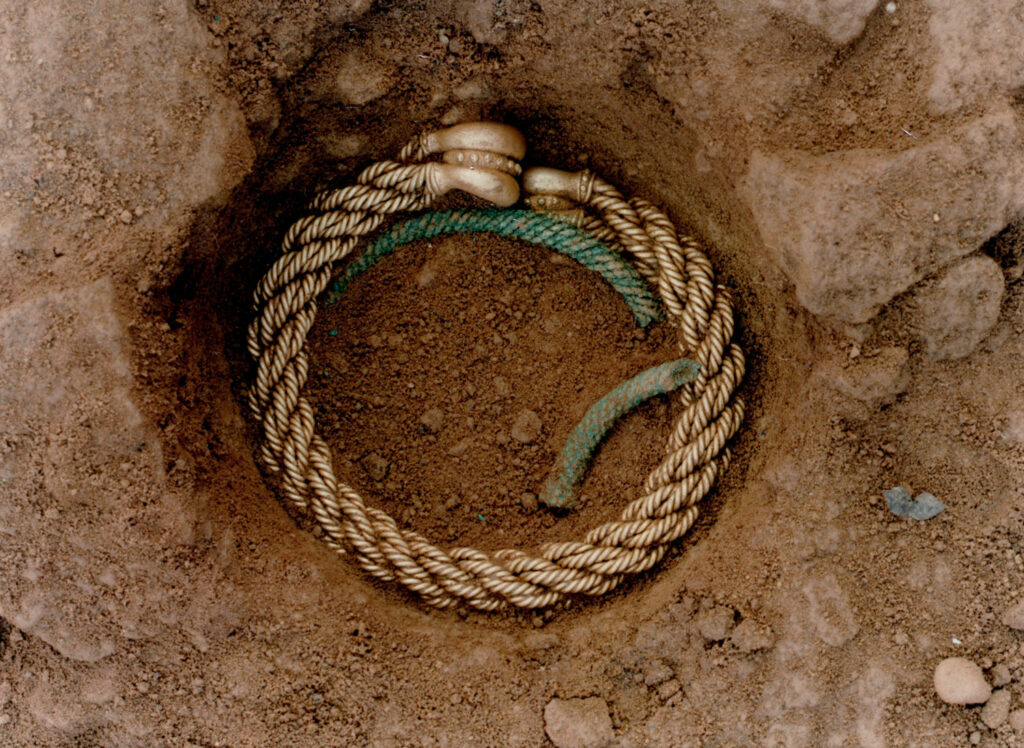
Farley and Joy have found evidence that the torcs on Ken Hill weren’t hastily buried in a time of unrest but were more likely offerings carefully deposited as part of a ritual. They have discovered that several of the torc hoards seem to have been arranged following a deliberate pattern: People would first place a simple, old, or heavily worn neck ring in the ground, followed by a series of carefully interleaved, more ordinary examples, and would top the offering with an especially impressive torc. Farley suggests people would later revisit the hoard, creating a second deposit above the first by adding a series of bronze torcs followed by a number of silver ones. “What that tells me is it’s not just for safekeeping,” says Joy. “There’s something ceremonial happening. And it must have been important for the people who did it because why else would you give up something that had material worth and could have been made into something else?”
People in Iron Age Britain may have worn torcs as a symbol of rank or position. “A torc could be a signature of office,” says Joy. “Once you had reached a certain level, then you would get to wear one.” A person might also have worn a torc to indicate that they had entered a particular phase of life or that they belonged to a distinguished family or community. However, it’s hard to know exactly which Iron Age Britons wore torcs as very few have been discovered in graves. Farley has found that the neck rings buried on Ken Hill were crafted in a variety of sizes, indicating that they could have been worn by adult men and women, and possibly even children.
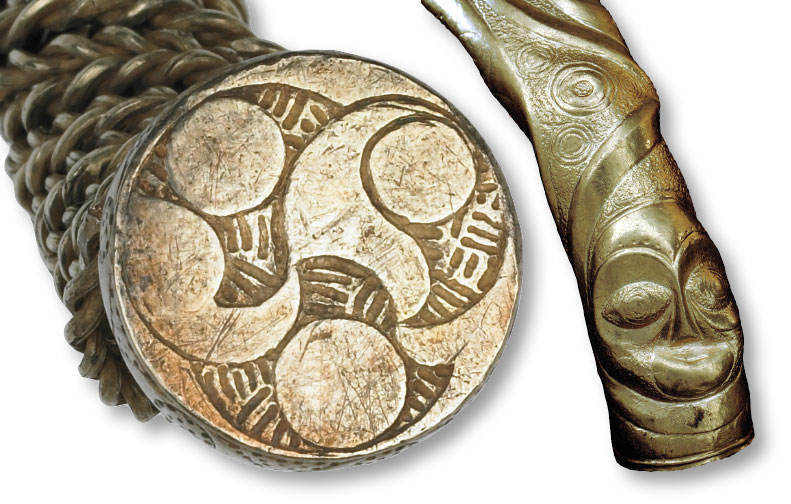
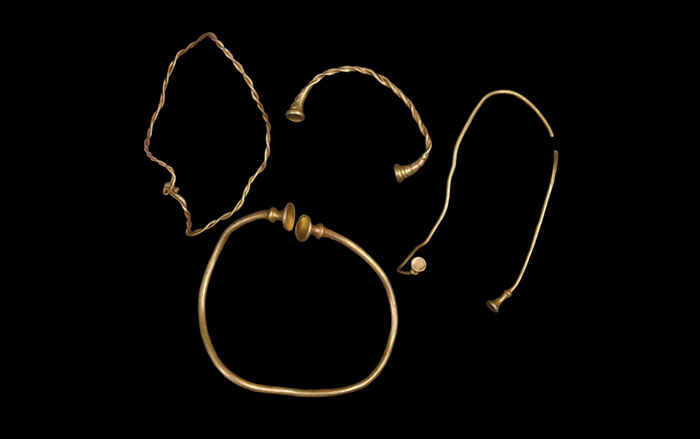
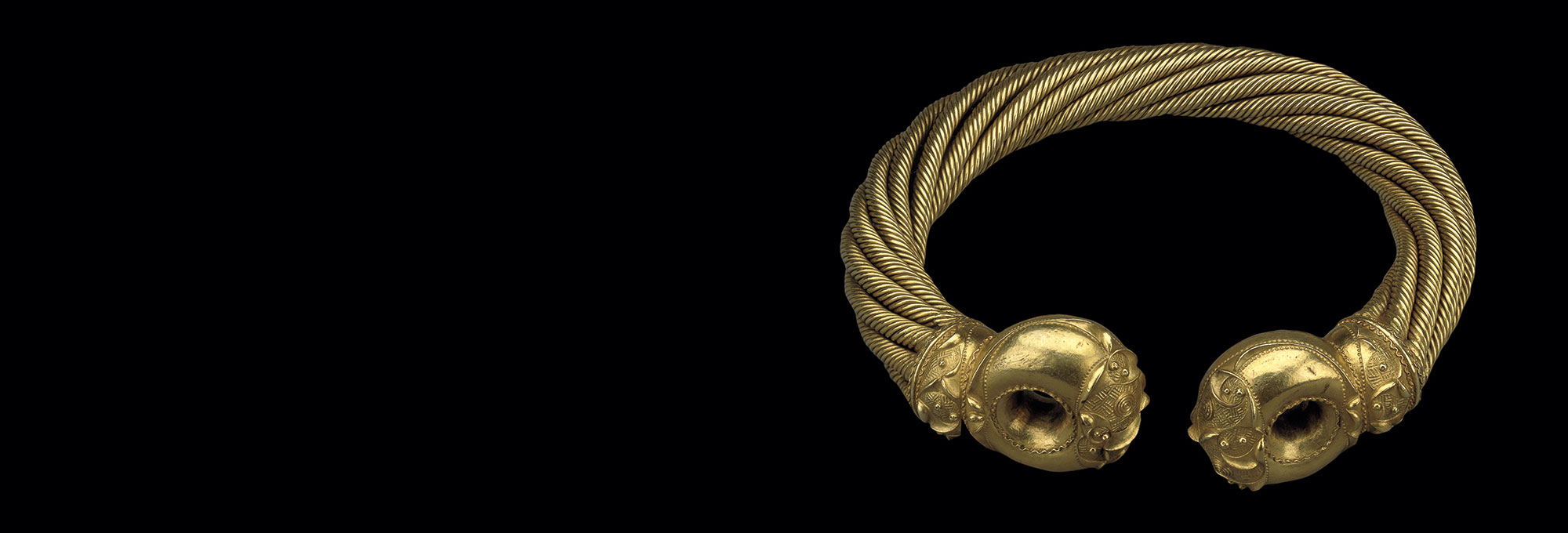
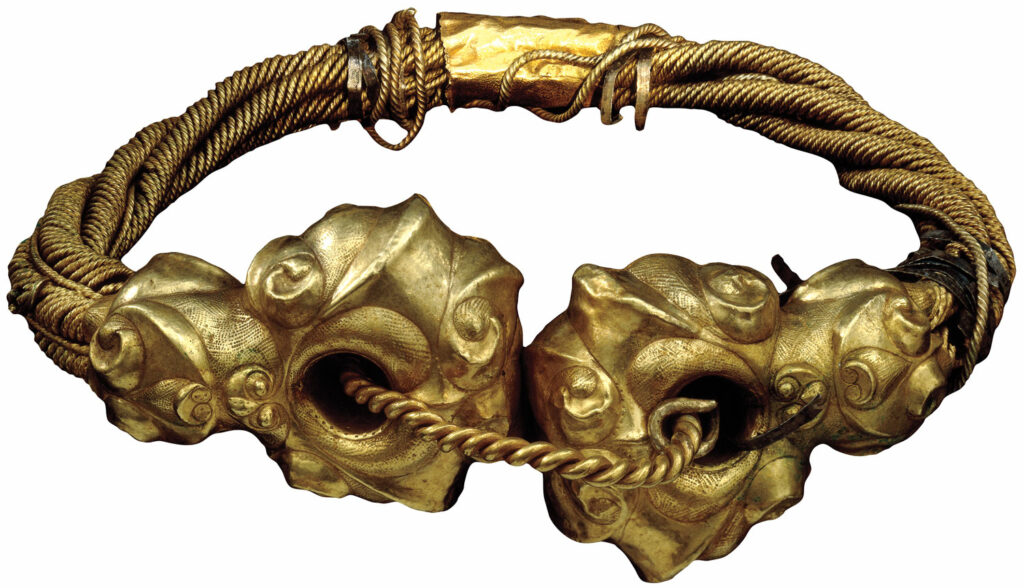
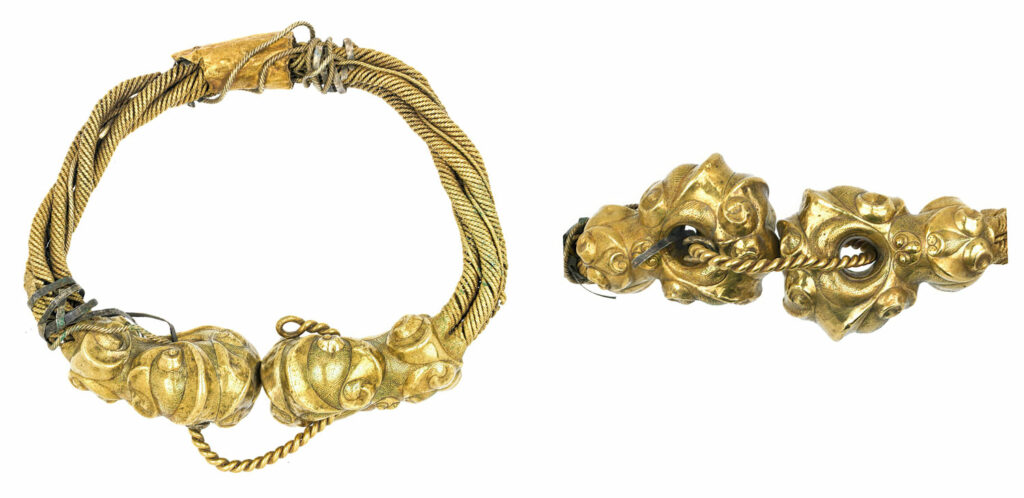
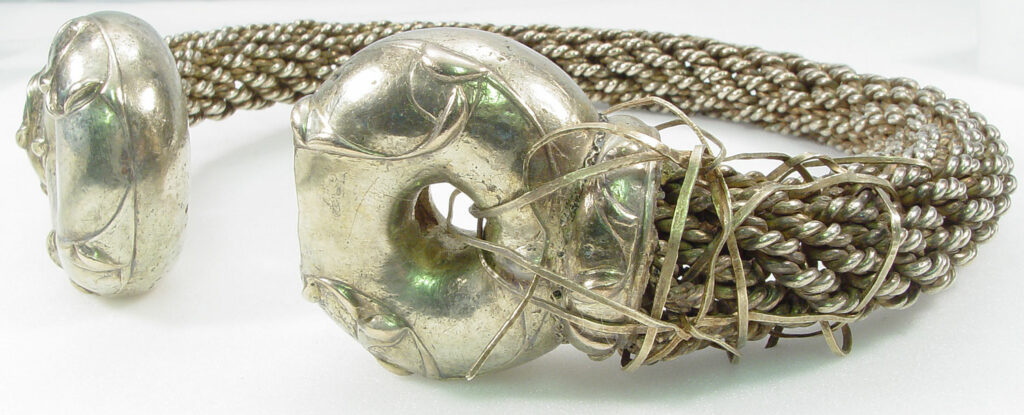
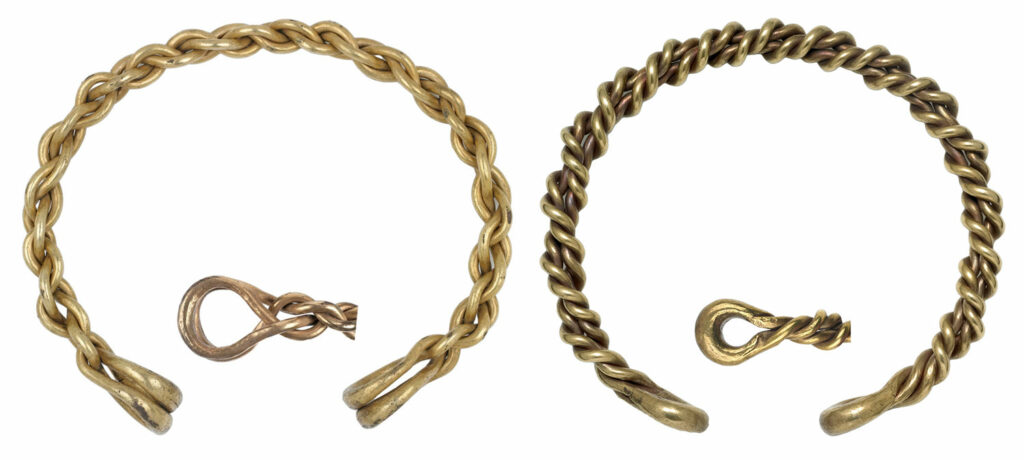
Iron Age torcs were highly individualized. Some were tubular, likely crafted from gold ingots through a process of repeated heating and hammering. Others were fashioned from twisted ropes of wire made of bronze or an alloy of gold, silver, and copper. They came in a range of colors, from yellow gold to whitish silver. Many were decorated with geometric and swirling motifs or images such as human faces. The terminals at each end of a torc had varied shapes, and some featured designs rendered using stippling and hash marks. To help torcs made using twisted wire ropes keep their form, they were coiled around a flexible wooden rod that could be bent into a desired shape. Researchers have identified at least seven different types of trees used to make the rods, including field maple and willow. “The rods didn’t stay a permanent part of the torc,” says Farley. “When the metal was annealed, the wooden cores mostly burned away, but we have some of the charcoal that survived, stuck in the ends of the terminals.” Among the hundreds of either partial or complete torcs in the Snettisham Hoards, Farley and Joy have found that no two are the same. “Their value, I would argue, is in their singularity, their uniqueness,” Farley says. “Each torc may have had its own particular identity and individual history. You’d be looking at someone and think, ‘Oh, they’re wearing that torc.’”
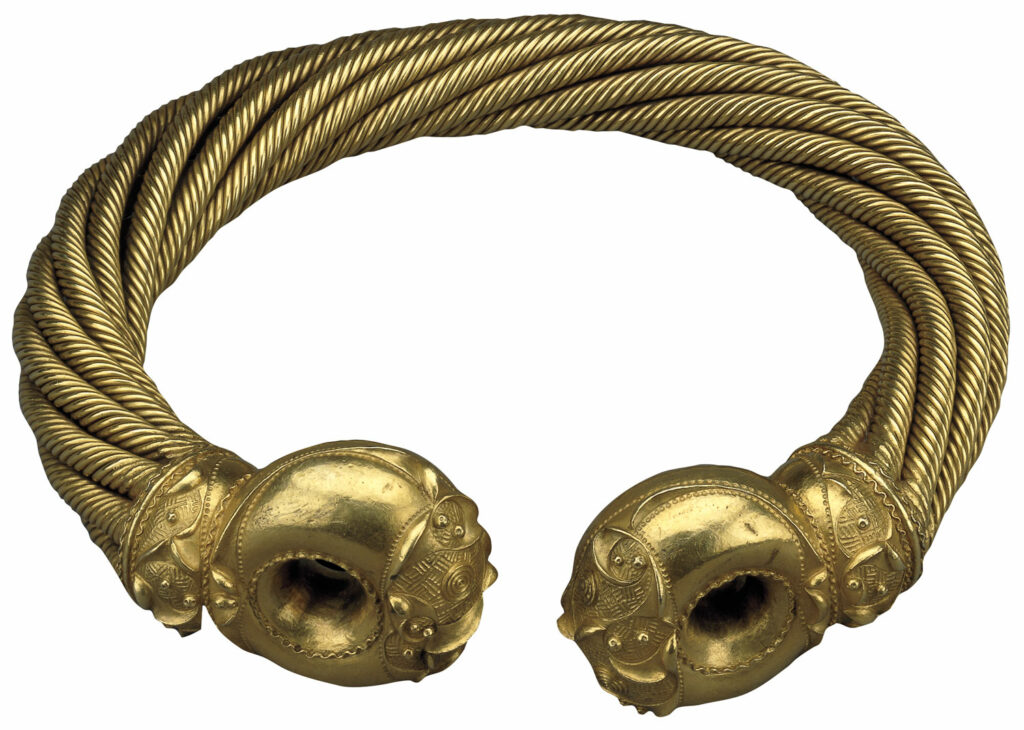
Two neck rings stand out as especially spectacular—one for its elegance and the other for its longevity. The Great Torc, crafted from more than two pounds of gold and silver, was made using eight twisted ropes, each consisting of eight wires hand-hammered to almost exactly the same diameter. “The person who made it was a master of their craft,” says Joy. The Grotesque Torc, on the other hand, is a testament to the wear and tear endured by torcs that were heavily used over many years. At some point, lengths of metal ribbon were wrapped around several sections to reinforce weak spots, most conspicuously at the back of the neck ring. X-rays of this area have shown that the torc broke in half, likely from having been repeatedly bent when its owners put it on and took it off over the years. A piece of gold sheet, perhaps from a tubular torc, was enlisted to help hold the pieces in place. A length of twisted wire was also threaded through openings in the torc’s terminals, either to stabilize it or to signal that it had reached the end of its life. “It’s a bit of a Frankenstein’s torc,” says Farley. “It’s been worn to destruction and had to be repaired multiple times. From the style of the artwork and how heavily worn it is, we think it has been passed down through many generations and is probably very old by the time it’s buried.”
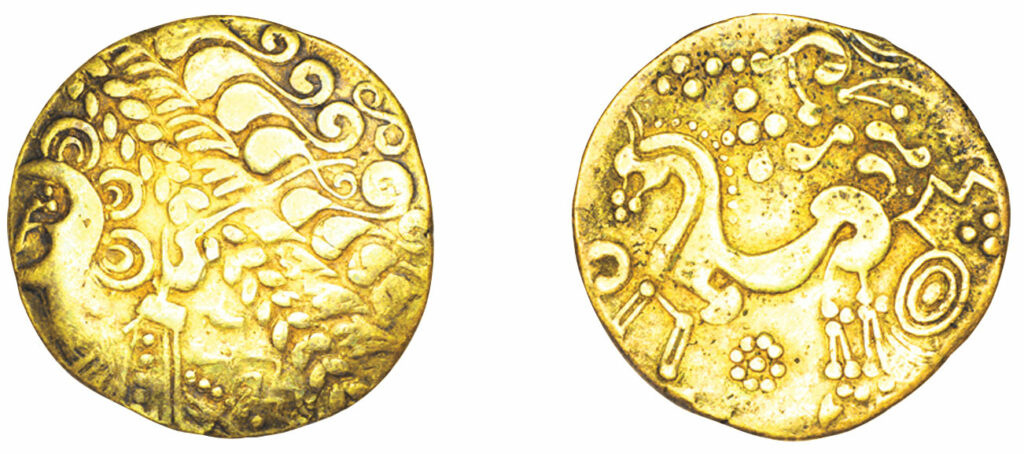
Some of the torcs in the Snettisham Hoards may have been crafted as early as the mid-third century B.C., based on radiocarbon dating of organic material found with them, including remnants of the wooden rods used to help shape the neck rings. Given that many, like the Grotesque Torc, were extremely worn, Farley and Joy have concluded that they were at least 100 to 150 years old when they were buried. Some of the torc hoards contain coins minted around 60 B.C., including examples of the first coins produced in the area. Farley and Joy believe that the hoards were deposited over a few decades leading up to around this time—and that the objects marked a transition in how people expressed their authority. “The first local coins are made right around when the hoards are put in the ground,” says Farley. “This may have been a period when people shifted from signaling their identity or status by wearing these beautiful neck rings to expressing their social status through coins.”
There can be no denying that torcs were attention grabbing. However, only one person at a time could wear a torc. “Coins are basically a new technology in the area at the time,” Farley says. “Instead of having a powerful person who wears a torc that’s associated particularly with them, coins are made for dissemination, and they make possible a society in which you create value not in showing it off, but in giving it away.” While nowhere near as precious as a torc, the gold coins that began to be minted in Norfolk in the mid-first century b.c. were nonetheless extremely valuable—some sources suggest that a single gold coin might have been equivalent to a season’s pay for a mercenary.
The Snettisham Hoards, then, may be evidence of a society-wide ritual of retiring an old-fashioned symbol of authority by burying it. “When we see those carefully nested hoards of torcs laid down one by one, I imagine that different people stepped forward to place a torc associated with them in the ground,” Farley says. Each hoard could represent a single such gathering. Interring the torcs with ceremony rather than recycling them into coins may have helped smooth the social transition. “These objects had likely been around for so long and had been associated with important events and people, so it might not have been socially acceptable to melt them all down without causing problems,” says Joy. “Perhaps you’re putting this wealth in the ground as an offering to the gods, hoping that they’ll approve of the change you’re making in society.”
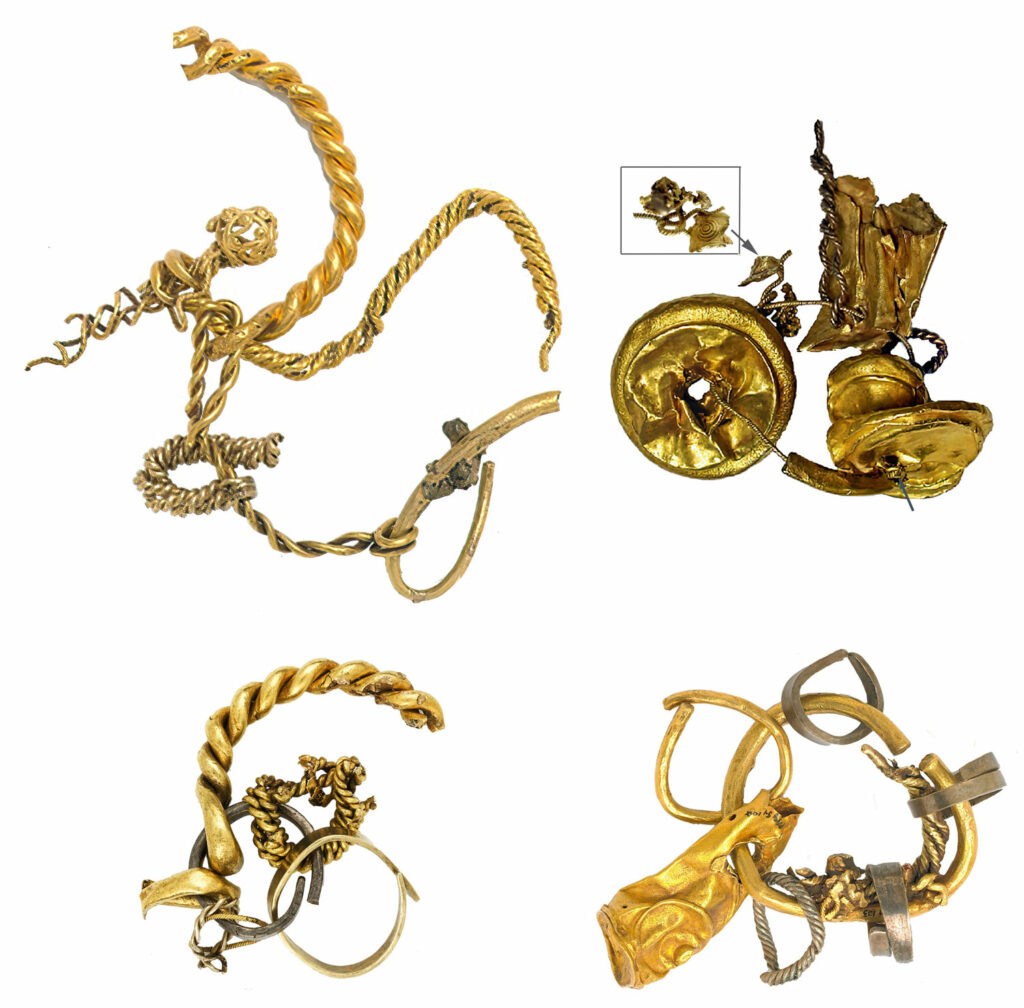
Not all torcs were buried in their entirety. Of the hundreds of fragments in the hoards, Farley and Joy have found that almost none were part of the same torc, nor have they been able to locate adjoining sections among fragments found at dozens of other locations in Britain. It’s likely that the fragments represent less impressive or less socially important examples, portions of which were buried and portions of which were turned into coins. “For a lot of the objects that aren’t quite as big personalities, I think people came to a compromise,” says Farley. “They bury part of it in this huge hoard that’s being given to the gods. But for the rest of it, they’re a bit more pragmatic, and they go away and melt it down.”
In the centuries after the torcs were buried, Ken Hill continued to be seen as a sacred place. Two additional hoards were deposited there in the first century A.D.—one containing silver alloy ingots and the other thousands of coins. Around the second century A.D., a ditch was constructed enclosing an area of 20 acres that included the torc hoards and was likely meant to mark the sacred space surrounding a Roman temple. “Even if they don’t know exactly what’s in the middle of that field,” says Farley, “the people in the Roman period who dug that ditch know there’s something there.” As another social upheaval washed over the region, this time in the form of the Roman conquest, the torcs of the Late Iron Age buried on a hill rising from the edge of the North Sea continued to exert an inescapable power.
Slideshow: A Wealth of Torcs
Beginning in the late 1940s, the greatest known assemblage of prehistoric jewelry in all of Europe was discovered on a forested promontory called Ken Hill in Norfolk County near England’s east coast. The caches of gold, silver, and bronze metalwork unearthed there have come to be known as the Snettisham Hoards, after the modern village at the foot of Ken Hill. Among the caches’ contents are rings, ingots, coins, bracelets, and, most importantly, torcs, or neck rings, which date to the Late Iron Age (ca. 350–60 B.C.). In an exhaustive review of the hoards, archaeologists Julia Farley of the British Museum and Jody Joy of the University of Cambridge Museum of Archaeology and Anthropology suggest that these torcs were deposited as part of a society-wide ritual that marked a shift in how leaders communicated their authority.
Further Reading
Secrets of Scotland’s Viking Age Hoard
A cache of Viking silver and Anglo-Saxon heirlooms reveals the complex politics of ninth-century Britain
Ka-Ching!
Archaeologists discovered a gargantuan hoard in the British Channel Islands—then they took it apart, coin by coin
Iron Age Britain’s Oldest Gold
Four gold torcs date to a time when people in Britain were thought to have forgone gold jewelry
The Snettisham Hoards edited by Julia Farley and Jody Joy
Archaeologists undertake an exhaustive study of the greatest assemblage of prehistoric jewelry ever found in Europe