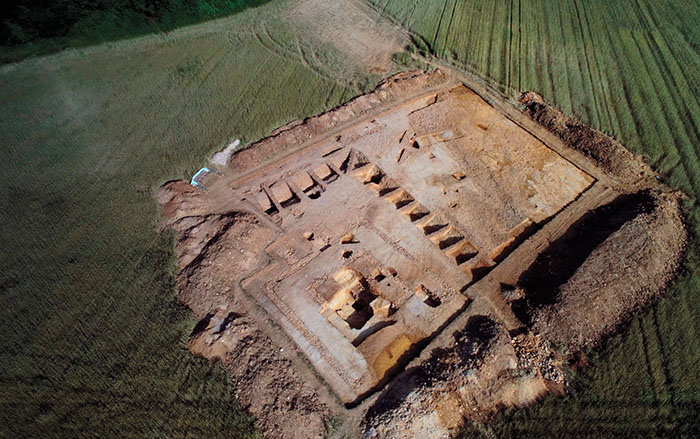
TAMAULIPAS, MEXICO—Vice reports that an unexpected modified cranium has been identified at Balcón de Montezuma, an Huastec site in northeastern Mexico dated to between A.D. 400 and 900. Biological anthropologist Jesús Ernesto Velasco González of Mexico’s National Institute of Anthropology and History (INAH) said that the skull, which belonged to a middle-aged man, had been flattened across the top, giving it a block-like, or parallelepiped, shape more commonly seen at the site of El Zapotal in Veracruz, to the south. The researchers therefore analyzed the stable oxygen isotopes in the man’s bones and teeth, only to determine that he had been raised locally and had not traveled far from northern Mexico. Velasco González thinks the shape of the man’s skull may reflect unknown cultural contacts experienced by the people of Balcón de Montezuma. To read about a 2,400-year-old burial in Mexico City in which some of the deceased had undergone intentional skull deformation, go to "Circle of Life."