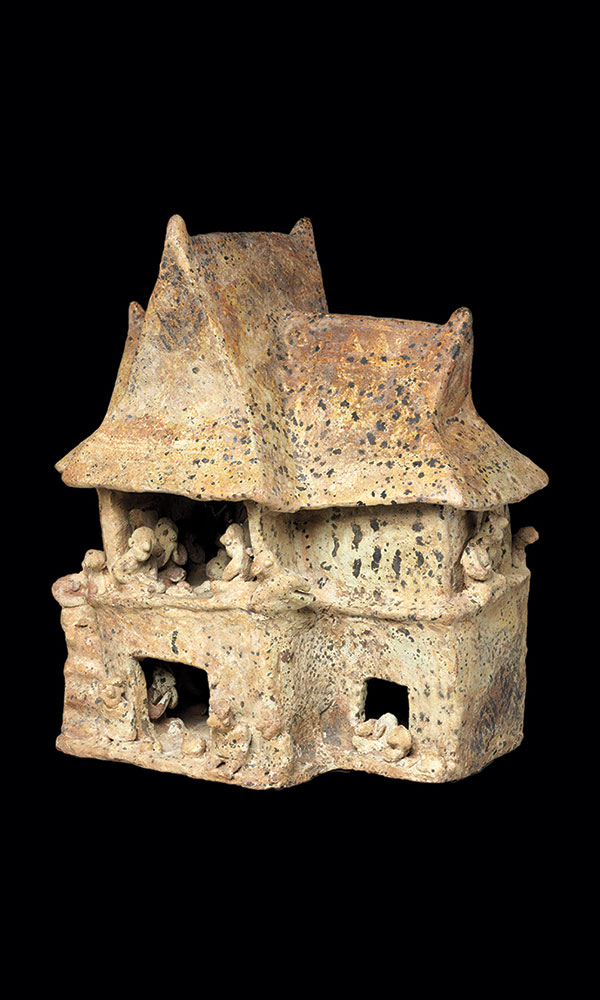



Archaeologists have found few glyphs and little domestic architecture to illuminate the lives and culture of people in western Mexico from around 200 b.c. to a.d. 300. But they do know that then, as now, it was agave country. Families enjoyed consuming large quantities of pulque, a fermented drink crafted from the succulent. In the present-day Mexican states of Nayarit, Jalisco, and Colima, ancient artisans sculpted evocative scenes in clay, among the most intricate of which were architectural models. Inside these models, figures at gatherings appear to be liberally availing themselves of pulque, crowding tables, embracing in corners, and even slumping against walls. “Feasting is about kinship and leadership,” says art historian Kristi Butterwick. “Someone who owns the agave lands makes pulque for everyone and invites people in.”
Each model and the scene it depicts is unique. Some are one-level, single-room affairs with a solitary human figure. Others have two levels, several chambers, staircases, multiple saddle-shaped roofs adorned with colorful geometric patterns, and as many as 18 occupants. Figurines wear conical hats, feathered headgear, cloaks, skirts, and jewelry such as earrings, nose rings, and bracelets. A few have pierced or cut cheeks, evidence of bloodletting rituals. “Everything is so meticulous,” says Butterwick. “The different headdresses on figurines, little birds on the roofs, even little round platters of food, like tamales. You think about someone trying to tell stories with these little figures.”