
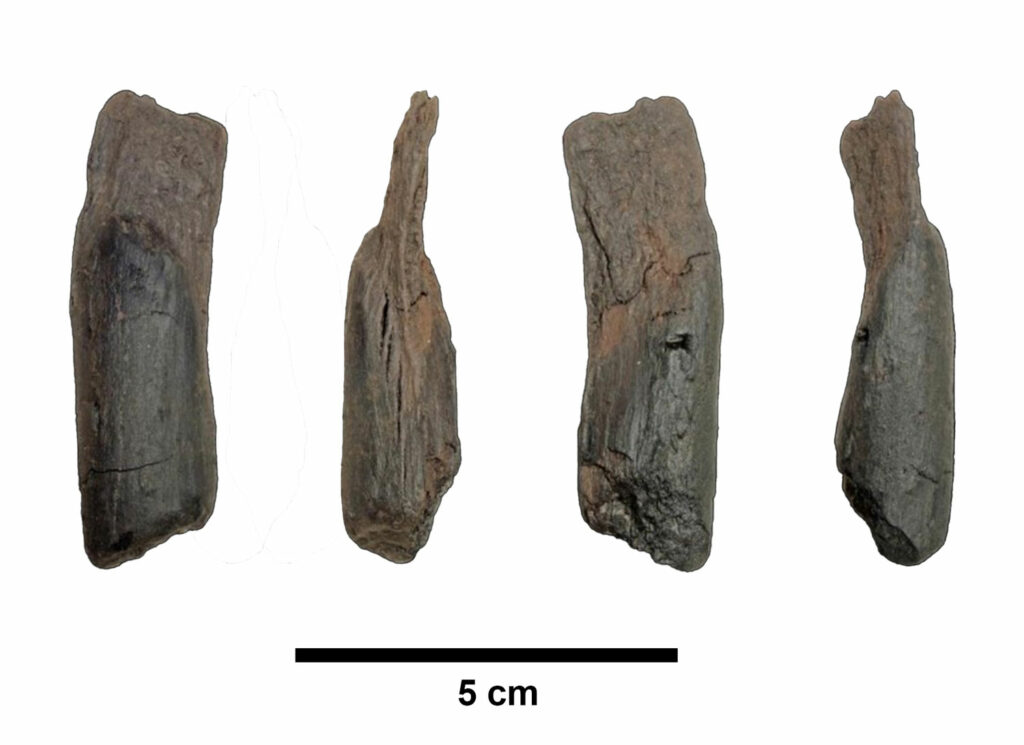
MARATHOUSA, GREECE—Science News reports that 430,000-year-old wooden tools likely crafted by Neanderthals or Homo heidelbergensis individuals have been discovered in Greece by a team of researchers led by Annemieke Milks of the University of Reading. The site, which is now a coal mine, is located in the central Peloponnese Peninsula. The rare wooden tools were recovered from waterlogged ground 100 feet beneath the surface, in an area that had been an ancient lakeshore, among thousands of pieces of wood, bone, and stone. One of the artifacts, identified through use-wear analysis as a 2.5-foot-long digging stick, was recovered in four pieces. Milks thinks this tool began as a thin alder trunk that was manipulated in order to remove its branches and fashion a handle. A second object, a piece of shaped willow, measures just three inches long. Milks suggests that this tool may have been used in combination with the stone or bone tools at the site to finish another object. For more recent research on hominins, go to "Around the World: Ethiopia."