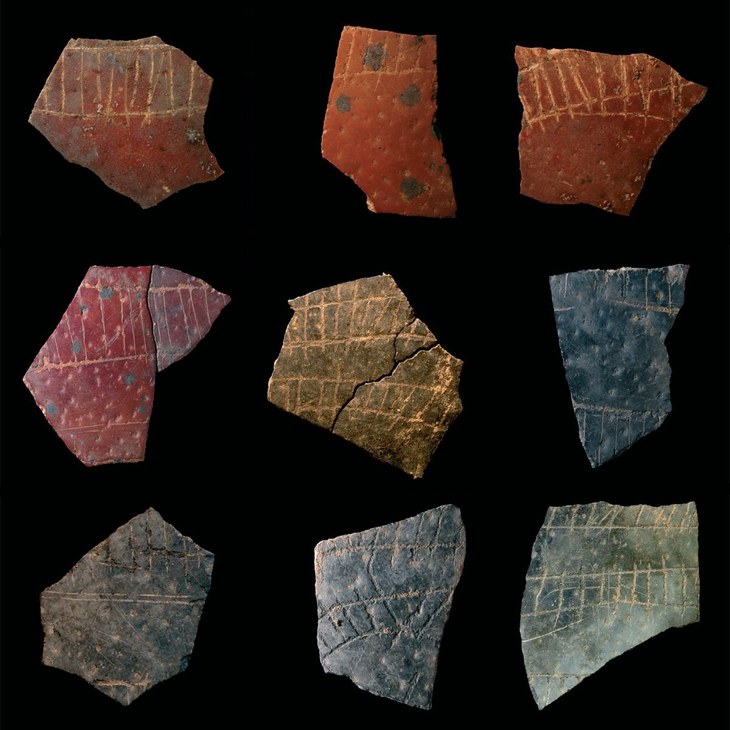
BOLOGNA, ITALY—Gizmodo reports that statistical analysis of marks made by humans on ostrich eggshells some 60,000 years ago determined that more than 80 percent of the designs had coherent spatial regularities. “We are talking about people who did not simply draw lines but organized them according to recurring principles—parallelisms, grids, rotations, and systematic repetitions,” said Silvia Ferrara of the University of Bologna. Ferrara and her team members first recreated the engravings on the eggshells, which had been unearthed at three sites in southern Africa. They then chose distinct angles, groups of parallel lines, and repeated use of hatches, grids, and diamond-shaped motifs as variables. These markings were then assessed for overall harmony on the large eggshell. “These engravings are organized and consistent and show mastery of geometric relationships,” Ferrara said. “There is not only a process of repeating signs; there is real visuo-spatial planning, as if the authors already had an overall image of the figure in mind before engraving it,” she explained. Although it is not clear if the markings carried meaning, Farrara and her colleagues assert that they are indicators of abstract thought. Read the original scholarly article about this research in PLOS One. To read about the ancient trade in ostrich eggs, go to "A Rare Egg."