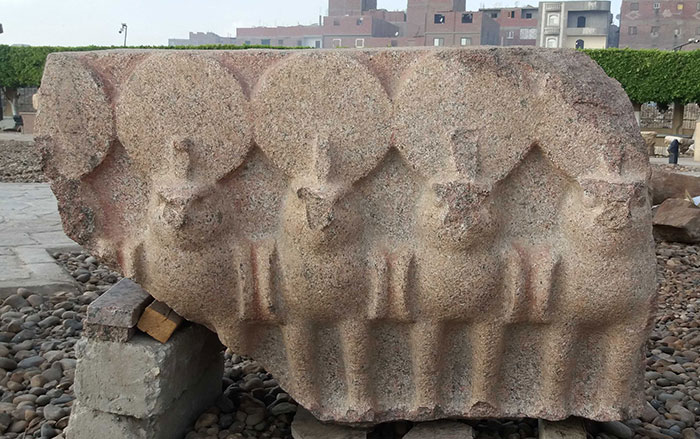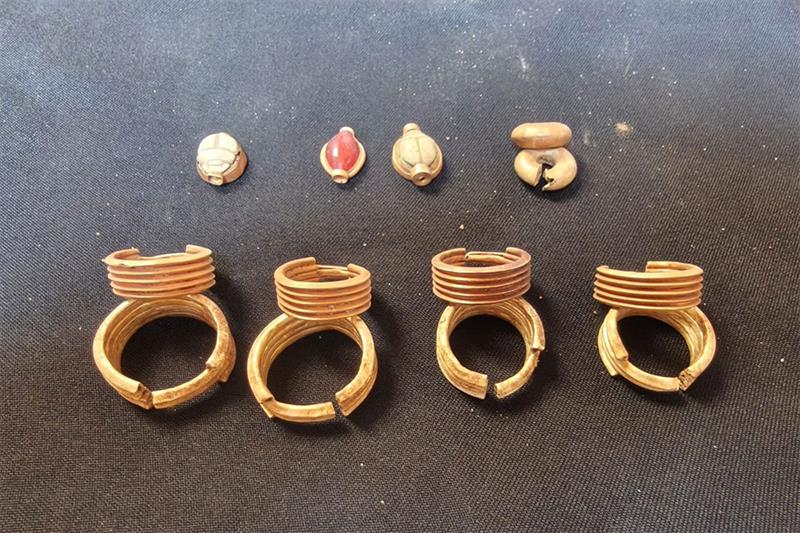
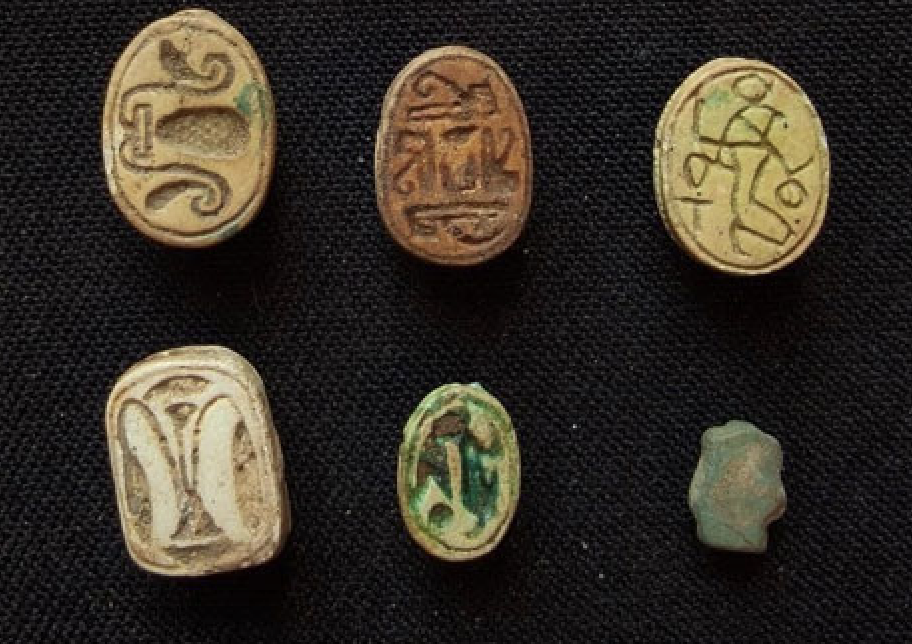
CAIRO, EGYPT—According to an Ahram Online report, an excavation of the mudbrick tomb of “Panehsy” in the necropolis of Heliopolis has uncovered human skeletal remains. Underneath the grave, Hisham El-Leithy of Egypt’s Supreme Council of Antiquities said that the researchers found a collection of cosmetic tools, a copper mirror, and two alabaster kohl containers holding traces of cosmetics. A third kohl container in the cache had been made of obsidian. Two light-blue faience vessels were also recovered. One of them held six inscribed scarabs, two of which appear to have been encased in gold. A duck-shaped amulet, and an amulet shaped like an Atef crown were found among a collection of faience amulets, in addition to two carnelian stones, a pink stone encased in a metal frame thought to be gold, and a greenish-blue stone. Five pairs of gold earrings of varying sizes were found, as well. “Additional limestone blocks bearing hieroglyphic inscriptions were also uncovered, further enhancing the archaeological significance of the site and supporting efforts to better understand its chronological and cultural development,” commented Mohamed Abdel Badie of the Supreme Council of Antiquities. To read in-depth about excavations at Heliopolis, go to "Egypt's Eternal City."