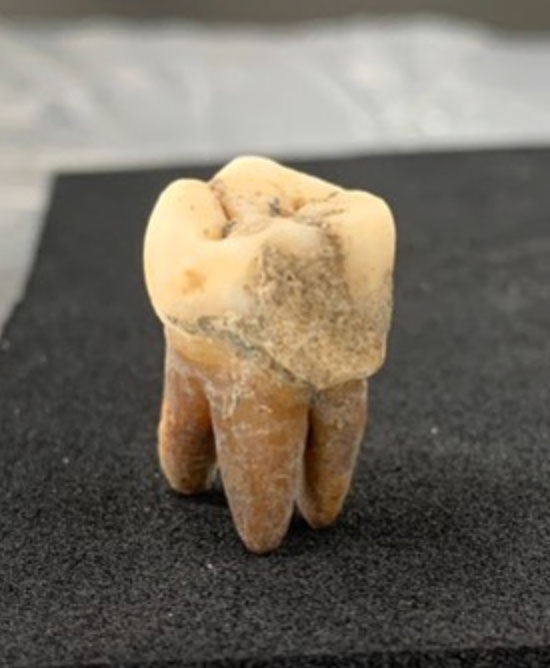
OSAKA, JAPAN—According to a statement released by the Graduate University for Advanced Studies (SOKENDAI), researchers from SOKENDAI, Aomori Public University, and Kyushu University analyzed samples of dental calculus taken from the teeth of eight sets of human remains unearthed at the Umeda cemetery in Osaka. These people lived in an urban environment during Japan’s Edo period, from A.D. 1603 to 1868. The scientists examined bone collagen stable isotope ratios and food-derived proteins in the hardened plaque using palaeoproteomic methods. The ratios of carbon and nitrogen isotopes indicate that the individuals consumed a wide variety of foods, including 38 different dietary proteins from nine different species of fish, several different land and marine mammals, and multiple kinds of plants. Six of the individuals consumed red sea bream (Pagrus major), a fish described in historical sources as a luxury food. Proteins from tonguefish (Soleidae) and other flat fish were also identified in the samples. Some of the individuals ate cold water fish, which do not live in nearby Osaka Bay and were likely imported via Japan’s coastal shipping routes. Proteins from cotton seeds were probably grown locally and eaten in the form of cottonseed oil. The researchers concluded that the diets of these individuals reflect the role the island of Osaka played as a hub for the production and redistribution of food products across western Japan. Future studies of premodern diets in Japan will examine the dental calculus of samurai, people who lived in rural areas, and people who lived in other areas of Japan, the researchers concluded. Read the original scholarly article about this research in Anthropological Science. To read about a medieval stronghold in central Japan, go to "Lost City of the Samurai."