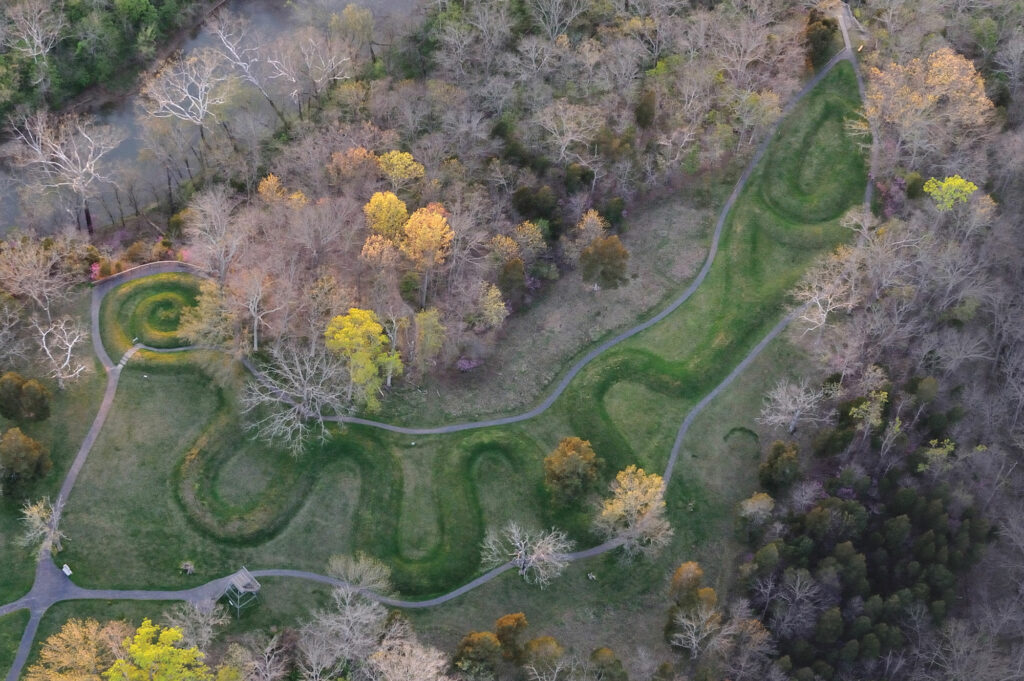
The rippling form of Serpent Mound appears to slither across the landscape, its curves pulsing with the illusion of life. Viewed from the air, the 1,350-foot-long earthwork winds near the top of a steep bluff overlooking a tributary of the Ohio River. Blanketed in a shimmering coat of emerald grass, the mound’s tail is coiled and its wide-open jaws seem poised to swallow a 120-foot-long oval earthwork. Those who visit the site on the summer solstice can watch the sun set over the snake’s mouth.
Today, the mound’s grass is carefully mowed. A paved path surrounds the earthen structure, known as an effigy mound, allowing it to be viewed from all sides. When Serpent Mound was first built, it would have stood out even more prominently against a landscape that had few other marks of human construction, save three small conical burial mounds and a village nearby. Those who built Serpent Mound could not have known that it sits amid an astrobleme, Greek for “star wound”—a five-mile-wide eroded crater left behind by a meteor impact 320 million years ago. Nonetheless, they undoubtedly made a sacred connection between the sky and the landscape’s geology.
By the late eighteenth century, when the first American settlers began farming this area of southern Ohio, trees and brush covered the serpent’s coils, obscuring its shape. The Shawnee tribes and other Indigenous peoples whose ancestors built the region’s many earthworks had been gradually displaced from their traditional lands and suffered devastating population loss. When archaeologists Ephraim Squier and Edwin H. Davis visited Serpent Mound in 1846 as part of a survey of mounds in the Mississippi River watershed, local farmers told them they thought it might have been some sort of defensive fortification. The researchers were astonished to find what they called “the most extraordinary earthwork thus far discovered at the West” and produced the first plan of the site. They also surveyed the oval earthwork near the serpent’s jaws and discovered a burned stone platform that had once stood inside the oval and could have served as an altar. In describing Serpent Mound for the Smithsonian Institution in 1848, Squier and Davis speculated that its symbolism might be connected to the serpent iconography of ancient Egypt, India, or England, though they admitted to having no evidence for this.
Shortly before the Civil War, a tornado heavily damaged the mound, and, soon after, farmers plowed over sections of its tail. All of Serpent Mound would likely have been razed, like so many other mounds in this era, were it not for archaeologist Frederic W. Putnam of Harvard University’s Peabody Museum, who recognized the site’s importance. In the 1880s, Putnam secured funding to purchase, excavate, and restore the earthwork and helped convince the Ohio state legislature to pass a law protecting it. Putnam’s careful excavations yielded important information about Serpent Mound’s history, though he proposed an improbable theory about its origins in an 1890 article: The mound, Putnam argued, was likely the work of Celtic travelers. He compared the Ohio earthwork to a curving glacial deposit near Loch Nell in Scotland that he believed to be an ancient Celtic serpent mound. “Is there not something more than mere coincidence in the resemblance between the Loch Nell and the Ohio serpent, to say nothing of the topography of their respective situations?” Putnam asked. “If the serpent of Scotland is the symbol of an ancient faith, surely that of Ohio is the same.”
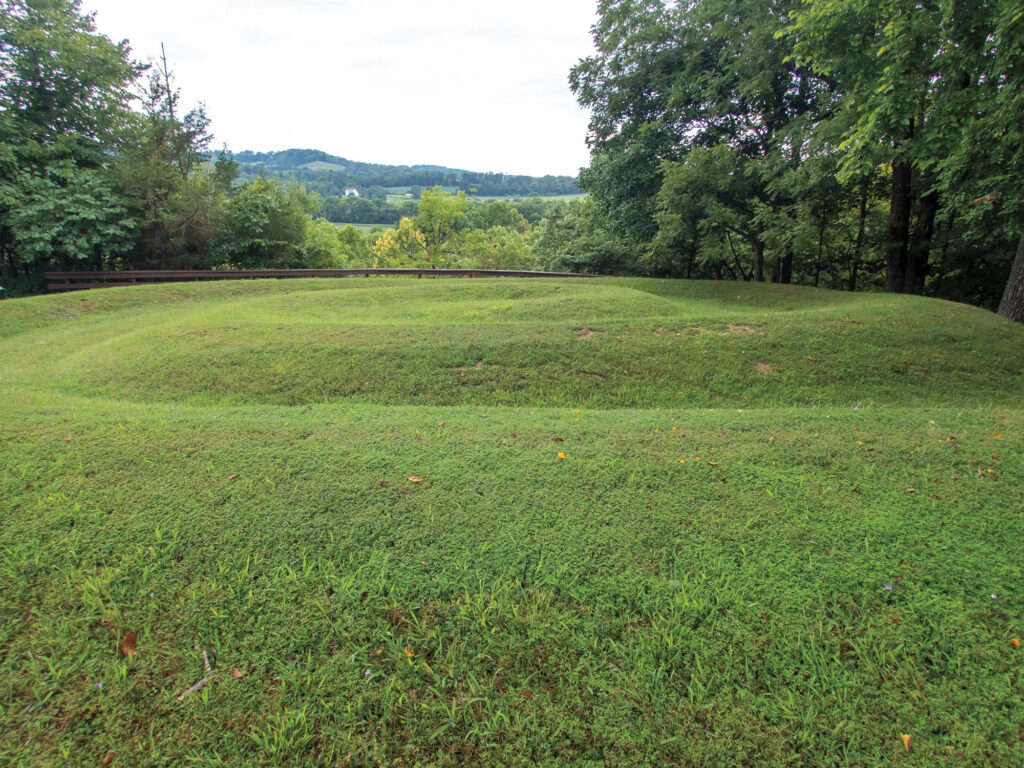
Putnam was correct that Serpent Mound served a spiritual purpose but wrong about its origins. Since the early twentieth-century, archaeologists have understood that the earthwork was built by Native American peoples sometime in the last 2,500 years, but just when it was first raised has become a topic of fierce debate. Researchers who have conducted limited test excavations of the site since the 1990s have used radiocarbon dating in an attempt to better understand the structure’s origins. But inconsistent results have left archaeologists disputing the age of the mound and which people first constructed it.
Intriguing new research combining Indigenous perspectives with recent archaeological discoveries is providing fresh insight into the origins of Serpent Mound. Brad Lepper, senior archaeologist at the Ohio History Connection, the state’s historical society, has endeavored to understand the earthwork by examining it through the lens of the traditions of present-day Native peoples of North America. First among these are the Shawnee, who lived in the Ohio Valley before being forcibly removed by the U.S. government in the early nineteenth century. The Shawnee, most of whom live in what is now Oklahoma, still consider Serpent Mound a sacred ancestral site. Lepper and his colleagues have studied other effigy mounds in the Upper Midwest as well as rock art depicting snakes. This research has allowed them to arrive at a new understanding of Serpent Mound, which connects its origins to historical events that occurred in North America in the twelfth century a.d.
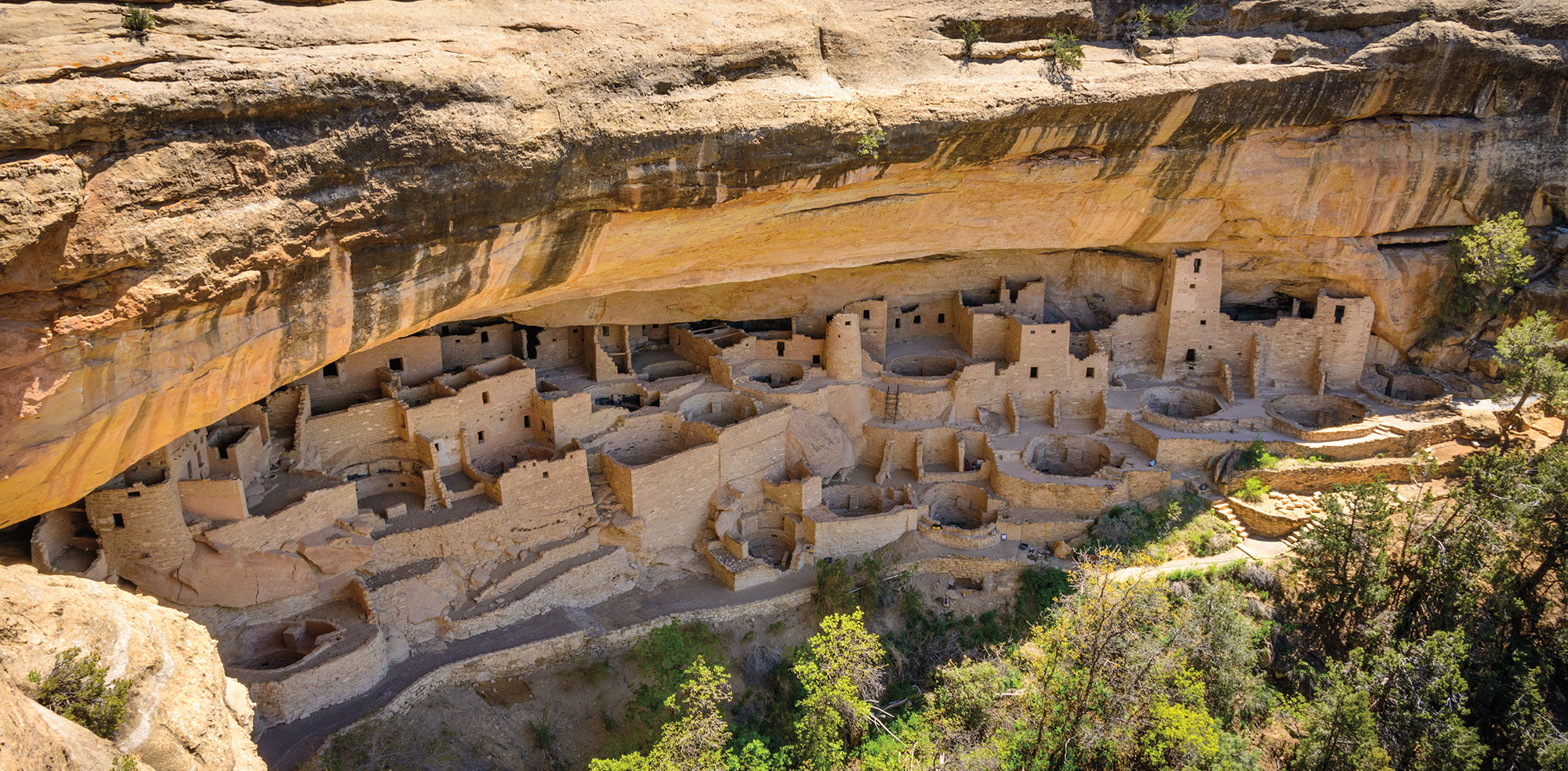
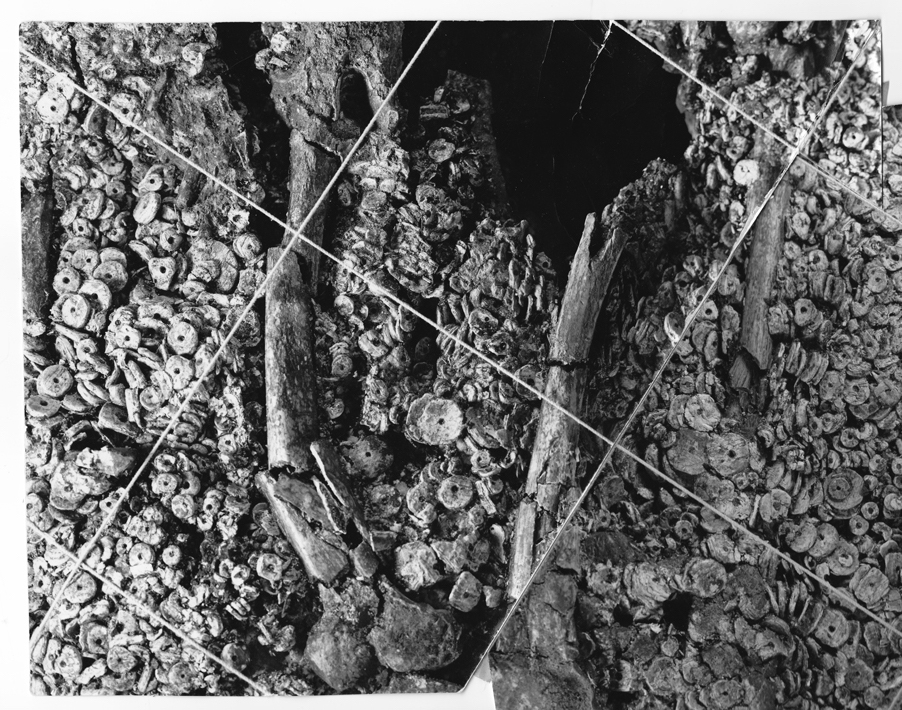
When Putnam excavated burials in one of the conical mounds near Serpent Mound, he discovered artifacts such as projectile points that later archaeologists identified as typical of the Adena culture. The Adena people lived in what is now Ohio and West Virginia during the Early Woodland period (ca. 1000–100 b.c.). They were likely not a single unified people but rather related groups of farmers. The Adena constructed large mounds, most of which were burial complexes. Many scholars have assumed that the Adena built Serpent Mound, too, even though Putnam had found no burials within the earthwork itself.
In 2011, a team led by geologist G. William Monaghan and geoarchaeologist Edward W. Herrmann, both of Indiana University, took soil samples from inside Serpent Mound and appeared to have identified the original ground level on which it was built. They analyzed radiocarbon dates of organic material in the soil and dated the initial building period to around 300 b.c., seeming to confirm that the Adena created the mound. “We’re really confident that we obtained a consistent set of dates on organic matter that was on the surface when the mound was built,” says Herrmann. The team also determined that the mound was later repaired around 1100 by the Fort Ancient people, who farmed corn and lived in the Ohio River Valley from a.d. 1000 to 1750.
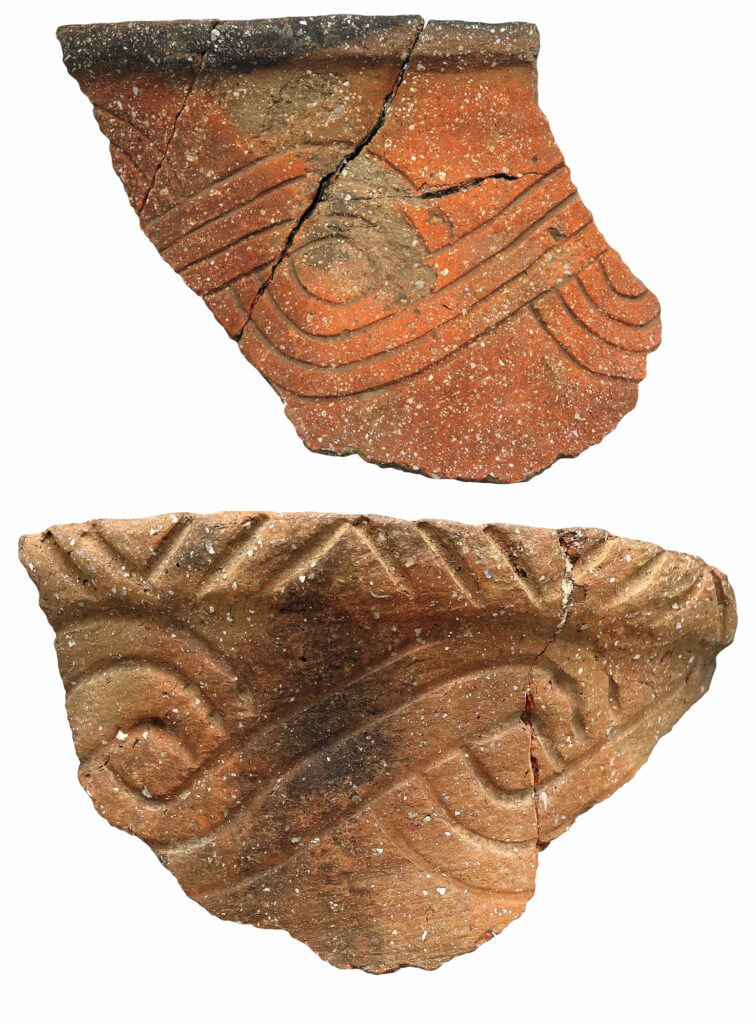
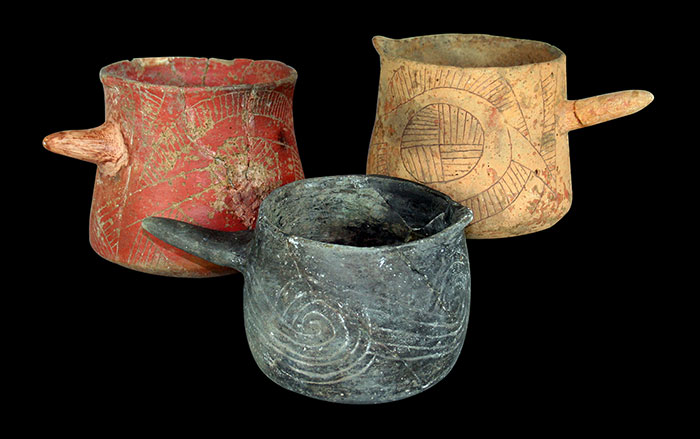
Pottery made between A.D. 1000 and 1750 by the Fort Ancient people of the Ohio River Valley features a sinuous design archaeologists believe may depict intertwined serpents.
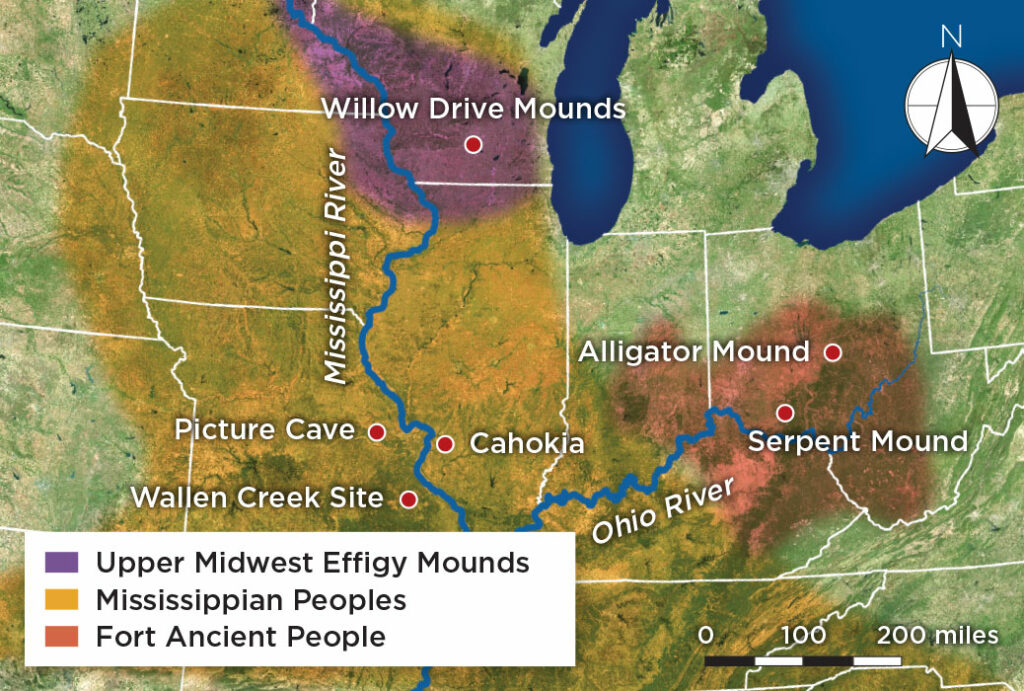
However, the early dates didn’t sit right with Lepper. For one thing, scholars have not conclusively identified any other effigy mounds built by the Adena people. In fact, Serpent Mound is one of only two effigy mounds known in Ohio. The other, located some 100 miles northeast of Serpent Mound, is a 250-foot-long depiction of a four-legged creature with a curved tail known as Alligator Mound, which was also surveyed by Squier and Davis. Most effigy mounds in North America were constructed as burial monuments in the Upper Midwest, especially in what is now Wisconsin, between roughly a.d. 600 and 1200, well after the heyday of the Adena culture. Researchers are also unaware of any similar examples of uncoiling serpent iconography in Adena art, while one of the most prominent symbols in Fort Ancient art was the serpent.
Lepper believes that the earliest radiocarbon dates recorded by Monaghan and Herrmann may be misleading and that the mound was actually built during the Fort Ancient period, a conclusion supported by radiocarbon dating of charcoal he recovered from the base of the earthwork in 1991. He suggests it’s possible that organic acids in the soil, called humates, skewed the radiocarbon dates of samples taken by the Indiana University team from within the mound. “When you date soil humates, they typically give dates that are too old, because it’s organic material that has been in the soil for a long time,” Lepper says. “If you go out and dig up a piece of sod in your front yard and put it in a radiocarbon dating machine, it’ll date to one hundred, two hundred, some number of years earlier, because those are the ages of the organic acids in the soil.” Hermann, however, points to the consistency in dates taken from multiple locations at the base of Serpent Mound to argue that the early dates are likely correct. Lepper and Herrmann agree that new excavations could definitively establish when the mound was first constructed. In deference to the wishes of the tribes most closely affiliated with the site, however, archaeologists have no plans to re-excavate Serpent Mound. “Someday, the tribal nations may have questions that they want to answer with non-invasive methods or even, perhaps, with targeted excavations,” says Lepper. “But that will be for them to decide.”
In the absence of agreement over the radiocarbon dates of Serpent Mound, Lepper has sought to understand the earthwork’s origins by exploring possible meanings of its iconography. He notes that curvilinear imagery resembling entwined serpents appears on Fort Ancient pottery. The serpent also plays a special religious role for the Shawnee, who many scholars believe are descendants of the Fort Ancient people. The Shawnee are an Algonquian nation, whose original homelands surround the Great Lakes, and they are one of the only Algonquian people with a clan that is represented by a snake. In some versions of Shawnee cosmology, four serpents support the four corners of the Earth.
Chief Ben Barnes of the Shawnee Tribe, headquartered in the town of Miami in northeastern Oklahoma, sees several lines of evidence connecting the Shawnee to the Fort Ancient people in general and to Serpent Mound in particular. These include tribal oral histories, similarities in cultural practices, and the fact that both the Fort Ancient people and the Shawnee once made their home in southern Ohio. “You have the right time, the right place,” says Barnes. “And then you have information from the ethnography of our people where we have a serpent clan.” He also points out that the Shawnee perform dances that wind like a snake, and compares Serpent Mound to the Shawnee Msi-kinepikwa, or “great snake,” a massive and powerful underwater serpent central to Shawnee oral history. For Barnes, reconnecting with Serpent Mound is one step in restoring some of what the Shawnee lost when they were forced from their ancestral lands in Ohio two centuries ago. “Perhaps one of the biggest losses for removed peoples is that the ancient stories of those places are now lost to time,” he says.
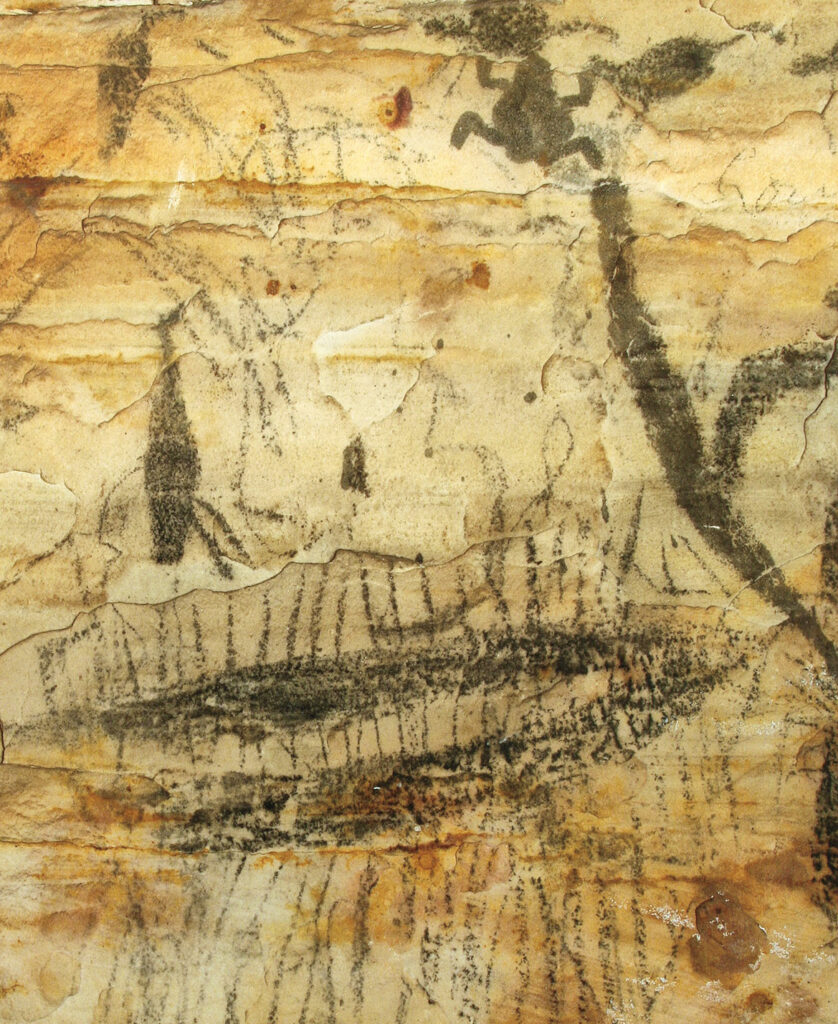
Lepper gained additional insight into the mound’s iconography when he came across a recent book exploring rock art at a site in Missouri by archaeologists Carol Diaz-Granados of Washington University in St. Louis and James R. Duncan, former director of the Missouri State Museum. While paging through the volume, one particular example reminded him of Serpent Mound. “I came to a panel that seemed to show a serpent and an oval that was very similar to the iconography at one end of Serpent Mound,” says Lepper.
The painted rock art panel that caught his eye is from Picture Cave, some 500 miles west of Serpent Mound. The cave’s walls are covered with vivid pictographs created by Mississippians, a name archaeologists give to a number of different peoples that flourished in the Mississippi Valley and the American Southeast from around a.d. 700 to 1600. Mississippians lived in large towns, built platform mounds, and cultivated several varieties of corn. Scholars believe the art in Picture Cave was made by Mississippian peoples who were the ancestors of five modern-day tribes who speak Dhegiha Siouan languages, including the Osage Nation and the Omaha Tribe of Nebraska. The cave is on private land, which was sold to an unnamed buyer at auction in 2021 despite the strong objections of the Osage Nation.
The panel at Picture Cave that drew Lepper’s attention features three adjacent pictographs. One shows what is clearly a serpent, while another takes the shape of an oval, run through with many lines. The third pictograph features a small, squat figure with four limbs that might be a human or possibly an animal such as a frog. All three pictographs seem to have been painted using the same pigment and the same technique, as though the work of the same hand. This suggests they are part of a single composition.
Lepper immediately saw a connection between the Picture Cave rock art and Serpent Mound. He recalled a map of the mound published in 1885 by John P. MacLean, a minister and archaeologist who had conducted a survey of the earthwork the year before. MacLean’s plan recorded parts of the site that Squier and Davis had missed when they documented it in 1846. On MacLean’s map, Lepper saw that the earthwork had once had an additional small, four-limbed figure located beyond the oval mound at the serpent’s mouth. MacLean thought the figure resembled a frog. Putnam believed the larger earthwork depicted a snake swallowing an egg and that the smaller “frog” figure was extraneous to the story embodied by Serpent Mound. He chose not to restore this figure and installed a trail that allowed visitors to walk over it, trampling the small earthwork and effectively erasing it from the landscape. Lepper thought it was unlikely that the lost figure and the oval mound were intended to depict a frog and egg. But he remained uncertain what the symbols might have meant to the people who created them.
Collaborating with Osage elders, Diaz-Granados and Duncan identified the four-limbed figure at Picture Cave as First Woman, the mother of all living things in Dhegiha Siouan tradition. The serpentine figure they interpreted as the Great Serpent, and the large oval as First Woman’s genitalia. Taken together, the three pictographs could represent a scene from the Making of the Earth, a creation story that is central to Osage cosmology. In the story, which begins in the heavens, the Great Serpent’s children kill First Man after a stickball game. First Man and First Woman’s twin grandchildren retaliate by attacking and defeating the Great Serpent’s children. Because the twins then treat the Great Serpent with honor, he bestows a gift on First Woman by having intercourse with her. This act fills her with the power she needs to create Earth and all of its creatures. The team concluded that the Picture Cave pictographs show First Woman’s union with the Great Serpent.
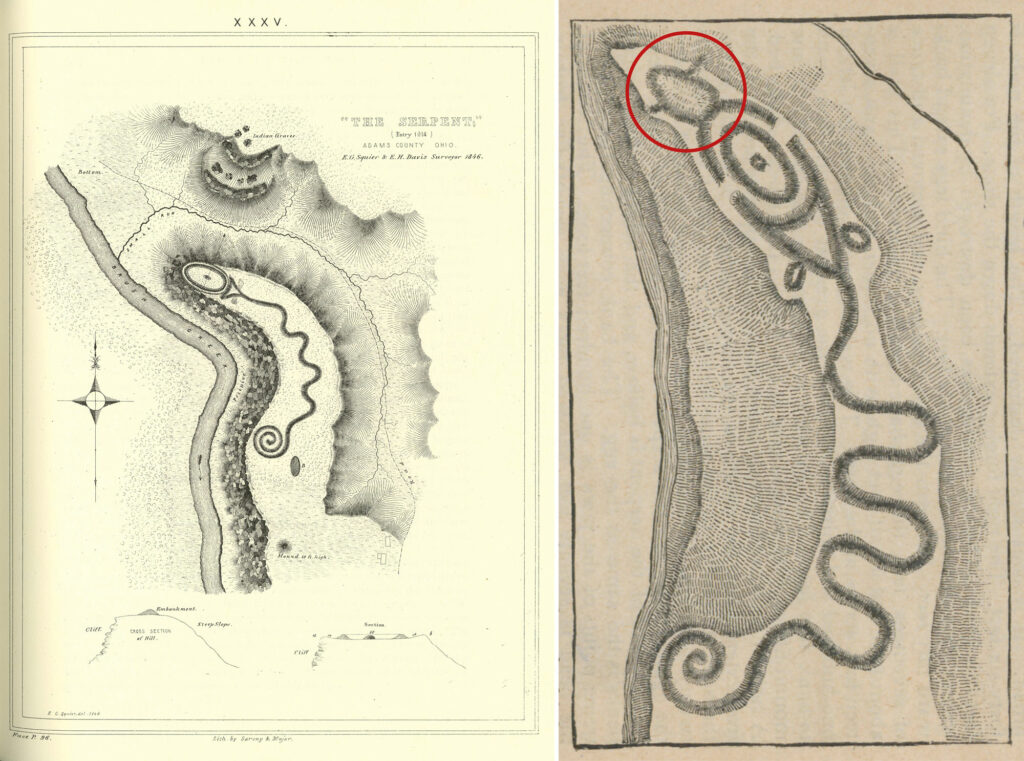
Lepper contacted Diaz-Granados and Duncan and worked with them to compare Serpent Mound’s iconography to characters and scenes in the Making of the Earth story illustrated in Picture Cave. They concluded that Serpent Mound and the now-vanished small four-limbed mound are akin to Picture Cave’s images of the Great Serpent and First Woman, while the oval earthwork resembles the depiction of First Woman’s genitalia. The key to understanding how the site embodies the creation narrative, Lepper believes, is the stone platform Squier and Davis discovered within the oval earthwork and identified as a possible altar. The platform’s location at the center of the earthwork suggested to Lepper that its purpose was to both conduct rituals for the dead and serve as a portal of creation connecting Earth and the heavens.
The researchers have now identified additional images of serpents and ovals in mounds, rock art, and artifacts across the Midwest and as far north as the Canadian province of Ontario. On the campus of the University of Wisconsin–Madison, for instance, the Willow Drive effigy mound group depicts a scene they believe is closely analogous to Serpent Mound. It seems to portray a snake next to a humanlike figure with legs spread. A petroglyph at the Wallen Creek site in eastern Missouri is even more explicit, showing a human figure, interpreted as First Woman, in the act of coitus with a serpent.
These examples, and many others depicting this narrative, all seem to have been created around 1180. A severe drought at this time afflicted the Mississippian heartland, which was centered around the city of Cahokia near present-day St. Louis. Scholars studying historical precipitation levels and Mississippian population movements believe this drought may have pushed waves of immigrants from the Mississippi Valley northeast into the Ohio Valley. It’s possible that these new arrivals brought the story of First Woman and the Great Serpent with them, and that they helped build Serpent Mound to embody this creation narrative.
For Barnes, the origins of Serpent Mound are not found in Mississippian migration but in the beliefs of his Shawnee ancestors. “It’s important for us to say we think we have a stake here in this site,” he says. “Arguably, I think ours is the tightest claim.” Barnes points to the absence of Mississippian varieties of corn in the Ohio Valley, where the Fort Ancient people grew their own varieties. Mississippian farmers, he says, would have brought their corn seeds with them. Lepper suggests that both Barnes and archaeologists who believe Mississippians migrated to the Ohio Valley may be right in different ways. He suggests that a cultural fusion took place between the Fort Ancient people and new Mississippian arrivals, and that the Shawnee inherited the rich and complex traditions of both peoples.
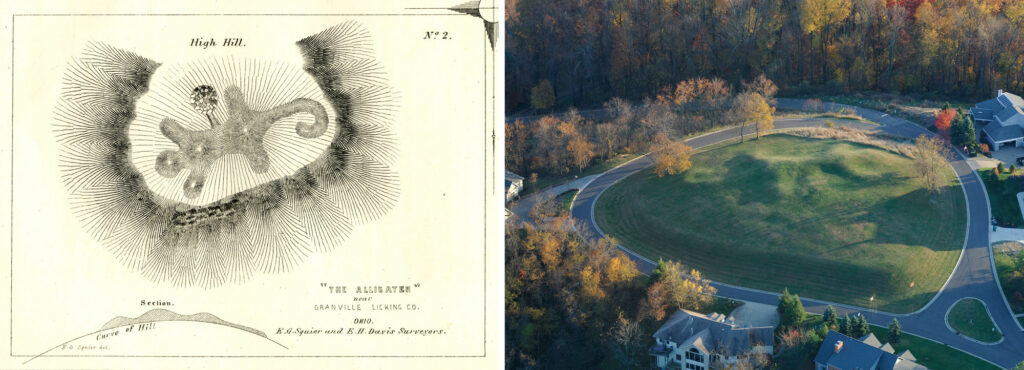
Recently, Lepper made a surprising discovery about Alligator Mound that could strengthen the case that Serpent Mound was created by people with Mississippian cultural ties. For decades, archaeologists have noted that Alligator Mound bears a striking resemblance to effigy mounds in Wisconsin that depict Underwater Panther, a powerful being known as Lord of the Beneath World in many Native American traditions.
Alligator Mound is situated in a residential neighborhood in Ohio’s Licking County, whose historical society recently received a donation of nine artifacts unearthed from inside the earthwork’s right hind leg during a 1925 amateur excavation. Lepper first learned of the artifacts in early 2026 and found that they include a coal pendant and other objects typical of the Fort Ancient culture. He believes this provides additional evidence that the Fort Ancient people built both Serpent Mound and Alligator Mound. Lepper also determined that the artifacts were possibly grave goods. Before these artifacts came to light, no evidence of burials had been discovered at either of Ohio’s effigy mounds, whereas virtually all the effigy mounds in the Upper Midwest are known to be mortuary monuments. Absent new excavations at either site, the Alligator Mound artifacts are likely to provide the best evidence that the two earthworks may have served as burial mounds and were built in the wake of Mississippian migration to evoke some of the most powerful figures in the cosmology of the Fort Ancient people.
Further Reading
Artists of the Dark Zone
How archaeologists discovered Native American rock art deep in the caves of Tennessee
Letter from Wisconsin: People of the Sacred Voice
The Ho-Chunk maintain a strong connection to their ancestors’ vast network of mounds
Ohio History Connection
The state historical society of Ohio maintains a trove of information about Serpent Mound