Tennis, Anyone?

Features July/August 2026

Discovering the origins of the peculiar racket game that swept sixteenth-century France
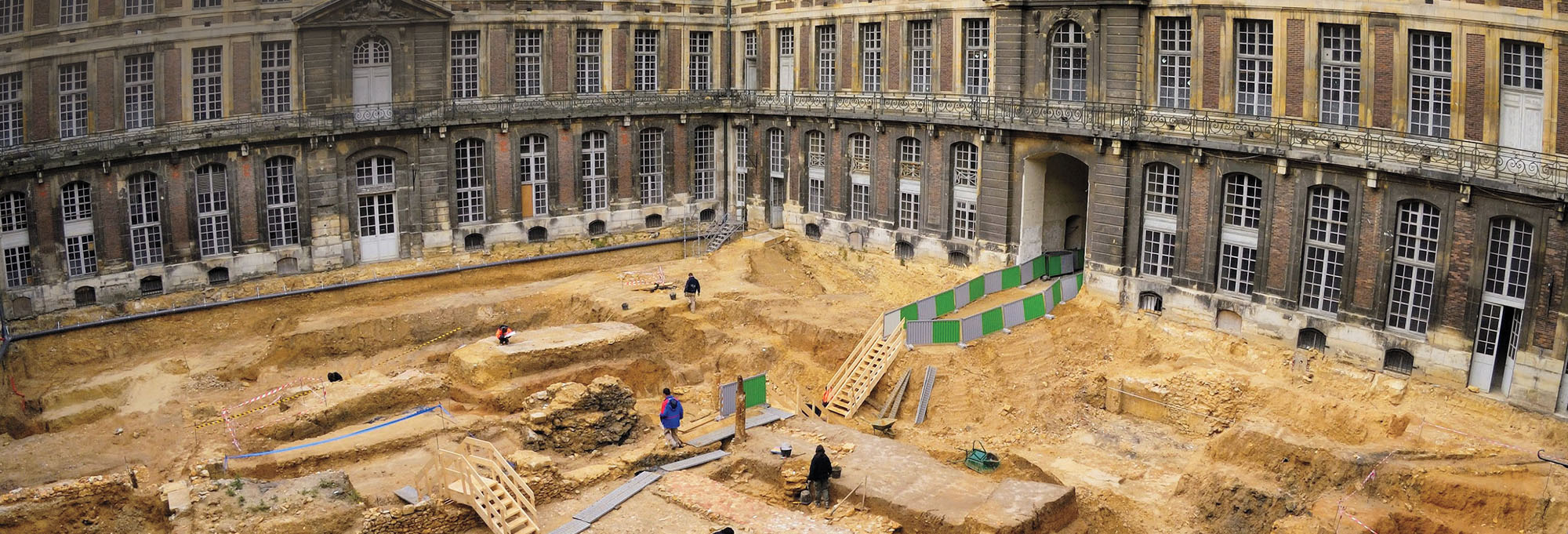
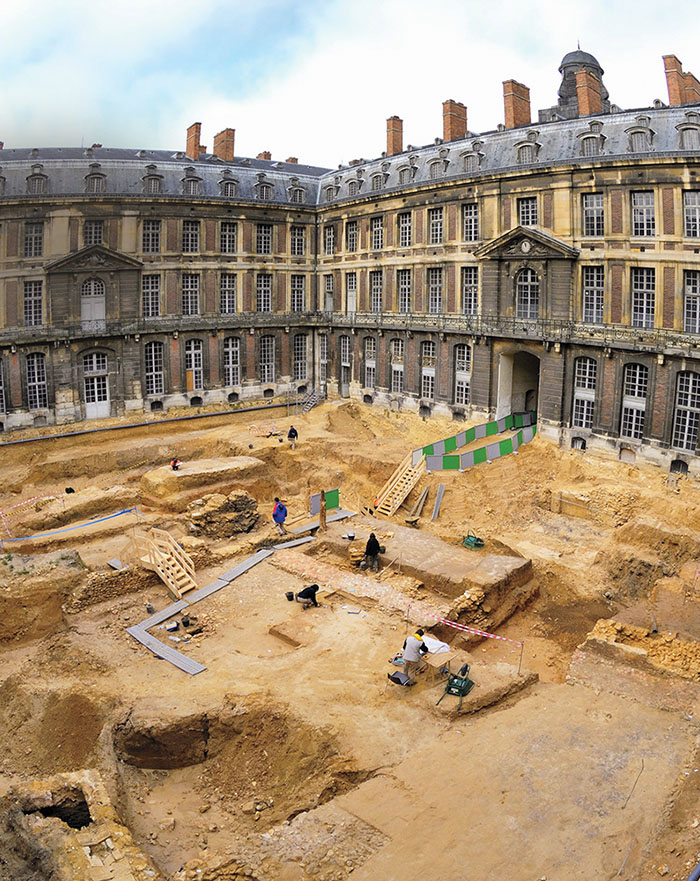
King Louis XIII's jeu de paume court at the Palace of Versailles King Louis XIII's jeu de paume court at the Palace of Versailles
© Denis Gliksman, Inrap
SHARE:

Like many city folk in seventeenth-century France, Jean Gascard rented a small apartment—in his case, a two-room, 600-square-foot abode. He ate a lot of salted fish. He signed paperwork with an X, as he did not know how to write. Yet archaeologists have become intensely interested in how Gascard lived. From at least 1631 to 1637, he served as the first maître paumier, or tennis master, in residence at the Palace of Versailles. King Louis XIII (reigned 1610–1643) was a die-hard devotee of the game who had personally overseen the design of his court, revising the royal architect’s original plans to factor in how sunlight and wind might affect his play. The tennis-mad king ruled a tennis-crazed land. The people of sixteenth- and seventeenth-century France couldn’t get enough of jeu de paume, or “game of the palm,” the precursor to the modern sport. There were at least 250 courts in Paris alone in the late sixteenth century—“two tennis courts for every one church,” English traveler Sir Robert Dallington estimated during his 1598 visit. “Ye would think they were born with rackets in their hands,” he marveled upon witnessing the elegant strokes of women, men, and children around the country. “Jeu de paume was as popular in the sixteenth century as football is today,” says archaeologist Jean-Yves Dufour of the French National Institute of Preventive Archaeological Research. 
No one was closer to the action than Gascard, the son of a tennis master and father of tennis masters, whose humble apartment abutted the indoor royal court. The maître paumier’s duties most likely started with maintaining the nets, balls, and court. During excavations at the paumier’s home and the site of the court, Dufour’s team recovered ornately decorated knobs and handles for wooden furniture, along with copper alloy tacks likely used to hang rackets, suggesting that Gascard stored and maintained equipment around the facility. Archaeologists also found glazed earthenware in the tiny apartment’s cellar. Gascard may have served the players après-match snacks. Archaeologists were curious about the contents of ceramic cooking pots, stoneware storage jars, and sandstone pitchers typically used to serve water. The team analyzed residue found in these vessels and determined that several had been filled with elixirs concocted with some combination of red wine, fruit, pine resin, lard, and fish oil. Gascard may well have mixed these piquant tonics, dispensing courtside sports medicine to perk up fatigued players or fortify injured athletes. “We were surprised,” says Dufour, “that a ceramic water bottle was, in fact, full of alcohol and stimulating substances.” 

According to records, registers, and reflections of tennis fans from the sixteenth through eighteenth centuries, paumiers crafted balls and rackets, scored games, coached aristocrats, and operated billiard tables for visitors interested in lower-impact leisure. They kept the books for the many, many people who bet on matches—often the paumier’s most lucrative gig. Dufour wondered whether, in addition to these assorted duties, the paumier was also an accomplished player: “Could we find proof that the master was an athlete? What did he eat? Was he fit?” Antoine-Henri Masson, one of eight paumiers on the roster of King Louis XVI (reigned 1774–1792), regularly bested the top talents of both the French and British. Masson was the undisputed GOAT, the Roger Federer of his day—if Federer had perfected maneuvers such as jumping in and out of a barrel in the middle of a point or rallying from astride a donkey. Another Parisian ace supposedly had to entertain 2,000 women who flocked to cheer him on during one day of games in 1648, irritating the paume court’s neighbors. Leaving no bone unturned in the garbage pits of Versailles’ seventeenth-century paumiers, Dufour’s team found that Gascard and his successors maintained a diet of preserved herring and cod, as well as sinewy shoulder cuts of beef and goat, but little in the way of delicacies such as peacock and turkey. Archaeologists may not know Gascard’s win-loss record, but they can show that he dined more like an everyman than a champion.

“Jeu de paume was played in the country, in the suburbs, in city marketplaces, and around churches—anywhere you had enough space,” says archaeologist and sports historian Serge Vaucelle of the University of Toulouse. Yet archaeologists had never investigated a jeu de paume court until 2006. That year, Dufour’s team excavated a courtyard in Versailles ahead of planned renovations and unearthed the foundations of a large open room dating to the seventeenth century that they later determined had been the tennis hall of Louis XIII. Archaeologists across France soon discovered that many courts from the country’s golden age of paume were hiding in plain sight, overshadowed by the ruined walls of castles or obscured when the courts had been refurbished to be used as theaters, concert halls, warehouses, and stables. As they surveyed and excavated ever more courts, researchers began to uncover floor surfaces, spectator galleries, and in-game hazards. Now, they’re deploying the full arsenal of archaeological techniques at the sites. These include radiocarbon dating, dendrochronology, archival research, experimental archaeology, and analysis of ceramics, pigments, and stone. Researchers are learning how the game was played, how it evolved, and how ideas about class and society came to the net. “With this ball game that seems unimportant,” says Vaucelle, “we can better understand how people organized their leisure, their attitudes, and their lives.”

In medieval France, jeu de paume referred to any net-and-ball game played with rackets, bats, or even the palm of one’s hand. Playable with any number of people in any open area, the aim of longue paume, or “long palm,” was to control the field, Vaucelle says, forcing the opposing team back in their defensive zone, as in soccer and rugby. Two important developments shaped the game that would become known as courte paume, or “short palm,” also called “court tennis” or “real tennis” by English speakers. One was the expansion of universities and military garrisons in cities, which brought youths streaming into narrow streets armed with rackets, projectiles, and a zeal for whacking trick shots off building facades. The other was the displeasure of shopkeepers, craftspeople, and homeowners at having their windows broken and noggins beaned when their neighborhoods became impromptu game turf.

Aristocratic aficionados of the game started building their own enclosed playing areas in which they could swing at walls and gamble freely without risking police intervention. In 2015, Vaucelle began excavating a paume court dating to the 1550s at the castle of Suze-la-Rousse in southeastern France, an early example of the setting for courte paume. Today, the space looks like a featureless pen, 107 feet long by 35 feet wide, but Vaucelle and his team could tell a great deal by scrutinizing its stone walls. The walls facing the court were clad with limestone blocks mortared using a technique that ensured they were perfectly flush. An expert in medieval tools examined marks on these surfaces and determined that they had been smoothed using three or four different types of awls and chisels. Competitors were thus able to play balls off the walls, as they do in racquetball or squash. Traces along three walls demarcated where wooden lean-to structures with sloped roofs had once stood. Called galleries, these structures intentionally mimicked rows of dwellings in the medieval cityscape of the old open-air pastime. The galleries were fair game—players could hit balls off their roofs. They also housed spectators, who risked serious injury until protective nets were installed. At Lourdon Castle in the region of Burgundy, a local ruler commissioned a court in 1586, even as civil wars embroiled the region. A gallery was positioned alongside a wall that doubled as a rampart. “You have a cannon terrace right next to the court,” says castellologist Hervé Mouillebouche of the University of Bourgogne.

At the Suze-la-Rousse court, archaeologists searched for hazards and targets that made courte paume akin to mini golf. Such targets, Vaucelle says, could include wooden sticks and holes in the walls or gallery structures. Hitting each earned a point. Vaucelle identified a section of wall that protruded into the playing area at an angle. This obstacle, called a tambour, or “drum,” would have stood next to a grille, a windowlike target in the backcourt. A missed shot at the grille would rebound off the tambour, plopping the ball at midcourt. “Now you can attack, even though just before you were on the defensive,” says Vaucelle. “You were in trouble, and very suddenly you are in a good position.”

During their study of the court, archaeologists noted some considerations that modern tennis court designers would endorse, such as the orientation of the court, which minimized the sun’s glare in players’ eyes. Other relics of jeu de paumepersist in the modern game as well. Tennis’ odd 15-30-40 point system derives from paume. Its origin is murky, but one theory is that the numbers represented denominations of French coinage that onlookers could use to bet on each point. Court tennis is still played in a few countries, tambour and all.

Before Dufour’s excavation of the Versailles jeu de paume court, scholars had pieced together its 1629 plans, largely from details in construction contracts. Archaeologists discovered that the actual structure deviated substantially from the plans, which had called for grand arched windows above the playing area. The final build tossed out the ostentatious apertures in favor of simple rectangular openings. Also absent from the plans were a cistern and latrine, both of which archaeologists found adjoining the hall. Dufour believes that Louis XIII himself overhauled the plans. Perhaps His Majesty deemed the fancy windows frivolities but toilets and drinking fountains necessities. “When Louis XIII built Versailles,” says Dufour, “it wasn’t open to the public, it wasn’t full of art, and the game court was simple.”

An eighteenth-century tennis treatise pronounced that a court’s walls should be coated black to make the white ball stand out, suggesting a blackening recipe of ox blood and bile, soot, and urine. At Versailles, Dufour’s team recovered fragments of blackened plaster and stone and sent them for microspectroscopic analysis, a technique in which a sample is pinged with a laser beam to identify its chemical makeup. The results showed that the king’s court had been painted with a black pigment containing finely ground charcoal instead of the more rustic mixture prescribed by the treatise. Archaeologists also unearthed terracotta floor tiles from the original playing surface and limestone slabs installed later to replace them.

In 2015 and again in 2022, archaeologists surveying the old university district in the city of Orléans, 75 miles south of Paris, extracted the first known jeu de paume balls dating to early modern France from holes in the exterior walls of medieval houses. The balls, which are about 1.6 inches in diameter, were made of woven fabric, probably hemp, and covered with a leather wrapping. Little survives of the stuffing, but enough remained to determine it was compacted wool, which archaeologists radiocarbon-dated to the sixteenth or seventeenth century. Vaucelle then enlisted physicists to bounce balls off old floors. They thwacked modern balls used to play court tennis against seventeenth-century terracotta tiles and limestone pavement taken from Versailles, capturing their velocities and trajectories with a high-speed camera. The researchers found that limestone was more durable, which would have made it cheaper to maintain than terracotta; thus the owners of tennis courts found it worthwhile to make the switch. “I was quite disappointed to find it was not done to improve game quality,” says Vaucelle. “The bounce is not much better.”

In the late seventeenth century, nobles began to lose interest in playing paume. King Louis XIV (reigned 1643–1715) demolished his father’s paume court in 1681. “Paume became a court spectacle which the king and his family attended to see the exploits of the paumiers,” says archaeologist Annick Heitzmann of the Palace of Versailles Research Centre. One paumier built a new hall for royal amusement in 1686 just outside the palace.

On June 20, 1789, representatives of the upstart National Assembly arrived at Versailles to challenge the aristocracy’s domination of the French government. Locked out of their usual meeting place near the palace, the representatives quickly thought of another chamber that could hold 500 men—and the paumier ushered them in. With townspeople crowding the galleries, the representatives signed the Tennis Court Oath, a pivotal statement of the French Revolution.

Jeu de paume had always belonged to the people, long before the revolutionaries or tambours or even rackets. Some of its amateur practitioners can be glimpsed in the sports pages of history. A woman named Margot showed up in Paris in 1427 and “played better than any man had ever seen,” defeating most male challengers with “great power and great cunning,” wrote a Parisian chronicler. A hapless boy in 1609, one Henri de Verneuil, was immortalized in the diary of the royal physician for regularly finding himself on the losing end of the future Louis XIII’s savage racket. “It’s a miracle when he hits a shot,” the seven-year-old prince yapped. “They should sound the trumpet.” 

Dufour was particularly excited a few years ago to excavate a public city court whose doors had been open to all comers. The jeu de paume hall in the town of Chinon, in western France, had remained standing for centuries after the last point was scored. Dufour’s team identified some of the telltale markers they’d seen at Versailles, such as traces of blackening mixture on the walls and fragments of terracotta tiles. Most impressive was the largely intact trusswork supporting the roof. Dendrochronological analysis indicated the timbers used to build it had been hewn from trees felled in 1590, the peak of tennis mania. The Chinon court had both lower galleries and an upper platform for more spectators 15 feet above the floor. Fans in these nosebleed sections were protected from losing their footing and plummeting to the floor below by only a flimsy wooden railing. “The court was for anybody who had some time and a little money to spend, not only for lords,” says Dufour. “In jeu de paume, you can play if you’re rich or poor. You can play badly or well. The rebound of the ball is irregular. Even if you’re the best, you have to be ready for anything. That’s what I think made the game popular. It mirrors the unpredictability of the flow of life.”

Slideshow: A Tennis-Crazed Land

All you needed to play was a ball, a net, and a couple of friends. Jeu de paume, or “game of the palm,” first became a popular diversion in western Europe during the thirteenth century, and the French got hooked. By the late sixteenth century, everyone played paume, the ancestor of modern tennis—kings and commoners, laypeople and clergy, women and men. The early game was played in fields or city streets. Enthusiasts picked up rackets, put down money on games, and smacked shots off roofs and facades. A slightly more restrained style of paume was played in tennis halls, some built for townspeople, others ensconced in the châteaus of aristocrats. Chroniclers estimated that by 1600 there were more than 250 courts in Paris.

With the discovery of Louis XIII’s (reigned 1610–1643) tennis hall during rescue excavations at the Palace of Versailles in 2006, archaeologists became students of the game. Over the past two decades, they’ve unearthed courts around the country and learned to identify how the floors were paved, the walls were painted, the balls were stitched, and odd in-game targets were positioned. Archaeologists have found courtside amenities such as latrines, changing rooms, and even evidence of possible tonics gulped to soothe aches and sprains. Their findings are a highlight reel of France at play amid the turbulent political, economic, and religious changes that shaped the early modern era.

Further Reading

The Pursuit of Wellness
How the ancients attended to mind, body, and soul

Bringing Back Moche Badminton
How reviving an ancient ritual game gave an archaeologist new insight into the lives of ancient Peruvians

A New View of the Birthplace of the Olympics
Taking an innovative approach to one of ancient architecture’s most intriguing questions

Artifact Spotlight: Subeixi Game Balls
Three young men buried in China in the first millennium B.C. went to the afterlife equipped for a ball game

  • Features July/August 2026

    Secrets of the Serpent

    Is a Native American origin story embedded in Ohio’s colossal earthwork?

    Read Article
    Serpent Mound
    Timothy E. Black
  • Features July/August 2026

    Slinging Insults

    Greek and Roman soldiers fired pointed barbs at their enemies

    Read Article
    Lead sling bullet inscribed with the Greek inscription MATHOU
    Courtesy Michael Eisenberg
  • Features July/August 2026

    Inside Africa’s Houses of Stone

    Archaeologists are rethinking how kings shared power beyond the great capitals of medieval Zimbabwe

    Read Article
    Ad/AdobeStock
  • Letter from Boston July/August 2026

    In the Shadow of Bunker Hill

    The forgotten lives of the townspeople who lost everything in the early days of the American Revolution

    Read Article
    A late eighteenth-century painting titled View of the Attack on Bunker's Hill, with the Burning of Charles Town
    National Gallery of Art