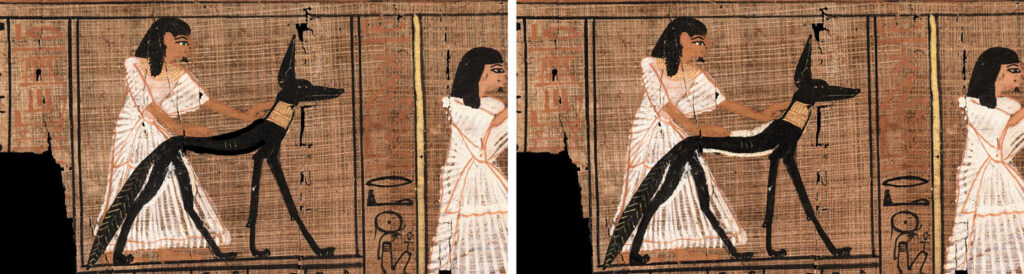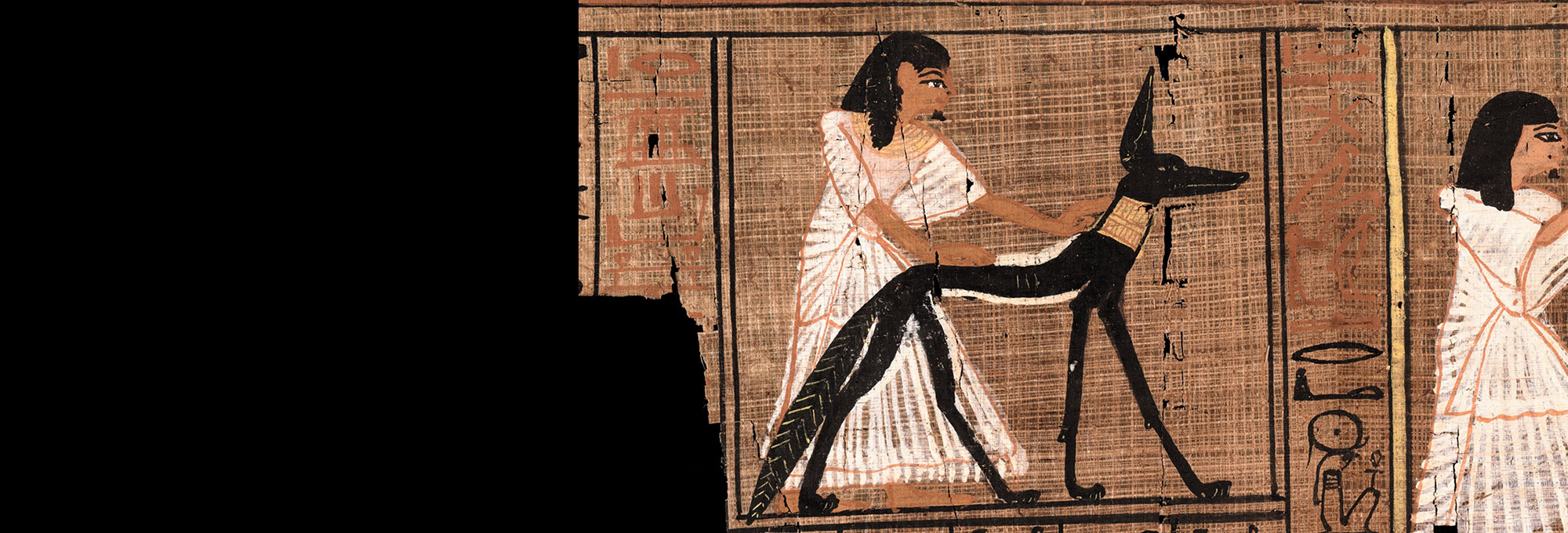
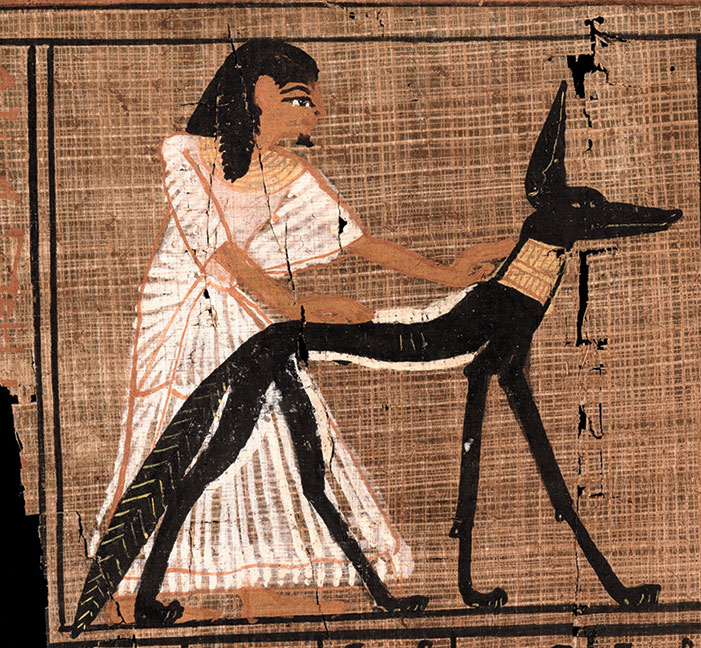
A painted vignette in a copy of a funerary text known as the Book of the Dead belonging to an early thirteenth-century b.c. Egyptian scribe named Ramose had a problem: The jackal in the scene was too chunky. “Perhaps a supervisor, or maybe Ramose himself, felt that the animal looked too much like a well-fed domestic pooch and less like a lean desert scavenger,” says Helen Strudwick, an Egyptologist at the Fitzwilliam Museum. “Somebody had a really detailed eye and said, ‘You know, this isn’t up to scratch. We’ll do it again, we’ll get it right.’” Along with the jackal, which likely represents the underworld god Wepwawet, the scene features a white linen–clad Ramose.
Strudwick noticed that someone had modified the papyrus by adding whitish stripes along the jackal’s body and back legs. By examining the illustration under infrared light, museum researchers could see that part of the jackal’s girthy black body had been covered by the white stripes. Analysis of the stripes revealed that the mixture used to paint them had been thickened with calcium to obscure the black pigment. This was a “correction fluid,” says Strudwick, akin to Wite-Out. The stripes are now visible against the tan papyrus, but they would have blended in with the cream-colored writing surface when it was new. This is the first time Egyptologists have documented the technique, and now Strudwick can’t unsee it. On a different papyrus, she noticed that the beards of gods had been similarly reshaped. And elsewhere in Ramose’s Book of the Dead, a heron’s beak had been slimmed down.