"Here I lie victorious, Diodorus the wretched. After breaking my opponent Demetrius, I did not kill him immediately. But murderous Fate and the cunning treachery of the summa rudis killed me..." -Epitaph
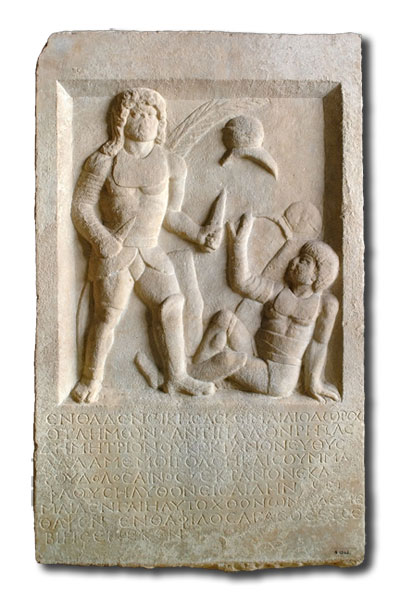
What is it?
Tombstone for the gladiator Diodorus
Culture
Roman
Date
2nd to 3rd century A.D.
Material
Marble
Found
Samsun, Northern Turkey (ancient Amisus)
Dimensions
18 by 12 inces
Currently Located
Musée du Cinquantenaire, Brussels
For modern athletes, there is nothing more frustrating than a referee's blown call. It can cost the player a touchdown or a home run, but in the case of the ancient Roman gladiator Diodorus, it cost him his life. Although Diodorus had, in fact, beaten his opponent Demetrius and taken his sword—the moment depicted on this marble tombstone—the referee intervened, allowing Demetrius to get up and keep fighting, a decision that led to Diordorus' demise. But was the referee, an official in the arena with the gladiators known as the summa rudis ("chief stick"), within his rights to make this call? Despite their great popularity in the Roman world, surprisingly little is known about the rules of gladiatorial contests. By focusing on the scene and the epitaph together, Roman historian Michael Carter of Brock University thinks he has found rare evidence that there were, in fact, rules that governed the combatants, including the right of the gladiator to submit before he was seriously harmed. The epitaph also makes it clear that the summa rudis was able to intervene in order to interpret the rules. Carter believes that understanding how the contests actually operated is key to understanding how spectators experienced this central social activity. "If this were simply murder on display," says Carter, "that's one thing. But since it seems to have been a spectacle of professional gladiators fighting according to established rules and procedures, then that is something quite different."