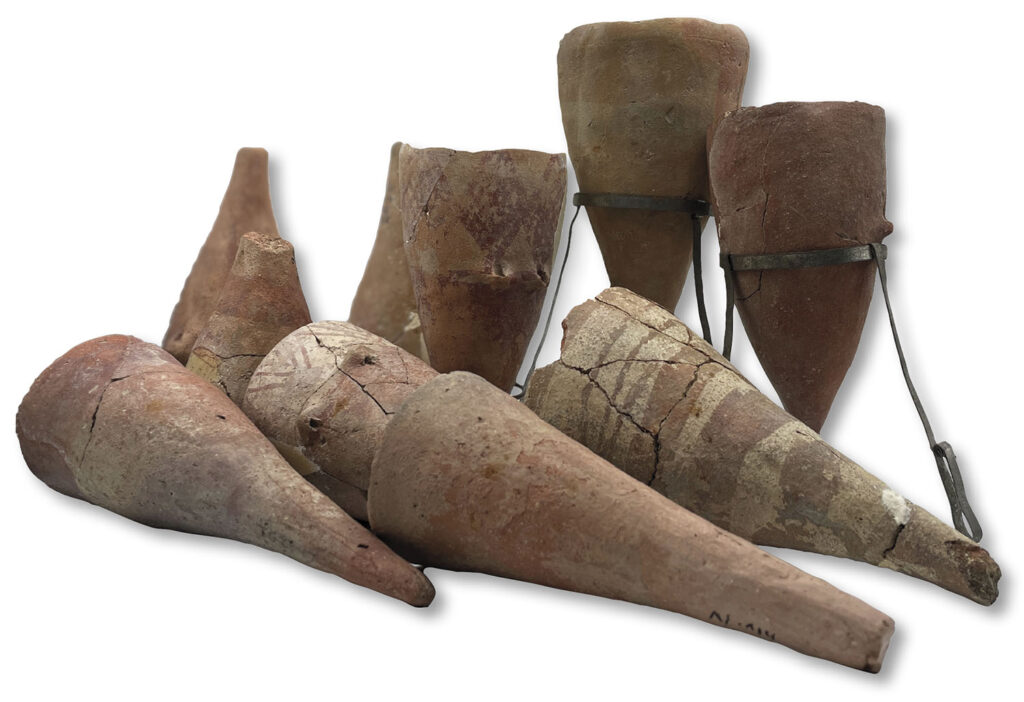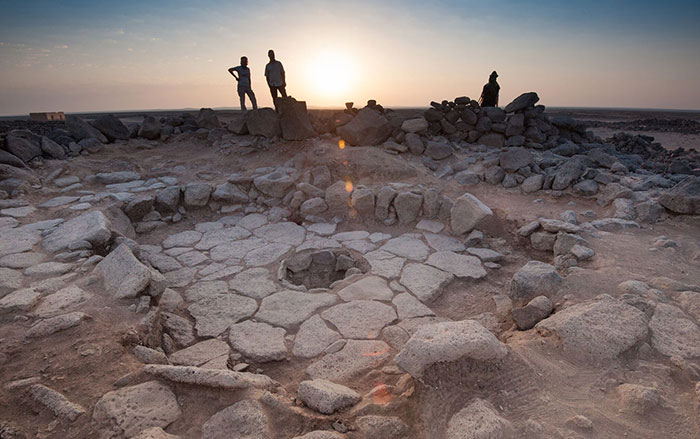
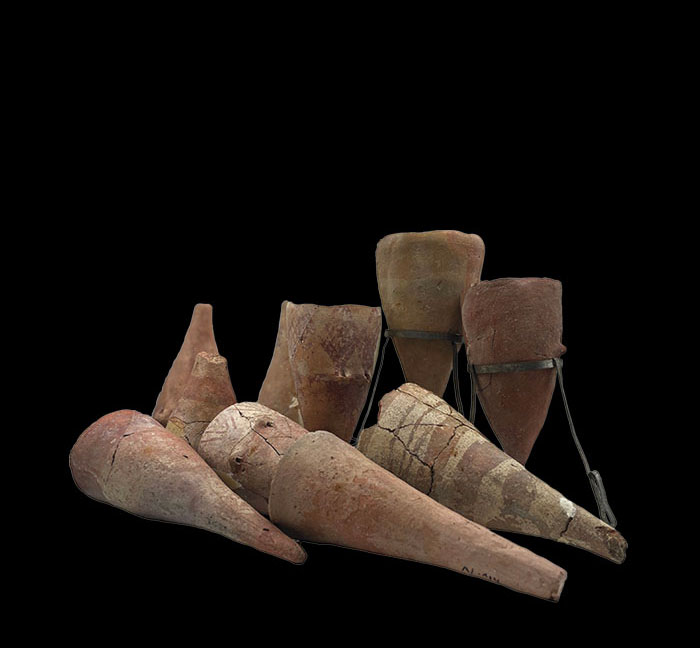
In 1929, when archaeologists began exploring the site of Teleilat Ghassul, just north of the Dead Sea in present-day Jordan, they suspected it might be the Biblical city of Sodom or Gomorrah. In fact, the site was primarily occupied during the Copper Age, between around 4700 and 3800 b.c. Archaeologists concluded Teleilat Ghassul may have been a cult or public center for surrounding villages, but one assemblage of artifacts flummoxed them: hundreds of ceramic vessels shaped like ice cream cones, most broken. “Almost none of these cornets are the same,” says archaeologist Sharon Zuhovitzky of Tel Aviv University, who analyzed nearly 600 sherds. “I thought, ‘Maybe the pattern is that there is no pattern.’”
Based on the discovery of cornets at Teleilat Ghassul and other likely cult centers, Zuhovitzky believes they were ritual objects. She suggests that individual families had their own traditions of crafting the cones. “You don’t need to be a professional to make one,” she says. “If you pray while you make it, then the vessel becomes precious and holy.” A potter herself, Zuhovitzky decided to mold cornets modeled after those found at Teleilat Ghassul to help determine how they were made and what function they served. Her attempts were fruitless until she came across a cornet-like object from a fifth-millennium b.c. site in Iran that revealed a useful trick. To make this item, a stick was inserted into a cylinder of clay and then rolled around to produce the conical shape. Using this approach, Zuhovitzky successfully produced a cornet in three tries. She doesn’t believe the cornets were used for drinking, so she tested the reproductions as beeswax candleholders. The cornets would have been easy to grip at the bottom or to hang using cords threaded through small handles on the sides. Zuhovitzky now thinks that the shape was perfectly logical—it protected the flame from the wind and, like a waffle cone, the holder’s hand from melting liquid.