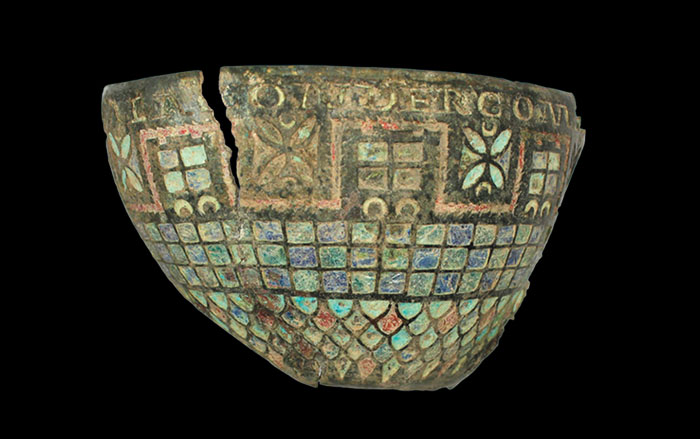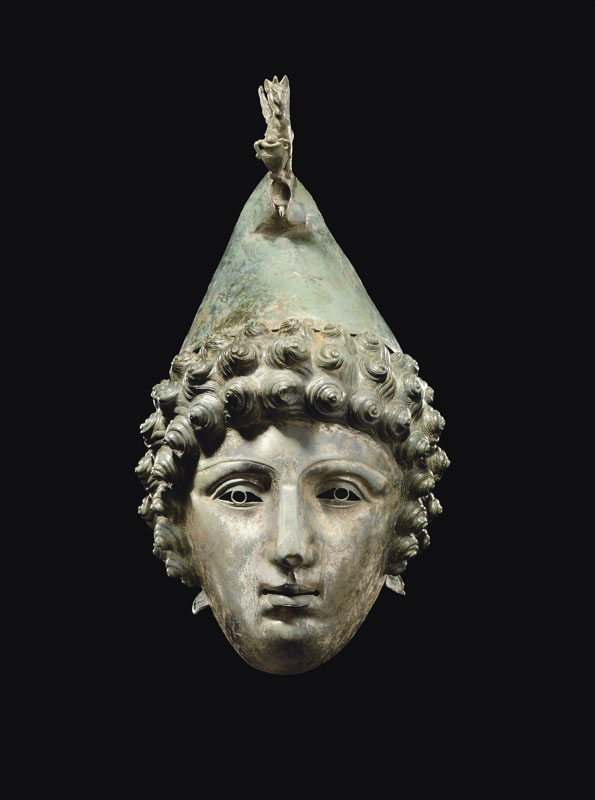
Last May, a 24-year-old man in northern England with a handheld metal detector found the remains of a stunning bronze-and-tin Roman helmet dating to the first or second century A.D. Within days, he had brought 40-some pieces of the artifact—called the "Crosby Garrett helmet" after the village near where it was found—to Christie's auction house in London. There, restorers began reassembling the helmet, preparing it for sale, even reattaching a rare figurine of a winged griffin that would have perched on the peak of the cap and had broken off.
Word of the find soon reached Tullie House Museum in Carlisle, 35 miles north of Crosby Garrett. Within a month, museum officials raised more than $2.5 million to buy the piece at auction, far above the artifact's high estimate of $477,600, and close to the museum's entire annual budget. But when the helmet went on sale in October, a Britain-based collector outbid the museum, paying $3.6 million. As a result, the British public may never see one of the most extraordinary Roman artifacts found on their soil.
Ralph Jackson, the British Museum's chief curator of Romano-British collections, saw the helmet under restoration at Christie's. "You look at the folds of hair, the eyes, the effect of the tinning on the face, and you can see it's an example of top-quality workmanship. And the face has a chillingly serene expression that makes you know that this is someone who's going to kill you," he says.

The case has shocked the British museum world. It has also revealed a gaping hole in the country's Portable Antiquities Scheme (PAS), by which people who find artifacts made of gold, silver, and other precious materials are required to offer them to a museum at fair market value. The law strongly urges metal detectorists and dealers to report all types of archaeological finds, but it does not require them to do so. (The auction house had voluntarily reported the helmet to PAS authorities.) Furthermore, the law doesn't apply to objects made of base metal or bronze, no matter how noteworthy. These shortcomings made the sale of the helmet possible.
"To have it bought by a U.K. private buyer was the worst possible outcome. It's a great loss that everyone very much regrets," says Roger Bland, a British Museum archaeologist and director of the PAS. The sale was an especially bitter pill for Tullie House, whose "Keep It in Cumbria" campaign to buy the helmet had kicked off with a $1.6 million pledge from the government-funded National Heritage Memorial Fund. "Naturally this has been very disappointing, but we're moving forward with several options we would like to pursue with the buyer, including a temporary exhibition or creating a replica," says Andrew Mackay, Tullie House's senior curator. "So far we have received no reply." The anonymous finder—who, along with the owner of the land on which the helmet was found, is now a millionaire—has shown authorities the artifact's exact find spot on a remote hillside, and archaeologists plan to excavate soon, according to Sally Worrell, a PAS officer in London. "But we're trying not to publicize the find spot too much, for obvious reasons," she adds.