

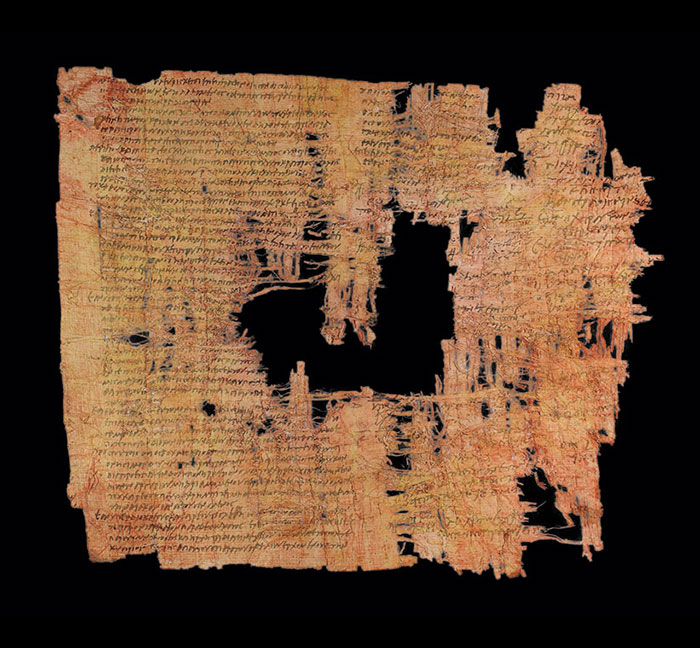
Any good lawyer knows that the most important thing to do pretrial is to prepare and that it’s essential to take good notes during the proceedings. This was certainly true for the attorneys approaching a legal showdown nearly 2,000 years ago in the Roman province of Judea. They used a sheet of papyrus to jot down notes for their arguments and to record transcripts of the trial. In the case, two men, Gadalias and Saulos, were charged with a slew of crimes including forgery and fraud, which they had allegedly committed to evade taxes on the sale and manumission of enslaved people. Four other men who were allegedly part of the scheme are also mentioned, as is another group suspected of forgery. The prosecutors landed the case after an informant alerted authorities to the men’s shady dealings—the document suggests that the informant may, in fact, have been an accomplice trying to save himself. “Tax fraud was considered a crime against the state that was not far removed from treason,” says historian and papyrologist Anna Dolganov of the Austrian Academy of Sciences. “The Roman state was relentless in exerting its claims.”
The 12-by-10-inch papyrus was found, likely by Bedouins, in a cave in the Judean Desert in the 1950s. It was then stored away in a drawer in the Israel Museum with documents written in Nabataean, a local language. Few scholars can read Nabataean, and the papyrus was ignored for decades. In 2014, historian Hannah Cotton of the Hebrew University of Jerusalem was sorting through the drawer and realized that the document was written in Greek, not Nabataean.