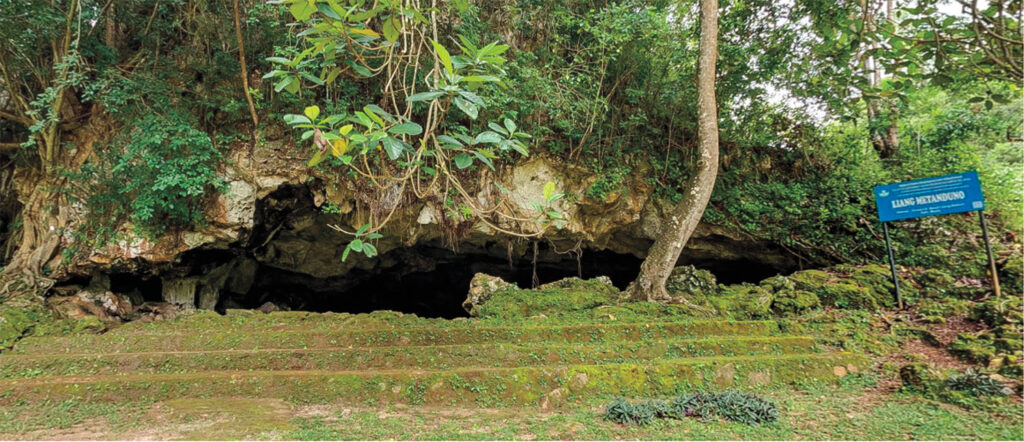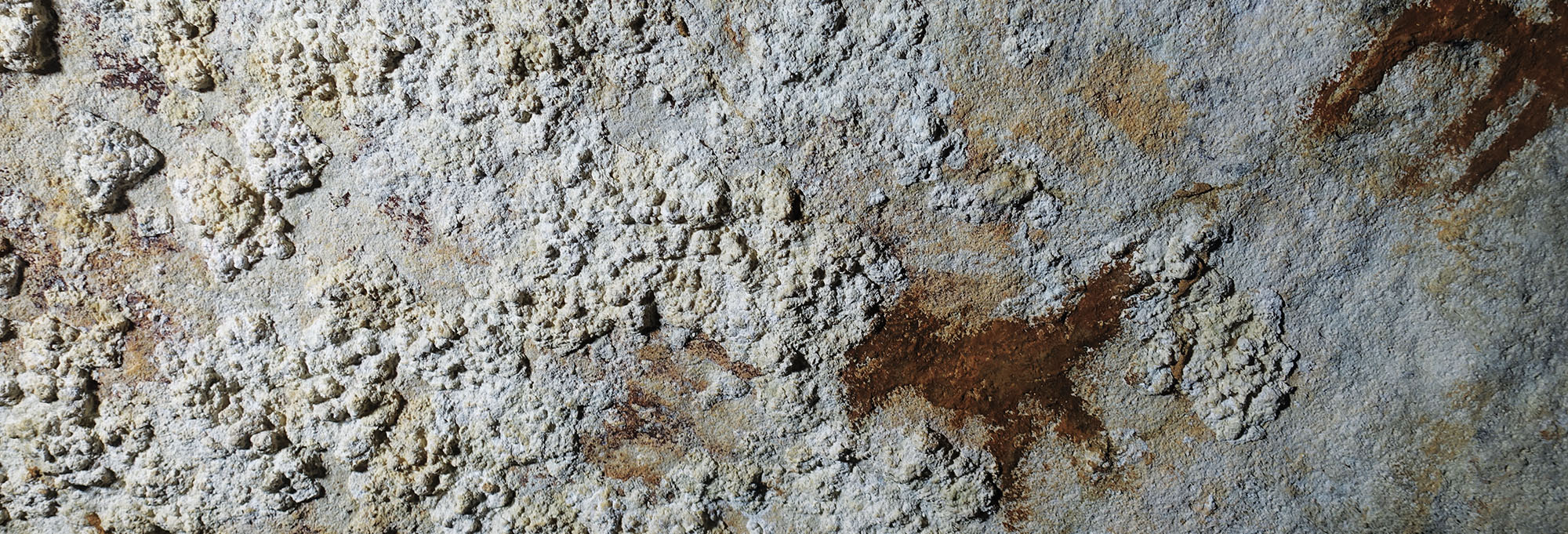
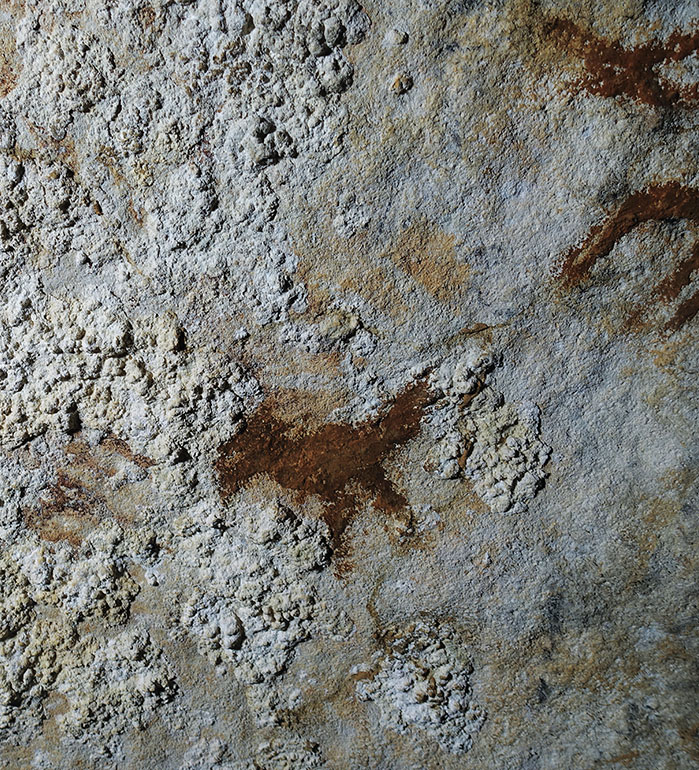
The world’s oldest known rock art, dating to at least 67,800 years ago, has been discovered in a cave in Indonesia. The extremely faint image of a hand stencil, created by placing one’s hand against a wall and blowing pigment onto and around it, was found in Metanduno Cave on Muna Island, just off the island of Sulawesi. Researchers established the art’s minimum age by dating calcium carbonate deposits that have formed on top of the pigment. These deposits contain small amounts of uranium, which decays to thorium at a steady rate. Thus, the painting’s age can be calculated based on the ratio of the two elements.
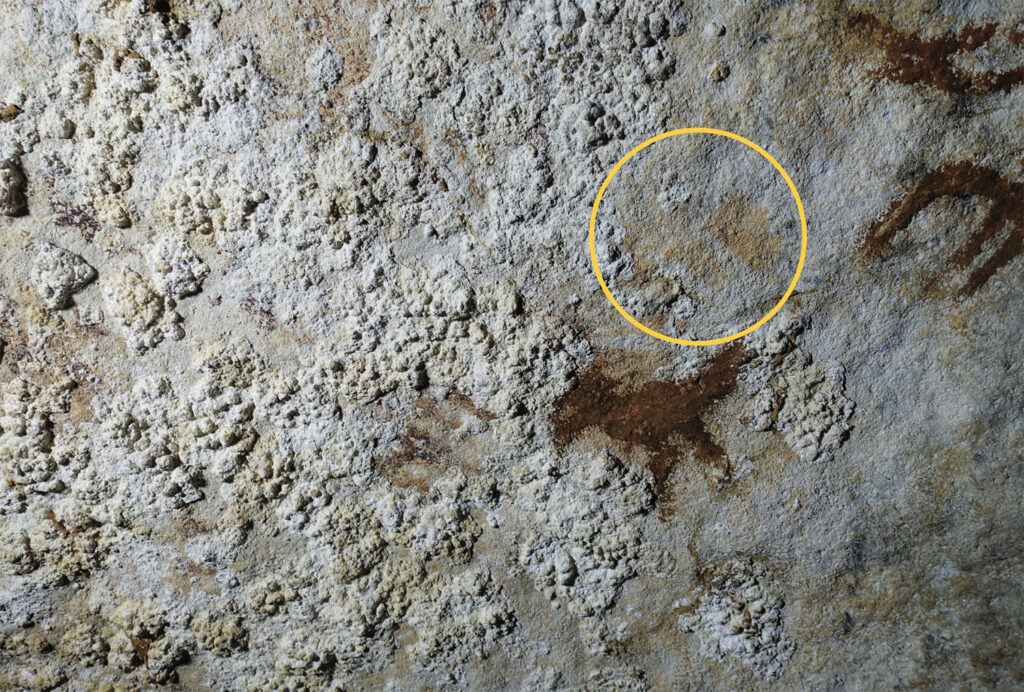
The minimum age of the Metanduno Cave hand stencil is 1,100 years greater than that of a hand stencil from Maltravieso Cave in northern Spain, which is thought to have been created by Neanderthals. Archaeologist Maxime Aubert of Griffith University believes the Metanduno Cave stencil was produced by modern humans because the appearance of one of the fingers was altered to resemble a claw, an artistic flourish known to have been employed on Sulawesi until around 20,000 years ago, when Homo sapiens would likely have been the only hominin there.
Aubert says the hand stencil also provides evidence that at least some modern humans migrating from mainland Southeast Asia to Australia took a northern route that passed through Sulawesi rather than a southern route that would have passed through the Indonesian island of Java. “Apart from the age of the rock art, it’s also a marker that proves modern humans were there at that time,” he says. “We can use that to trace the movement of people.”