(Courtesy Melissa Lutz Blouin, University of Arkansas)
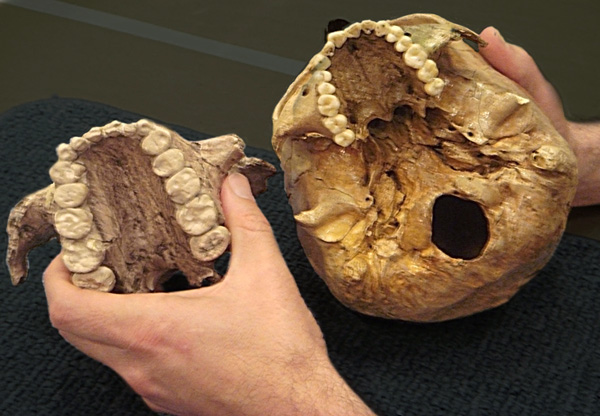
Direct evidence that reveals the behavior of the human race's earliest ancestors has been all but impossible for paleoanthropologists to find. Now, however, studies of chemical isotopes in tooth enamel are providing new lines of evidence concerning the lives of early hominins. As tooth enamel forms during the first eight years of life, it absorbs chemicals from the food and water that people consume and, indirectly, from the bedrock in the area where they reside. That chemical signature provides an important record of an individual's life, which scholars are now learning to read. Two recent isotope studies are changing paleoanthropologists' understanding of hominins who lived roughly 2.2 to 1.4 million years ago.
A study published in Proceedings of the National Academy of Sciences examined the amounts of carbon isotopes in two Paranthropus boisei teeth from eastern Africa. Carbon isotopes reveal details about diet, and the research showed that these individuals dined on grasses and sedges. Previously, P. boisei had been nicknamed Nutcracker Man because paleoanthropologists believed the species' large teeth and powerful jaws were an evolutionary adaptation to eating hard foods.
A second study, published in the journal Nature, measured strontium isotopes in the teeth of Australopithecus africanus and Paranthropus robustus from southern Africa. Strontium isotopes offer evidence of the bedrock in an individual's early home area because plants and water absorb strontium from the bedrock, which is then absorbed by tooth enamel. This study showed that females of both species tended to grow up in areas with a different type of bedrock than the places where their teeth were ultimately found. The finding could indicate that females left the social groups they were born into and moved away to live with their mates.
The major impact of this research has less to do with the results of the two studies and more to do with providing paleoanthropologists with a new research tool, according to the University of Colorado's Matthew Sponheimer, who took part in both projects. "If we can be clever enough, we might be able to design ways to get at interesting behaviors that had seemed forever lost," he says.