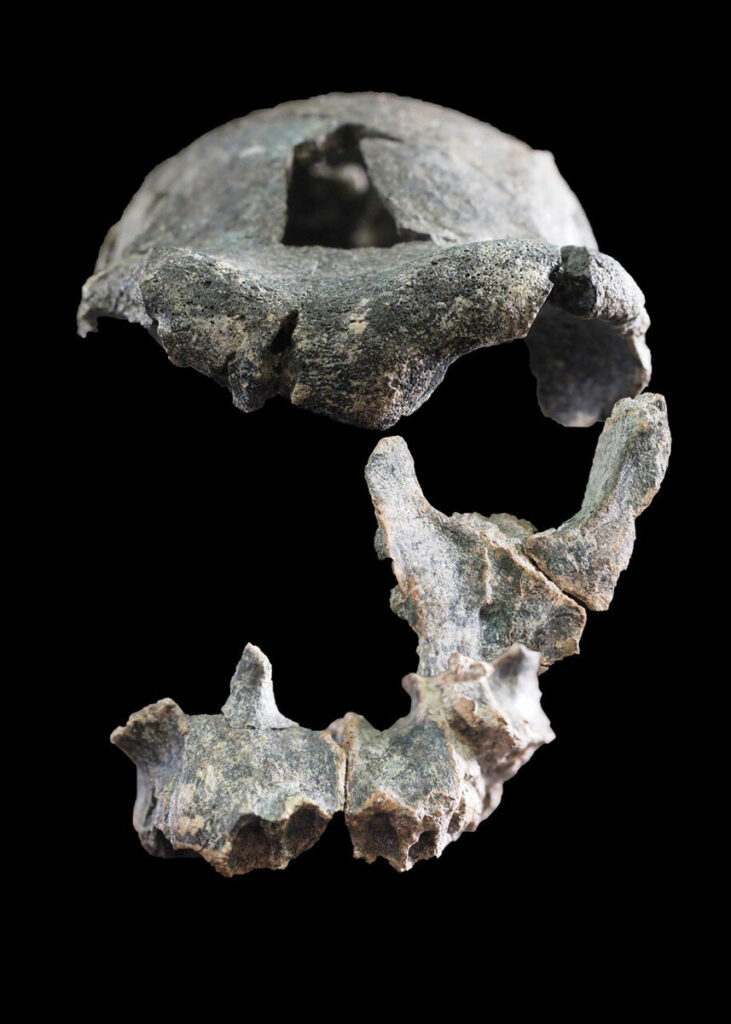
GLENDALE, ARIZONA—According to a statement released by Midwestern University, paleoanthropologist Karen L. Baab and an international team of scientists created a virtual reconstruction of the face of DAN5, the 1.5 to 1.6-million-year-old Homo erectus individual whose fossilized remains were discovered at the site of Gona in Ethiopia's Afar region. The fossils include a brain case, teeth, and smaller fragments of one individual’s face. 3D computer models of the facial fragments were made with CT scans fitted together virtually, and teeth added to the upper jaw when possible. A scan of the brain case was then virtually attached to the reconstructed face. The study suggests that this Homo erectus individual had a typical Homo erectus braincase, but a face with a flatter nose bridge and larger molars, more like those found in older species. “We already knew that the DAN5 fossil had a small brain, but this new reconstruction shows that the face is also more primitive than classic African Homo erectus of the same antiquity,” Baab explained. This combination of traits in Homo erectus had previously been observed in Eurasia, which suggested that Homo erectus may have evolved outside of Africa. “The oldest fossils belonging to Homo erectus are from Africa, and the new fossil reconstruction shows that transitional fossils also existed there, so it makes sense that this species emerged on the continent,” Baab stated. “But the DAN5 fossil postdates the initial exit from Africa, so other interpretations are possible,” she added. “One explanation is that the Gona population retained the anatomy of the population that originally migrated out of Africa approximately 300,000 years earlier.” Read the original scholarly article about this research in Nature Communications. For more, go to "Homo erectus Stands Alone," one of ARCHAEOLOGY's Top 10 Discoveries of 2013.