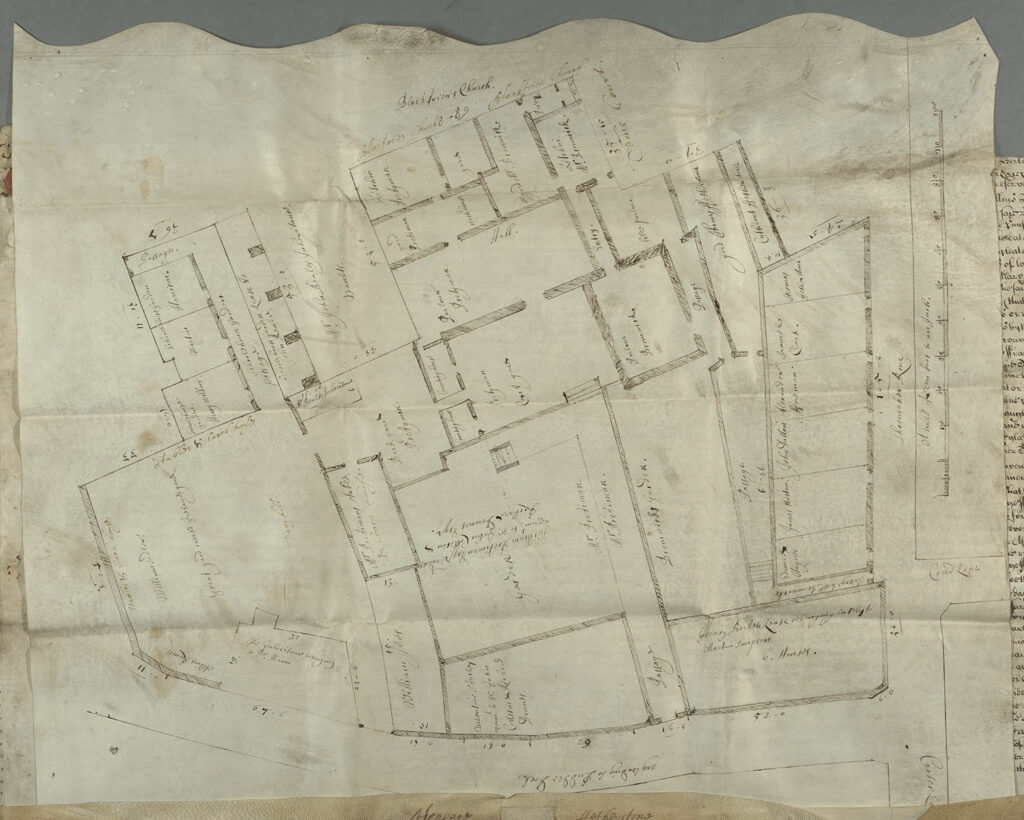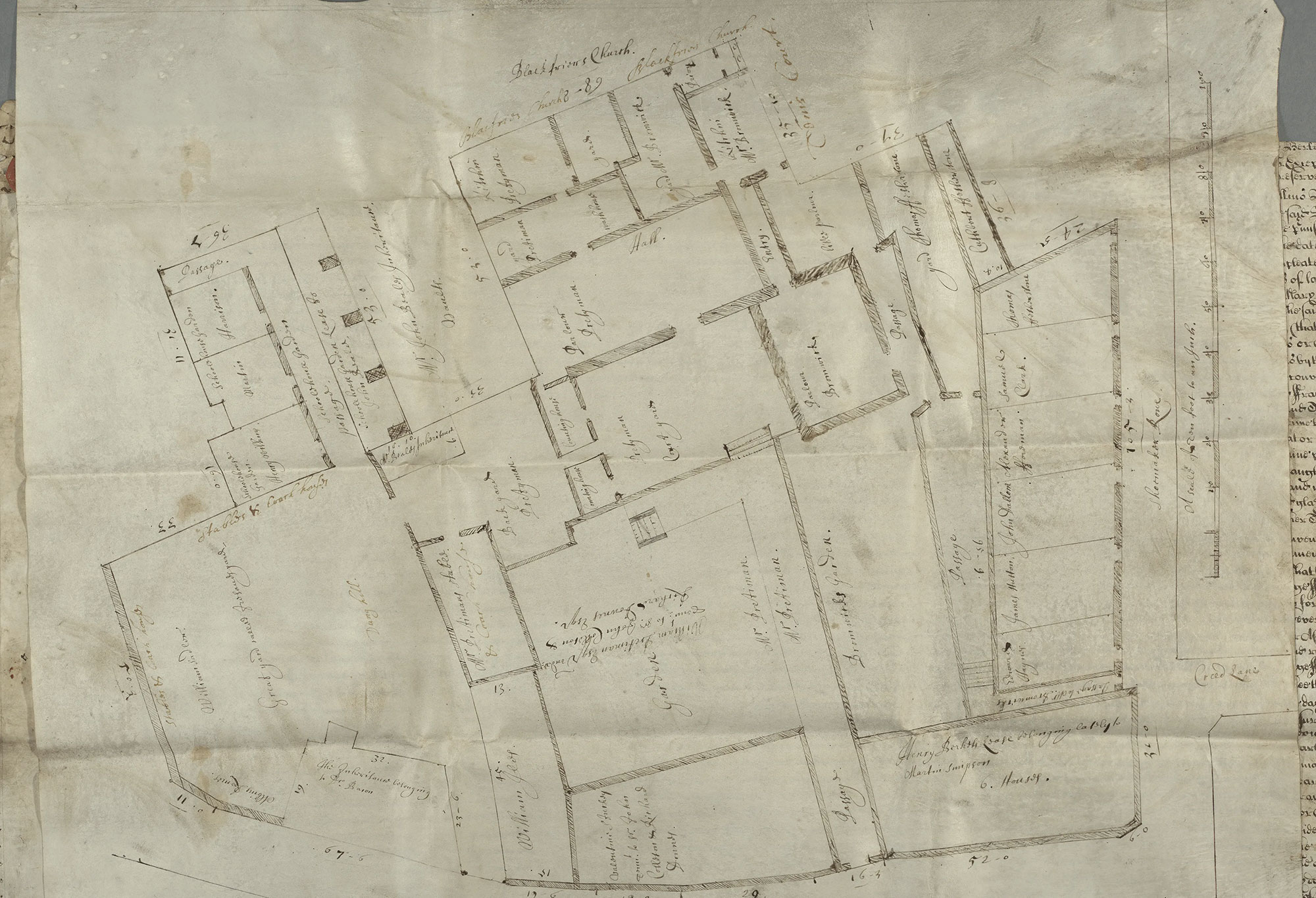
LONDON, ENGLAND—According to a statement released by King’s College London, the location of a property purchased by William Shakespeare in 1613 has been pinpointed on a previously unknown plan identified by Lucy Munro of King’s College London. Located in the Blackfriars neighborhood of central London, the property was situated in the gatehouse of the medieval priory that gave the neighborhood its name, but scholars had been uncertain as to where that gatehouse stood on the site. Munro recovered two documents from the London Archives and one from England’s National Archives that helped resolve this problem. The first document is a plan of the Blackfriars precinct that was drawn in 1668, after the Great Fire of London. This drawing shows the location and size of Shakespeare’s house, except for the section that spanned the medieval gate, since it did not have a foundation and did not survive the fire. The drawing does not detail the internal layout of the house, though it does reveal that the building had been divided into two houses by 1645. “This discovery throws into question the narrative that Shakespeare simply retired to Stratford and spent no more time in the city,” Munro said. “It has sometimes been thought that he bought his Blackfriars property merely as an investment, but we don’t know that this is true, or that he never used it for himself,” she continued. This house would have been close to the Blackfriars theater, where he worked, she added. The other two documents relate to the sale of the property to Elizabeth Hall Nash Barnard, Shakespeare’s granddaughter, who in turn sold the property in 1665 before it was destroyed in the Great Fire. To read about excavations of an Elizabethan theater where Shakespeare's plays premiered in the late sixteenth century, go to "Behind the Curtain."