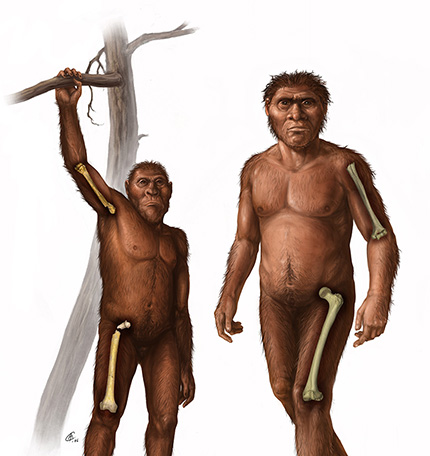
JOHANNESBURG, SOUTH AFRICA—According to a SciNews report, researchers led by Kristian J. Carlson of the University of Southern California, Los Angeles, and the University of the Witwatersrand have evaluated the relative strength of limb bones from Little Foot, the fossilized remains of a 3.67-million-year-old Australopithecus uncovered in South Africa’s Sterkfontein Cave, and the 1.8-million-year-old fossils of an early Homo individual discovered in Dmanisi, Georgia. The ratios of the arm and leg strength of these two were then compared with those of modern humans, chimpanzees, gorillas, and orangutans. The researchers determined the proportions of Little Foot’s limbs resembled those of African apes. This Australopithecus is therefore thought to have been able to move through trees, despite its larger body size and lower leg bones resembling those of humans. “This is one of the most surprising results,” said Carlson. On the other hand, the proportion of limb strength found in the Homo individual from Dmanisi was found to be within the range observed in the limbs of modern humans. The shift toward bipedalism had therefore begun by about 1.8 million years ago, at about the same time that human brain size was expanding, the researchers concluded. “What caused the shift remains uncertain,” Carlson said. “It could be linked to changes in ranging, food gathering, and other pressures that favored stronger lower limbs and greater dependence on life on the ground,” he concluded. Read the original scholarly article about this research in Science Advances. For more on Little Foot, go to "Sticking Its Neck Out."