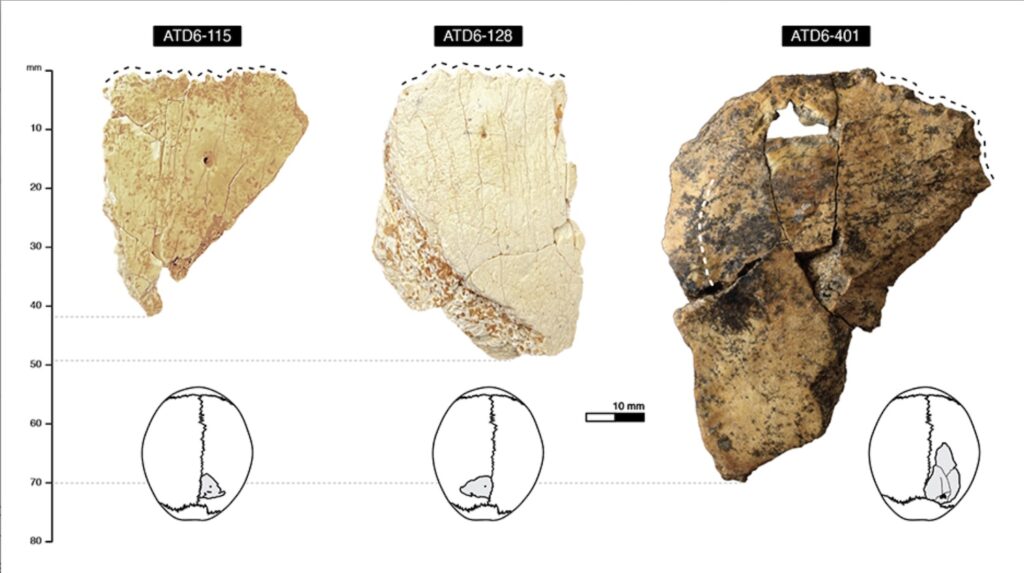
BURGOS, SPAIN—SciNews reports that researchers led by Rafael Gallareto-Sande of Spain’s National Research Center on Human Evolution have conducted a new computed microtomography study of Homo antecessor skull fragments representing three individuals. The fossils were recovered from northern Spain’s Gran Dolina cave in 1994. Homo antecessor lived in Europe between 1.2 million and 600,000 years ago. Previous studies have determined that the hominin was similar in height to modern humans and was fully bipedal. It had been thought that Homo antecessor may have been the last common ancestor of Neanderthals and modern humans, based on their facial features and tooth structure. But the new study has found that the middle layer of the Homo antecessor skull bone fragments is similar to that of Neanderthals and modern humans. The inner and outer sections of the cranial bones were found to be thinner than that of Neanderthals and modern humans, however. Thick skull bones have long been considered a hallmark of archaic human relatives. “The available sample is still limited and fragmentary, so any new fragment could refine these results,” Gallareto-Sande said. To read about possible Homo antecessor tracks, go to "England's Oldest Footprints."