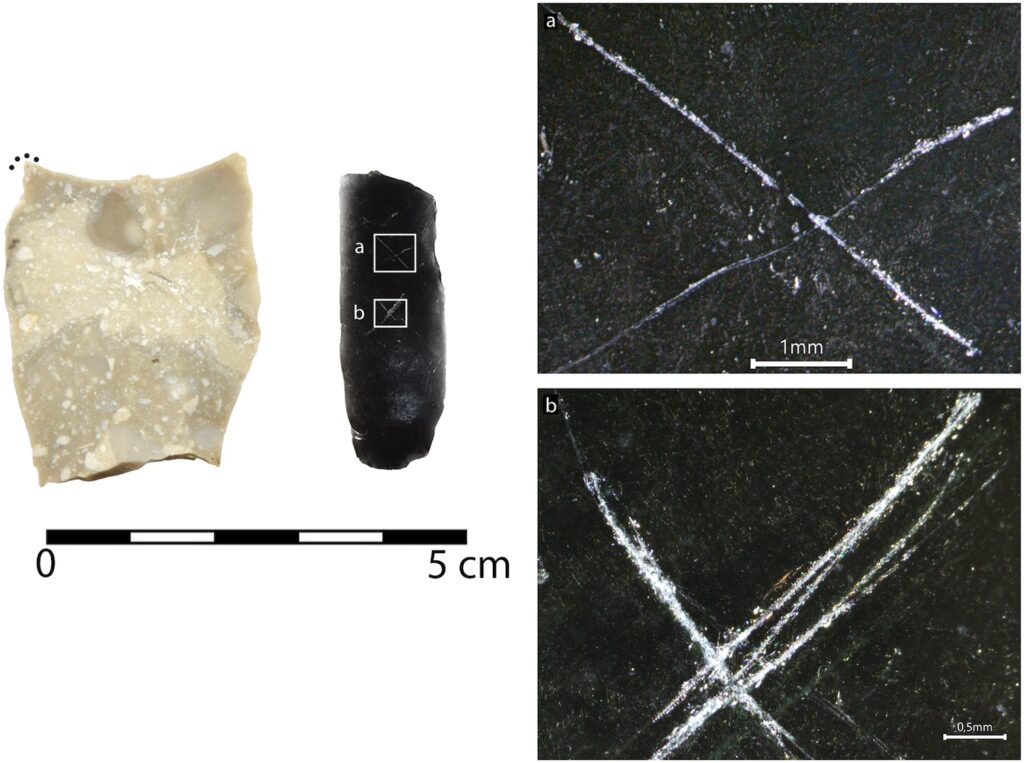
CAPPADOCIA, TURKEY—According to an IFL Science report, 11 obsidian points have been discovered in central Anatolia at the Neolithic village of Tepecik-Çiftlik, which is situated between two large sources of volcanic glass. Each of the points is etched with a unique design. In all, etchings have been found on only 54 of the thousands of obsidian arrowheads found in the region. Alice Vinet of Aix Marseille University and Denis Guilbeau of France’s Ministry of Culture examined all of these etched arrowheads under microscopes and then attempted to reproduce the marks. They determined that repeated strokes with a piece of flint were required to mark the smooth surfaces of the arrowheads, making it unlikely that the marks were made accidentally. They also established that the etched arrowheads were of similar size and shape as arrowheads without marks, and that the incised points were not found in special places such as graves. Likewise, the etched points showed signs of wear similar to those identified on unmarked arrowheads. The researchers did notice, however, that incised arrowheads unearthed at the same sites had similar motifs engraved on them. They concluded that all the mysterious markings may not have been made to serve the same purpose. Read the original scholarly article about this research in PLOS One. To learn about obsidian that the Akkadians obtained from a volcano in central Turkey, go to "Obsidian and Empire."