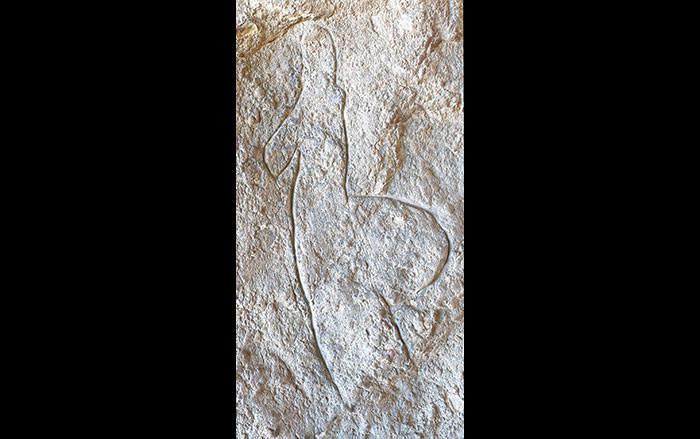
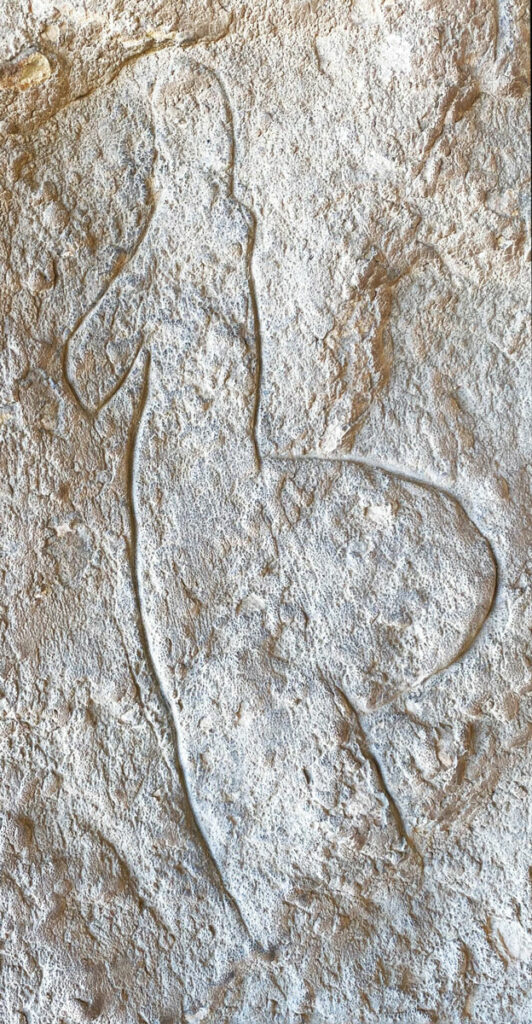
Archaeologist Hesham Hussein of Egypt’s Supreme Council of Antiquities has surveyed rock art in the Sinai Peninsula for more than 25 years. Nevertheless, he was utterly unprepared for his team’s recent discovery of some 350 petroglyphs in Al-Zolma Cave, or the Cave of Darkness, in the desert of north-central Sinai. “The rock art in Al-Zolma Cave didn’t match anything I’ve seen before,” Hussein says. He found that the cave’s walls were covered with overlapping petroglyphs depicting some 150 animals, including camels, ostriches, gazelles, and at least one aurochs, an extinct species of wild bovine. More than 100 engravings portray headless women whose bodies resemble those of Upper Paleolithic (ca. 50,000 to 12,000 years ago), or Ice Age, “Venus” figurines found in Europe. “The more I looked at the engravings,” says Hussein, “the more I thought the artworks resembled those you might find in Lascaux Cave or other famous European Paleolithic sites.”
Hussein learned that an engraved depiction of an aurochs very similar to the one in Al-Zolma Cave had been made in southern Egypt around 15,000 years ago. That date helped clinch his conviction that the people who created the Al-Zolma Cave petroglyphs lived during the last Ice Age, when the Sinai was a savanna that served as a highway for people crossing back and forth from Africa to Asia. Hussein notes that the Al-Zolma Cave artists left behind evidence of their creative process in the form of hundreds of flint tools employed to carve the petroglyphs. A limestone block at the site bearing sharpening marks was likely used by Paleolithic artists to hone the tools of their trade between bouts of inspiration.