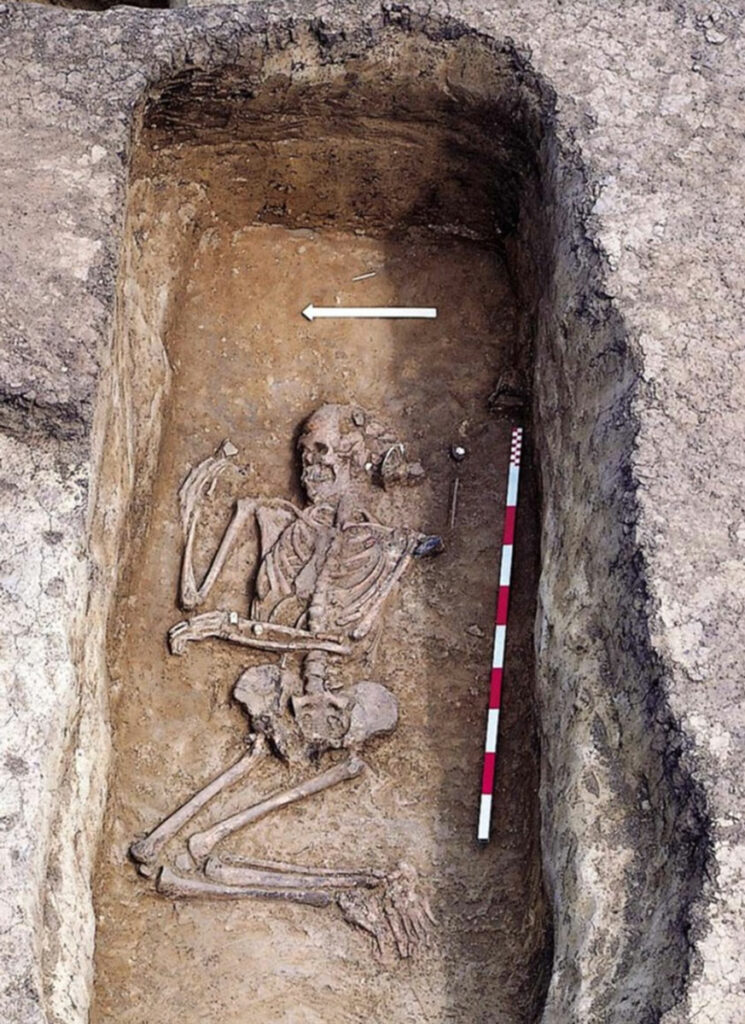
PARIS, FRANCE—An international team of researchers including Sébastien Villotte of the French National Center for Scientific Research examined 125 skeletons unearthed in two Neolithic cemeteries in eastern Hungary, according to a Live Science report. The burials were dated to between 5300 and 4650 B.C. Villotte and his colleagues recorded changes to the skeletons brought about by physical exertion, such as upper-limb overuse and toe hyperextension, which can be caused by working in a kneeling posture. Examination of the remains suggests that all of the men and women in the study engaged in heavy physical work, including activities involving kneeling. Men, however, were found to have signs of right-sided upper-limb overuse, which may have been caused by throwing movements. Men and women were also found to have been buried differently. Most of the women had been buried on their left sides with shell bead belts, while most of the men were found on their rights sides and had been buried with polished stone tools. Yet the burials of two of the men and five of the women did not align with this practice. In particular, the remains of one older woman were found with a polished stone tool, and the wear on her bones suggests that her activity pattern was more like the men who had been buried in the cemetery. “This is the period in Central Europe when people began to express previously existing gender roles in a new arena,” Villotte commented. Read the original scholarly article about this research in the American Journal of Biological Anthropology. To read about burials in a fifth-century a.d. cemetery in western Hungary, go to "Head Space."