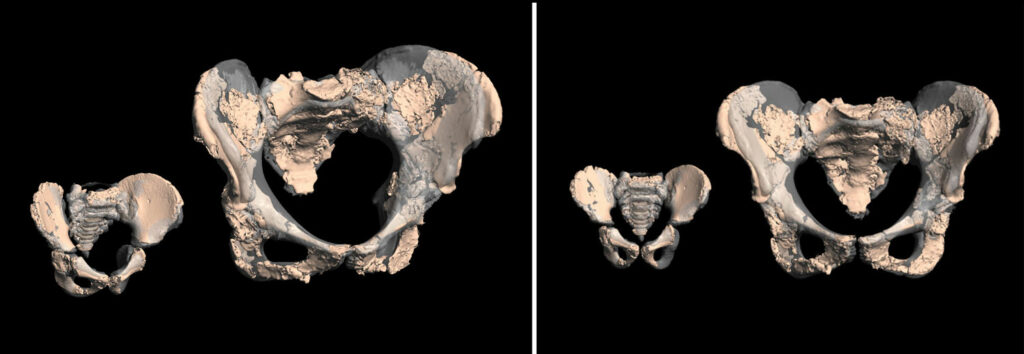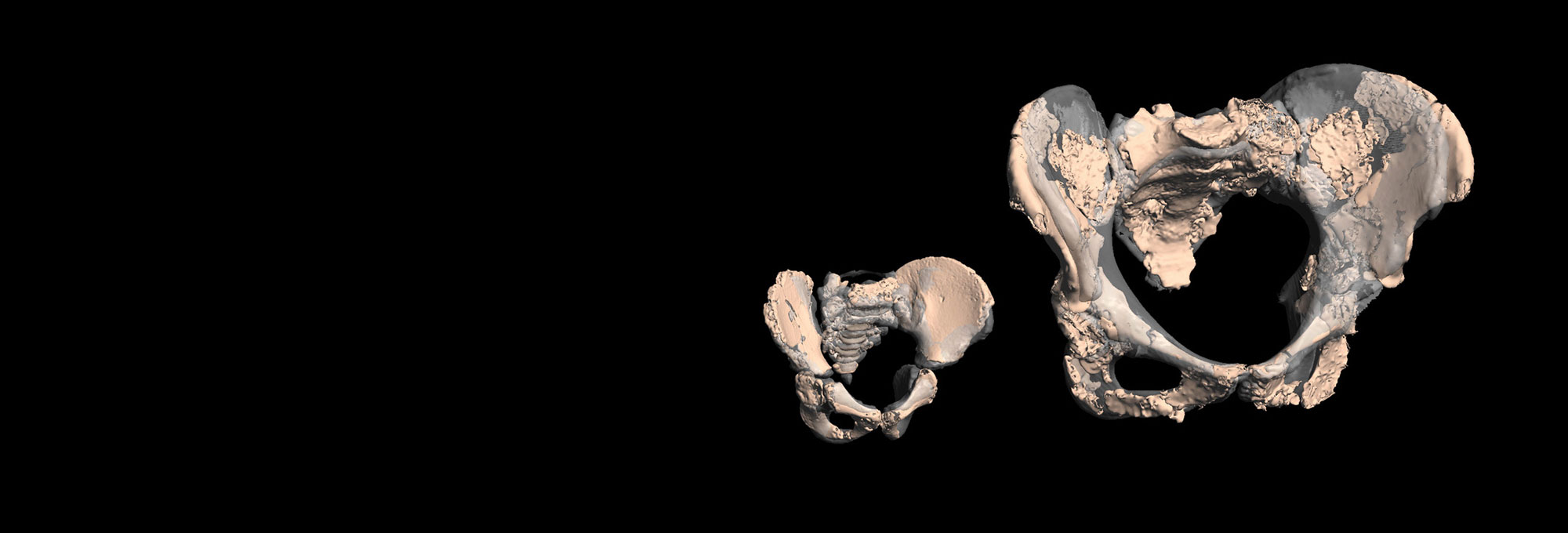
ZURICH, SWITZERLAND—Phys.org reports that a team of researchers led by Christoph Zollikofer and Marcia Ponce de León of the University of Zurich and the Institute for Basic Science in Busan digitally reconstructed the nearly intact pelvises of an infant Neanderthal whose remains were recovered from Dederiyeh Cave in Syria, and a young adult female Neanderthal found in Spain’s Sima de las Palomas. These fossils were then compared with the reconstructed Neanderthal fossils known as the Tabun female and the Kebara male, and with medical scans of modern human pelvises. The study suggests that differences between Neanderthal pelvises and modern human pelvises are visible from a young age. Neanderthals were found to have wider pelvises overall, but the parts of the pelvis involved in Neanderthal childbirth were found to be similar to those of modern human women. The parts of the pelvis related to bipedal walking, however, were found to differ between the two hominins. Neanderthals were found to have reduced pelvic tilt, lower-back curvature, and shorter muscle lever arms. This would suggest that Neanderthals were powerful, stable walkers. The narrower, front-to-back pelvic shape of modern humans allows for efficiency in long-distance running. Read the original scholarly article about this research in PNAS. To read about a site where Neanderthals lived for more than 200,000 years, go to "A Traditional Neanderthal Home."