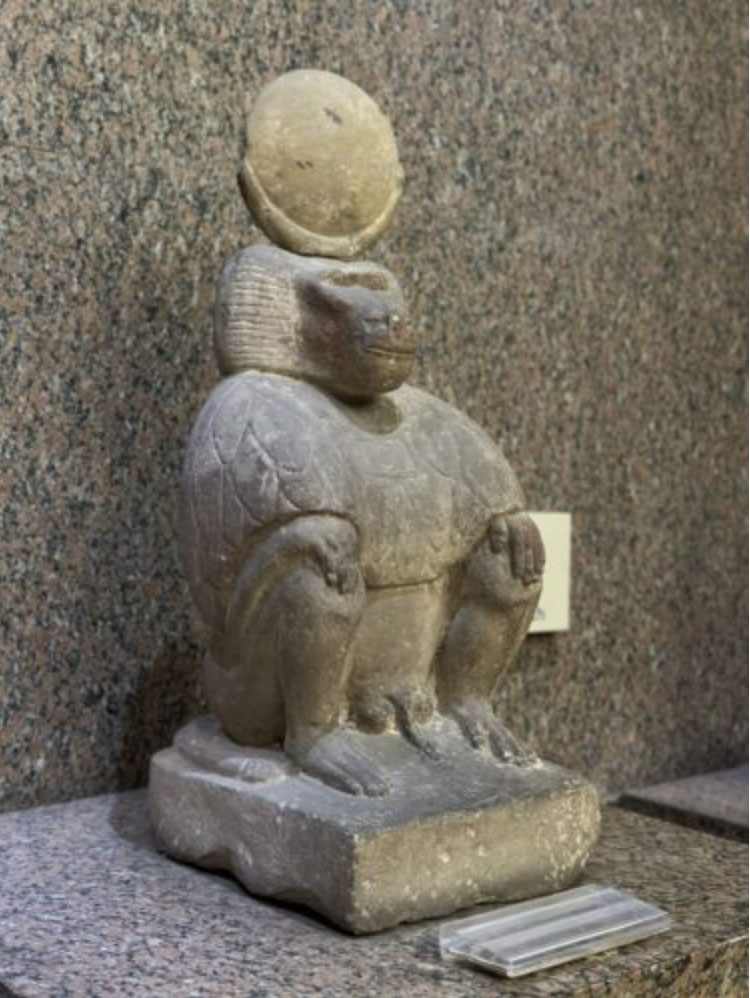
ST. ANDREWS, SCOTLAND—According to a statement released by The University of St. Andrews, new research may have finally solved the mystery of why ancient Egyptians associated the moon god Thoth with ibises and baboons. It was not out of the ordinary for Egyptians to connect deities with animals. For example, Horus is often depicted as a falcon and Anubis as a jackal. However, Egyptologists have long wondered why two exceedingly different species came to represent Thoth. Some scholars speculated that the ibis' black-and-white coloring and its crescent moon–shaped peak provided a possible link to the moon. The connection with the baboon, an animal reviled by many human societies, presented a conundrum. University of St. Andrews primatologist Catherine Hobaiter and Dartmouth College anthropologist Nathaniel Dominy suspected it may also have to do with color. Since color is subjective and people see hues in different ways, the researchers used spectroscopy to scientifically analyze the wavelengths of light that reflected off ibis feathers and hamadryas baboon fur. The results revealed that these spectral profiles were indistinguishable from moonlight, which is probably why manifestations of Thoth in Egyptian art and religion often took the form of these two creatures. “Sacred ibises and hamadryas baboons are different in many ways, but one thing that unites them is their moon-like color,” said Hobaiter. Read the original scholarly article about this research in the journal Time and Mind. To read about ibises sacrificed to Thoth, go to "Birds of a Feather."